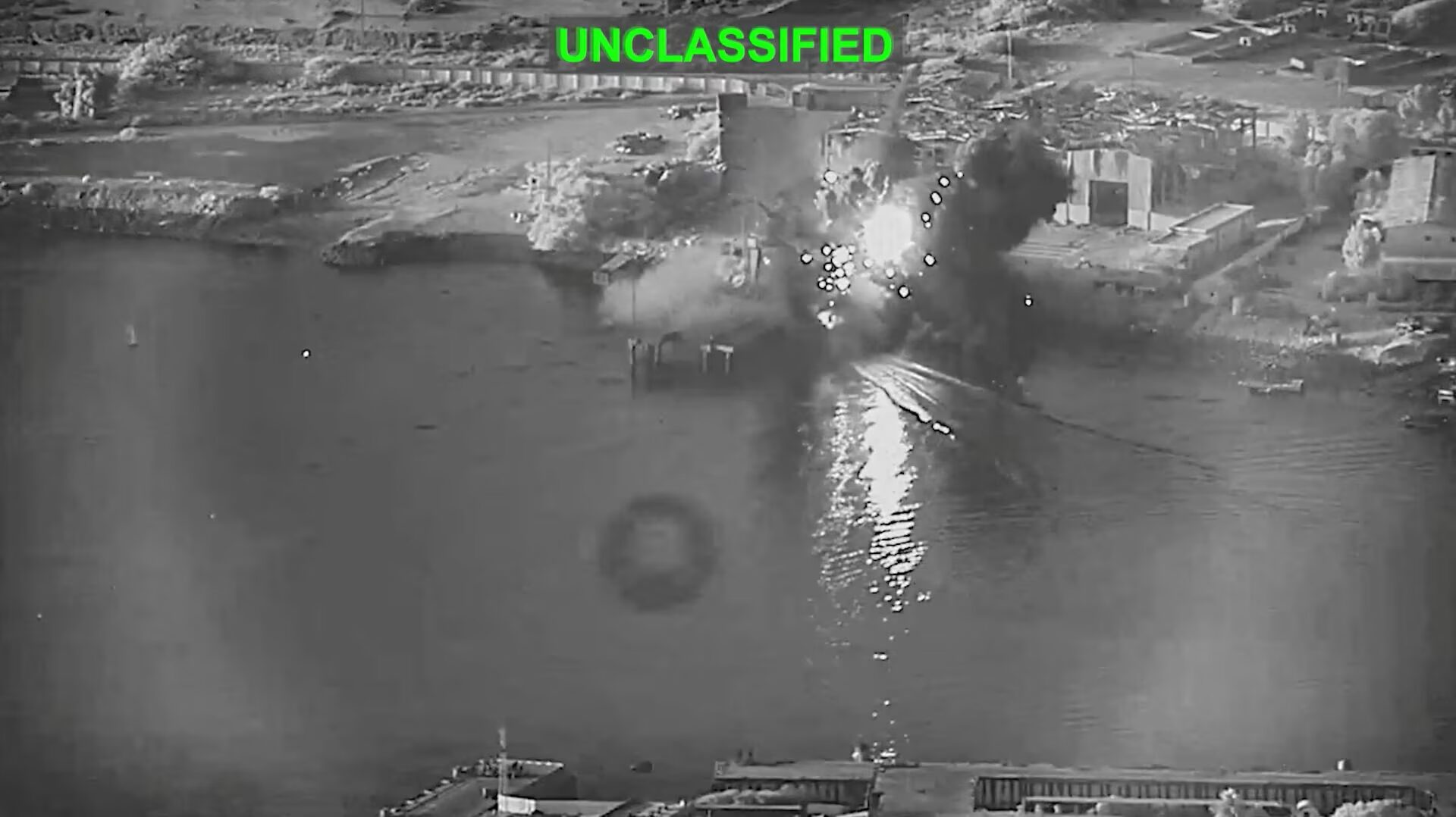
Hitting more than 170 targets in Iran in 48 hours across two waves is an unprecedented escalation. The recent third wave of attacks, targeting more than 100 sites, has set the stage for ending the interim agreement and the collapse of the 60-day negotiating period, as this will widen distrust and impact diplomacy or the negotiating process entirely. US’s gambling with red lines is again a significant reading of Iran’s capabilities and strategic behaviour. The offramp and recalibration intent of US is risking the security of the region and not leading to any strategically desirable outcome.
Red Line Gamble
US’s resumption of a barrage of strikes against Iran stems from two reasons. The first and most potent is control of the Strait of Hormuz, and the second is Iran’s continued horizontal expansion, including its reemergence as a strong regional power after the conflict. Despite agreeing to an interim framework where Iran has technically got control of the Strait of Hormuz by setting up an administration with Oman in the Strait of Hormuz, the authority is further solidified by point 5 of the MoU, where “Islamic Republic of Iran will make arrangements using its best efforts for the safe passage of commercial vessels”; this very line in the MoU gives Iran significant technical leverage and authority to regulate traffic through the Strait of Hormuz.
However, this leverage and regulatory scope for Iran has become a pain point, or, to be more appropriate, has failed the strategic endurance test, as Iran is upping the ante to dominate the maritime domain by enforcing the northern route for vessel passage, while the US is trying to enforce the UN-recognized Southern route for vessel passage. Both have set their red lines and are aggressively contesting them through kinetic and counter-kinetic actions.
Ceasefire Over and Strikes
Iran’s coercive tactics to coerce vessels to follow their designated route have set the stage for a fiery escalatory response from the US. Iran is perhaps playing the same card it played decades ago, following the tanker-harassment strategy by targeting commercial vessels that are not complying with Iran’s rules or designated routes in the Strait of Hormuz. US’s response can be decoded in three ways. First, the threat to the US’s strategic space in the Middle East by Iran’s horizontal escalation has eroded the trust of Gulf nations and pushed them to rethink the new security reality in which they can’t rely fully on the US for security guarantees and need to chalk out a new collective security framework. Second, Iran’s horizontal strategy of influence in the region remains highly active despite tensions and strikes; instead of isolation, Iran has managed to engage with regional partners due to obvious economic reasons successfully, and even Gulf countries have realised that to ensure massive economic hubs and vision, they need to engage with Iran. Historically, the UAE has been Iran’s largest single source of imports, sustaining $25 billion to $27 billion in annual trade. Recognising the mutual ruin of an embargo, the two nations swiftly moved past the conflict; by July 1, 2026, the UAE and Iran officially resumed direct commercial flights and reopened vital direct cargo shipping routes via Dubai’s Jebel Ali Port. Third, the deal itself, where Iran was to some extent successful in getting the upper hand in the deal, specifically on the Strait of Hormuz, has now become the centre of gravity in the renewed fiery escalation between the US and Iran.
The collapse of the interim arrangement, as US President Trump said, stems from a wake-up call in the Strait of Hormuz. The interim framework was vaguely explained and poorly defined, perhaps a deliberate constructive ambiguity to sign the deal so that the US-Iran could have a tactical pause and an off-ramp for a brief period. Still, it has become a strategic trap, as both sides now interpret clause 5 of the deal to their advantage. It can be argued that this ambiguity, apart from a tactical pause, was also intended to put pressure on Iran to ensure open and free transit of vessels and to avoid giving Iran full control of the situation, but that now seems to be backfiring.
Escalation Control Falling Apart
The primary strategy of the US is to control escalation through strength by escalating costs and imposing punitive action through kinetic measures against Iran, specifically degrading Iran’s maritime and coastal action capabilities to deter Iran from any dominating action or tanker harassment and to coerce it to get back on the negotiating table again.
However, this coercive escalation control through strength seems to be falling apart for two reasons. First, there is strategic fatigue, and a realisation among Gulf nations that prolonged war will destabilise regional economic stability; hence, the fatigue of dragging the war on is waning, especially after the recent strikes. Further, there is a realisation that Iran is a regional hegemon and a core disruptor, which cannot be isolated or ignored. Hence, Gulf nations have to cooperate and normalise relations with Iran.
The second reason is the US’s desperate scramble and misreading that punitive actions against Iran are not working; the Iranians have built unshakable asymmetric capabilities and have not given in to massive escalation and US pressure since February. There is no logical or comprehensible explanation for laying down arms now. Overall, the deterrent or coercive value of the US against Iran has fallen to almost zero, especially in controlling the Strait of Hormuz. The lessons of war have been clearly learned and adopted by Iran. However, the US still seems to be struggling to learn from 1988, when the US launched Operation Praying Mantis, a massive, devastating escalatory strike against Iran. During the Iran-Iraq War, a US frigate was nearly sunk by an Iranian naval mine. In retaliation, President Ronald Reagan ordered the largest US surface naval engagement since World War II. The US’s core intent was to completely degrade and destroy Iranian naval and strategic capabilities that could challenge the West, especially US influence. However, the US may have won tactically but failed strategically, as Iran quickly readjusted, absorbed, and learned its lessons, becoming the world’s most sophisticated practitioner of asymmetric warfare in which the US is currently entangled.
These recent strikes against Iran to deter Iran from controlling the Strait of Hormuz are just a face-saving exercise and not driven by real persuasive strategic power, as Iran has now devised ways to bypass and absorb the full might of the US. Unfortunately, the US’s Intelligence agency, especially Israel’s Mossad, still thinks that they can bring down the shield with one kink.