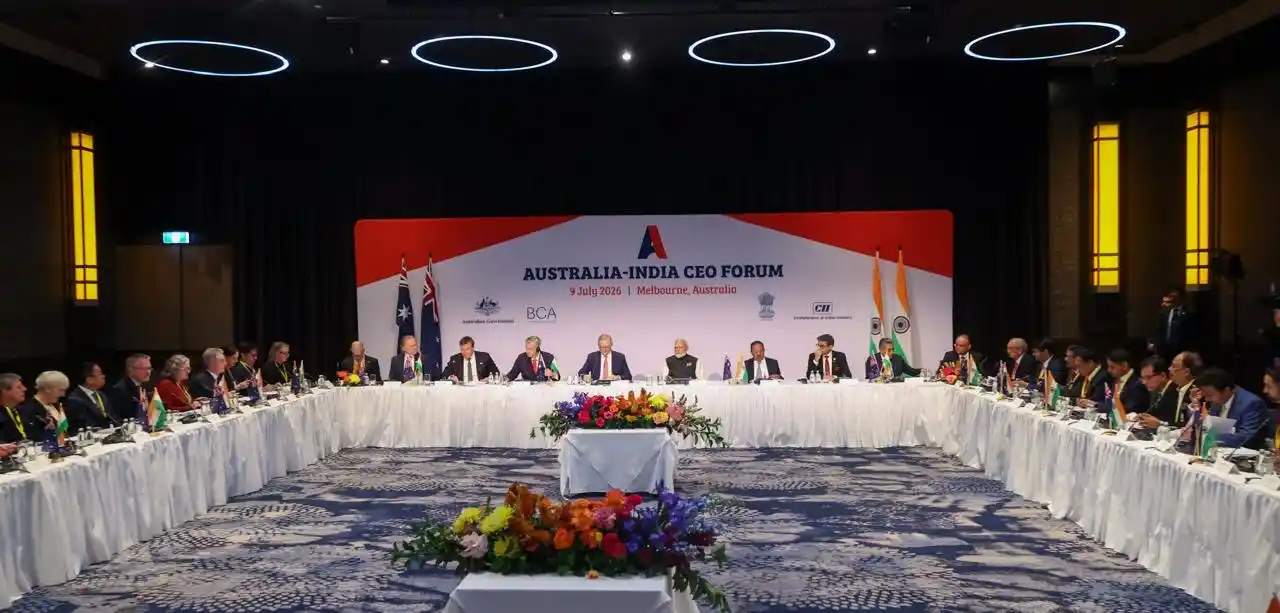
India and Australia are at a genuinely strategic inflection point: the Melbourne summit signals that the relationship is no longer just about diplomacy or trade, but about building shared capacity in energy, technology, talent and capital. The language of “natural and trusted partners” is not just summit rhetoric; it reflects a policy framework that now spans clean energy, education and skills, agribusiness and technology, with wider room for defence, space and advanced industry cooperation.
A partnership with structure
The biggest mistake commentators make is to treat India-Australia ties as episodic, rising only when leaders meet. In reality, both governments have spent years building institutional scaffolding: the Australia-India Comprehensive Strategic Partnership, the economic roadmap for engagement with India, the Australia-India ECTA, and the critical minerals investment partnership all point in the same direction. The Melbourne summit therefore matters because it converts a long list of possibilities into a more integrated industrial and geopolitical agenda. That agenda is important not just for bilateral trade, but for the resilience of supply chains in an increasingly fragmented world.
Clean energy realism
Clean energy is the most obvious win. Australia’s roadmap identifies clean energy as one of four focus sectors, and the critical minerals deal is designed to support India’s low-emissions transition and manufacturing ambitions. This is not abstract green rhetoric: India needs secure access to lithium, cobalt, rare earths and other inputs for batteries, storage, electric mobility and grid modernization, while Australia has major reserves and a well-developed mining and processing base. The two countries are therefore well placed to move from a buyer-seller model to a co-investment model, where Australian resources and Indian manufacturing capabilities reinforce each other.
Nuclear cooperation
Civil nuclear power is the most politically sensitive but potentially transformative part of the relationship. Australia has long had the legal framework to export uranium to India under civil safeguards, and earlier agreements established the principle of peaceful nuclear cooperation. The current moment is significant because India’s energy transition requires not only renewables, but firm, low-carbon baseload power, especially as industrial electricity demand grows. A reliable uranium arrangement would not solve India’s energy challenge on its own, but it would strengthen fuel security and signal that Australia sees India as a long-term energy partner, not just a commodity market.
AI and advanced industry
The inclusion of AI shows how the relationship is moving up the value chain. India offers scale, software talent and a fast-growing digital market; Australia offers research depth, regulatory experience and strong links to mining, energy and infrastructure sectors that can generate real-world AI use cases. In practical terms, this could mean AI tools for grid optimization, mineral exploration, predictive maintenance, logistics and smart infrastructure. The strategic value is that both countries can shape emerging technology norms together rather than importing standards from elsewhere.
Education and people
Education is one of the relationship’s most underappreciated strengths. Australia’s roadmap explicitly elevates education and skills, while recent reporting around the Melbourne summit highlights deeper talent partnerships beyond simple student mobility. That is exactly the right ambition. Indian students already form a major bridge between the countries, but the next step is to connect universities, vocational systems, employers and migration pathways so that skills flow in both directions and are tied to industrial needs. In a world short of engineers, data specialists and clean-energy technicians, education cooperation is not a side story; it is the workforce engine of the bilateral relationship.
Capital and infrastructure
Long-term investment may be the quietest part of the summit, but it could be the most consequential. Indian growth, Australian pension capital and cross-border project finance can align in infrastructure, clean energy, processing facilities, logistics and technology ventures. The challenge is to move from speeches to bankable projects, because both countries need predictable policy, faster approvals and credible dispute-resolution mechanisms. If they get that right, Melbourne could be remembered less as a ceremonial gathering and more as the place where bilateral capital began to think in decades rather than transactions.
Strategic meaning
There is also a larger geopolitical logic. India and Australia are both Indo-Pacific powers, both wary of concentrated supply-chain dependence, and both increasingly convinced that economic security and national security are now intertwined. That is why sectors like critical minerals, clean energy and advanced technology are no longer merely commercial; they are strategic infrastructure for sovereignty. The summit’s emphasis on trusted partnership therefore reflects a broader shift in global politics: middle powers are trying to build resilient networks before shocks force them to rebuild.
The real story of Melbourne is not that India and Australia suddenly discovered one another. It is that both sides now understand they need each other to solve the next decade’s hardest problems: energy transition, secure supply chains, skilled labour shortages, industrial modernization and technological competitiveness. If they sustain the momentum, the relationship could become one of the Indo-Pacific’s most productive examples of democratic economic statecraft. If they do not, the partnership will remain impressive on paper but underpowered in practice.
Here is the strongest case for the future: India brings scale, demand and entrepreneurial velocity; Australia brings resources, institutional reliability and capital depth. Combined properly, those strengths can power a relationship that is not only “natural and trusted,” but durable, useful and strategically consequential.