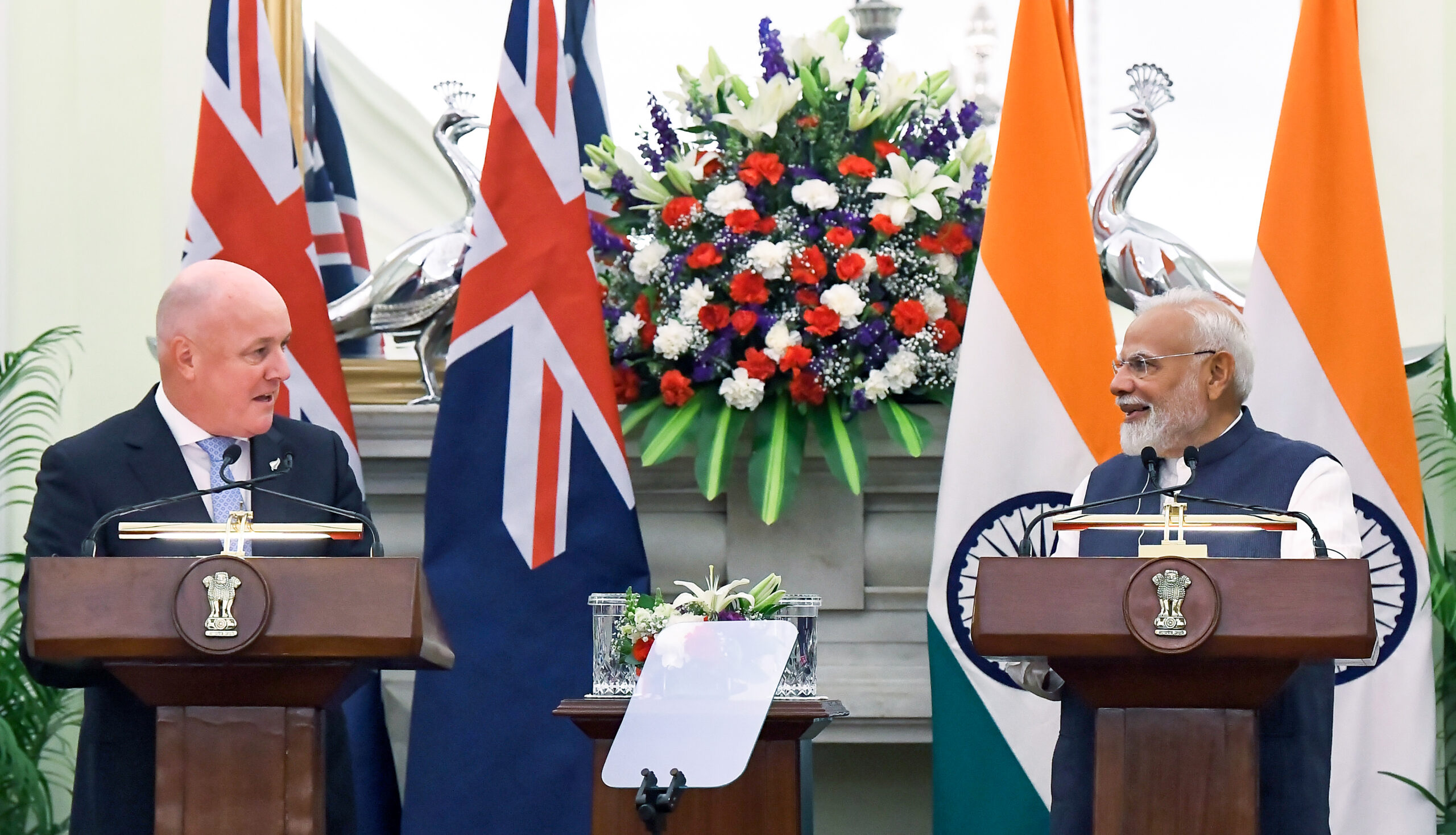
For long, strategic thinkers lamented India’s lack of a clear maritime strategy, stemming from a continental security mindset driven by land-oriented concerns, weak naval foundations, and limited geo-economic obligations. However, the picture has been changing gradually since the dawn of this millennium. Today, the maritime neighbourhood is increasingly featuring prominently in India’s strategic formulations. After demonstrating her strategic considerations vis-à-vis the Western Indian Ocean Region with Prime Minister Narendra Modi’s recent visit to Seychelles, India is now focusing on its eastern maritime zone, opening to the wider Pacific world through the prime minister’s visit to Indonesia, Australia, and New Zealand this week. This visit, undertaken immediately after receiving Japanese Prime Minister Sanae Takaichi in New Delhi and against the backdrop of the USA’s reverting to US Pacific Command and dropping ‘Indo’ from its nomenclature, is significant, highlighting India’s own Pacific strategy in the Act East Policy format independent of any superpower’s guidance or enthusiasm.
Amidst growing skepticism about the future of the Quad grouping amid the Trump administration’s apparent waning interest in it, the US allies in the Pacific are formulating a security framework that would endure even in the absence of direct US security assistance to ensure a free and open Indo-Pacific region. Undeniably, China’s growing military strength, a revisionist regional policy, and the USA’s volte-face approach to alliance commitments on security issues cause consternation among Pacific countries, which are now determined to grasp the nettle. Therefore, the proposed Philippines-Australia defense pact, Japan-Australia security cooperation agreement and Japan-Philippines defense pact-all denote an exclusive Asia-Pacific security arrangement on the anvil.
This emerging security structure aligns with India’s own non-confrontational, cooperative defensive security policy towards the Indo-Pacific region. In fact, this emerging defense web among the middle powers of the Pacific region can serve as an important stabilizing mechanism amid intense strategic competition. Most importantly, this security architecture, outside the traditional US-led Asia-Pacific security hierarchy, can allay Chinese frustration, since none of the component states intend to confront the dragon militarily (as the USA does). For India, with similar limitations, this defensive security approach, which intends not to unleash military aggression on China but to ensure a similar move from Beijing turns costly both strategically and economically for it, is a welcome scenario. China, contained within its own backyard in the Pacific, can relieve India of its pressure in the Indian Ocean region.
Defense cooperation under the 2026 Jakarta Treaty between Australia and Indonesia intends to enhance the bilateral security relationship. This maritime defense cooperation, when juxtaposed with the proposed BrahMos missile deal and collaboration on Scorpene-class submarines with Indonesia, high on the agenda during Prime Minister Modi’s Indonesia visit this week, reflects the convergence of the maritime defense objectives of the three Indo-Pacific littoral states. India is currently investing in augmenting the anti-access/area denial as well as maritime patrolling capacity of the South China Sea littoral states like Indonesia, where the supply of BrahMos missiles and the Scorpene-class submarines is significant. On the other hand, India and Australia are working to finalize the Joint Maritime Security Collaboration Roadmap, collaborate on maritime domain awareness activities, and explore opportunities to enhance undersea domain awareness.
The first visit by an Indian prime minister to New Zealand in four decades also signals India’s expanding focus on the Indo-Pacific region’s periphery. The visit comes at a time when Wellington intends to diversify its trade relationships and expand access to one of the world’s largest and fastest-growing economies. Strategically also, the visit is important with the growing Chinese presence in New Zealand’s neighbourhood causing trepidation in Wellington. India and New Zealand unveiled the Defense Strategic Dialogue in 2025 and concluded an MoU on defense cooperation to strengthen bilateral defense cooperation. New Zealand recently appointed its first resident defense advisor to India to explore opportunities for collaboration given the similarities between the nations’ navies, including in air operations and at-sea refueling.
Prime Minister Modi’s visit, however, is not limited to security augmentation but also includes trade and the acquisition of critical minerals, whose demand is on the rise. Indonesia is a key player in the global nickel-processing industry, and, once largely an exporter of raw ore, is now emerging as a major producer of higher-value nickel products. There is growing interest in electric vehicles (EVs), and nickel is vital for their batteries. With mounting environmental and pollution concerns, EVs are promoted as an alternative mode of transportation, and the Indian government actively promotes the plan. Nickel is a critical mineral for India’s transition towards cleaner energy technologies, while India imports more than 80 percent of its ferronickel (an alloy of iron and nickel), which is critical for steel production, from Indonesia. Therefore, the MoUs to be signed during Prime Minister Modi’s visit will presumably include critical minerals, as India intends to enter into joint ventures with Indonesian firms to establish processing factories for them. With Australia, India hopes to conclude an agreement on the supply of uranium, which has been under negotiations following the signing of the Civil Nuclear Cooperation Agreement between the two countries in 2014. India needs uranium to meet its growing energy needs, especially in light of New Delhi’s push for global data centers for artificial intelligence, which require large power capacity, making nuclear energy essential. Apart from this, Prime Minister Modi’s maiden New Zealand visit comes after the conclusion of a free trade agreement between the two countries this April, eliminating tariffs on 95 percent of New Zealand’s exports, opening new opportunities in agriculture, food processing, dairy technology, education and investment, while also strengthening India’s access to a high-income Pacific market.
Prime Minister Modi’s Pacific tour reiterates India’s Act East mission at a critical time, when the Indo-Pacific security situation is navigating a tumultuous period, with the onus of handling it increasingly placed on regional powers. It also opens new avenues for economic cooperation. Therefore, it is high time for India to leave its mark as a major contributor to the ongoing effort to revamp the region, brimming with the potential for geopolitical and geo-economic transition.