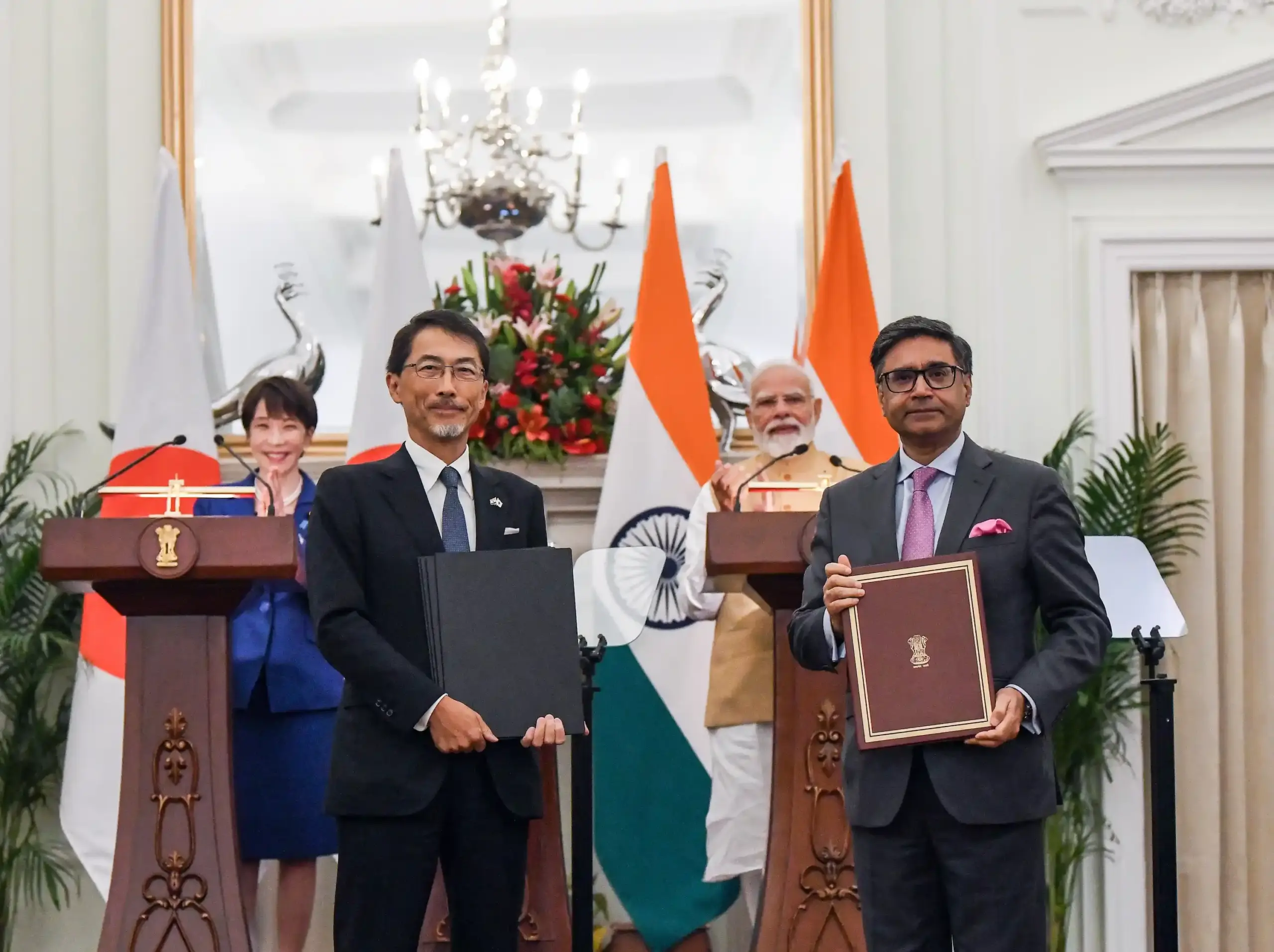
Diplomatic summits are often judged by the agreements they produce. But their deeper significance lies in whether they alter how two countries see each other. Prime Minister Sanae Takaichi’s recent visit to India, and the outcome of her summit with Prime Minister Narendra Modi, are likely to be remembered for doing exactly that.
The Joint Statement issued after the summit does more than record fresh initiatives. It suggests that India and Japan are entering a new phase of engagement — one that may best be described as the era of Strategic Trust.
That is more than a neat phrase. It reflects a real shift in the logic of the relationship. New Delhi and Tokyo are no longer speaking only of cooperation in broad terms. They are beginning to rely on one another in areas that now sit at the heart of national resilience, technological strength and economic security. Just as important, the relationship has been shaped by more than a decade of steady political attention from Prime Minister Narendra Modi, whose role has become central to the partnership’s continuity and direction.
Seen over seven decades, India–Japan relations have passed through three broad phases.
The first was trust built through development assistance. In the post-war years, Japan emerged as one of India’s most dependable partners. Official Development Assistance helped finance infrastructure that altered the physical landscape of the country and created a reservoir of goodwill that has outlasted many individual projects. Japanese engagement in that period was marked by patience, consistency and long-term thinking.
The second phase was trust through commerce. The Global Partnership in 2000, followed by the Comprehensive Economic Partnership Agreement, expanded the relationship into trade, investment, manufacturing and connectivity. The Delhi–Mumbai Industrial Corridor, the Dedicated Freight Corridor and the Mumbai–Ahmedabad High-Speed Rail became the most visible symbols of that period. Strategic dialogue deepened, but economics remained the main driver.
Prime Minister Modi inherited that foundation in 2014. He also widened its ambition. More than any other Indian leader in recent memory, he made Japan not just a partner of convenience but a partner of consequence. His rapport with Prime Ministers Shinzo Abe, Yoshihide Suga, Fumio Kishida and now Sanae Takaichi has helped preserve a rare continuity at the top of the relationship. That continuity has been vital. It has moved the partnership from one centred on infrastructure and commerce to one increasingly shaped by shared strategic interests.
The 2026 Modi-Takaichi Summit points to a third phase: trust through shared capabilities.
The global environment has shifted rapidly. Supply chains are no longer judged only by efficiency; resilience now matters just as much. Artificial intelligence, semiconductors, critical minerals and data are no longer just economic inputs. They are strategic assets. In this setting, countries are not merely looking for capable partners. They are looking for trusted ones.
That convergence is not accidental. The fragmentation of supply chains, the weaponisation of economic interdependence and the race for critical technologies have made trusted partnerships a necessity, not a luxury. The growing centrality of the Indo-Pacific has added further urgency. New Delhi and Tokyo have moved faster than many other strategic partners in recognising this shift and adapting to it.
The Joint Statement reflects that transition clearly. Its emphasis on semiconductors, critical minerals, advanced manufacturing and resilient supply chains shows how closely economics and national security are now linked. India and Japan are not pursuing diversification for its own sake. They are building trusted production networks that reduce vulnerability while preserving the benefits of global integration. For businesses, that opens opportunities in manufacturing, logistics, clean energy, electronics and strategic materials. For governments, it signals a shared commitment to growth that is resilient rather than dependent on a few concentrated nodes.
The same shift is visible in technology and innovation. Earlier phases of the partnership were defined by infrastructure. That story is no longer enough. Today, artificial intelligence, digital infrastructure, cybersecurity, advanced manufacturing and innovation ecosystems are at the centre of the relationship. Japan brings precision engineering, robotics and materials strength. India brings software, digital public infrastructure and a rapidly expanding innovation base. The aim is no longer just technology transfer. It is the creation of trusted technological ecosystems that can help shape standards across the Indo-Pacific.
Defence and maritime security form another important strand. Cooperation in this field has been building for years through exercises, dialogue and interoperability. The summit suggests a further move toward defence industrial collaboration and co-development. That is a significant step. Countries do not co-develop sensitive technologies unless they trust each other deeply and believe the partnership will endure. Maritime cooperation, regional connectivity and a shared commitment to a free, open and rules-based Indo-Pacific all reinforce the same strategic direction. India’s Indo-Pacific vision and Japan’s long-standing advocacy of a Free and Open Indo-Pacific now align more closely than before.
Investment, too, is acquiring a more strategic character. Japanese investment has long supported India’s industrialisation and infrastructure push. What is changing now is the direction of that capital. It is moving more clearly toward advanced manufacturing, semiconductors, green technologies, digital infrastructure and innovation. That shift matters for corporate leaders as much as for policymakers. Investment decisions will increasingly depend not only on market size and cost competitiveness, but also on regulatory trust, supply-chain reliability and the depth of technological collaboration. In that sense, investment is becoming strategic capital.
And that capital is not merely financial. It is a way of building resilience, capability and competitiveness over time. That is likely to shape the next wave of Japanese investment in India, especially in sectors where commercial returns and strategic value reinforce one another.
Human capital is the other essential pillar, though perhaps the most overlooked. No partnership of consequence can remain a government-to-government exercise. The Joint Statement’s emphasis on education, research collaboration, skilled mobility and innovation partnerships recognises that the future of the relationship will depend on people as much as policy. Scientists, engineers, entrepreneurs and young professionals will ultimately determine whether this partnership becomes durable or remains only aspirational. India’s demographic depth and Japan’s technological sophistication make that a powerful combination.
The strategic implications extend beyond the bilateral relationship. A deeper India–Japan partnership in technology, supply chains and defence is likely to be watched closely in Beijing, where it may be seen as part of a broader pattern of strategic coordination among major Indo-Pacific democracies. That perception, in turn, underscores the wider geopolitical significance of the partnership.
Taken together, these developments point to a real shift in the relationship’s philosophy. India–Japan ties are no longer organised mainly around individual projects, however significant those projects may be. They are increasingly organised around shared capabilities. Infrastructure changed India’s physical landscape. Shared capabilities are likely to shape its strategic landscape.
That matters well beyond the bilateral relationship. As geopolitics becomes more competitive and technology changes faster, countries are rethinking how they build partnerships. The era of hyper-globalisation rewarded efficiency, scale and low cost. The new era gives greater weight to resilience, technological sovereignty and trusted collaboration. India and Japan now have a framework that allows them to navigate that transition without abandoning open markets or a broader commitment to regional stability.
The real test of Strategic Trust will not be the next joint statement. It will be whether the two countries are willing to share sensitive technologies, co-develop critical capabilities, deepen industrial links and maintain policy continuity when the external environment becomes less forgiving. The durability of the relationship will depend on whether political intent is turned into institutional habit and commercial depth.
For business leaders, the message is equally clear. The next wave of opportunity will lie where commerce meets strategy. Investment in advanced manufacturing, clean energy, digital technology, logistics, critical minerals and innovation ecosystems will not only generate returns. It will also help build a more resilient economic architecture across the Indo-Pacific. Companies that understand that early will be best placed to benefit from the next phase of India–Japan cooperation.
The 16th Annual Summit between India and Japan will therefore be remembered less for any single agreement than for the direction it confirmed. It showed that both countries are moving beyond a relationship defined mainly by development assistance, infrastructure and trade. It also reaffirmed that Prime Minister Modi remains the vital pivot of the relationship — the leader who has consistently translated broad goodwill into strategic continuity, and continuity into momentum.
In an age when technology, supply chains and capital increasingly shape geopolitical influence, Strategic Trust may become one of the defining ideas of twenty-first century partnerships. India and Japan appear to have understood that early. Whether this moment proves transformational will depend on how well governments, industry and research institutions in both countries turn that trust into lasting capability.