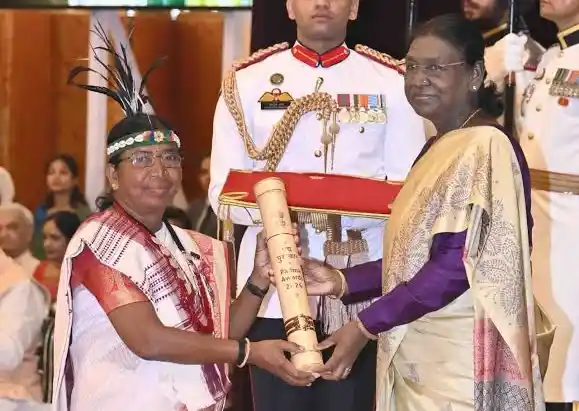
For four decades, a woman from Hiranar village in Chhattisgarh’s Dantewada district has been winning a war that no rifle could win. Dr. Budhri Tati — known across South Bastar as Badi Didi, “elder sister” — walked on foot to roughly 570 remote tribal hamlets to coax children into classrooms, organize women into self-help groups, and carry literacy and basic health care into forests the rest of India had all but abandoned. This year, she was awarded the Padma Shri. It was the right recognition for the right kind of hero, and a timely reminder of who actually rebuilds a broken region.
That reminder matters, because Bastar’s story is too often narrated through the men who tried to wreck it. Madvi Hidma, the dreaded commander of the Maoists’ Battalion No. 1, was killed in a security operation in Andhra Pradesh in November 2025 — an event police described as the “last nail in the coffin” of a severely weakened insurgency. For two decades his name surfaced after nearly every major ambush in the region: the 2010 Tadmetla attack that killed 76 security personnel, the 2013 Jhiram Valley massacre that wiped out a state’s political leadership, the 2017 Burkapal ambush in Sukma that left around two dozen CRPF men dead. Some still reach for the language of rebellion and romance when they speak of such figures. The people of Bastar know better. They lived the cost.
Consider what Dr. Tati’s forty years produced. Where formal education was once almost nonexistent, she sat with parents for hours, hamlet after hamlet, explaining how a school could protect a child from exploitation — and when the distances proved too great, she built a residential hostel under her own self-funded organisation. She turned more than 500 tribal women into self-reliant earners through stitching, weaving, and indigenous crafts, then taught them micro-savings and basic banking so they could escape the moneylenders who had owned their families for generations. None of this was abstract. It was a child back in class, a mother with her own income, a village re-stitched into the social fabric of the country.
This is the unglamorous truth about how a region recovers: not by force alone, but by sustained, patient labour that rebuilds institutions and the texture of ordinary life. Security gains can open the door, but someone still has to walk through it carrying chalk, a sewing machine, and a vaccination register.
What violence actually cost
The insurgency offered the opposite. For decades, fear forced schools to shut, clinics to retreat, weekly markets to shrink, and road and bridge projects to stall. Whole generations of tribal children grew up without a classroom within reach; whole communities were cut off from the markets, banks, and hospitals that other Indians take for granted. The result was not the ideological liberation its champions advertised. It was long-term impoverishment and insecurity, borne overwhelmingly by the very tribal poor the movement claimed to defend.
That is the human arithmetic that romantic narratives erase. Every ambush celebrated as resistance corresponded to a school that stayed locked, a clinic that never opened, a livelihood that never began.
The development that followed
As the security situation has improved, the contrast has become visible on the ground. The state reports that thousands of kilometres of roads and hundreds of mobile towers have been laid across Bastar, connecting once-isolated villages to markets, schools, and banks. Hundreds of schools have reopened and health outreach has resumed in areas that were no-go zones a few years ago. In a particularly telling shift, some former security camps are being converted into “Public Facilitation Centres” that offer health care, banking, and welfare services — turning a security dividend directly into a development one.
Surrendered cadres, meanwhile, are being offered skill training, housing, and education for their children: a path out of the gun and into a livelihood. These are measurable, durable outcomes. They are precisely what social reformers and honest governance produce, and precisely what cannot be built by weapons or by mythologising the men who carried them.
Why idolising violent figures is unjust
To celebrate leaders who used terror as a tactic is to whitewash the suffering of the civilians who paid for it — in deaths, displacement, interrupted schooling, and ruined livelihoods. It does something worse, too. It erases the agency of the people who quietly risked their own safety to keep a school, a clinic, or a small market alive through the worst years. When a society valorises the wrecker, it discourages everyone tempted to do the slow, thankless work of rebuilding trust.
Honouring peacebuilders like Dr. Tati corrects the historical record. Progress in Bastar is owed to community organisers, teachers, health workers, and decent administration — not to those who profited from prolonging the conflict. A democracy reveals its values in who it chooses to elevate. Its public honorifics and its national stories should reflect the people who improved lives, not those who made lives precarious for their own ends.
Development, in the end, is not a policy abstraction. It is the quiet return of regular life: children in class, farmers reaching a market, a clinic with its lights on, women organising for their rights and their incomes. That return is the work of people like Budhri Tati. Celebrating them openly, protecting their work, and scaling their model across every region scarred by conflict is the surest way to honour the victims of violence — and to break the cycle that produced them. If India’s republic means anything in Bastar, it is that those who rebuild the social fabric, one dusty forest path at a time, have earned its highest respect.