
In May this year, three sets of news dominated headlines about India-Nepal ties. The first, Nepal’s new Prime Minister Balendra Shah-led government, objected to the India-China agreement on the Kailash Mansarovar Yatra, as it was to be conducted through Lipulekh—a territory that Kathmandu unilaterally claims as its own. The second was about Prime Minister Shah’s remarks in the parliament, suggesting that Nepal ‘encroached’ on each other’s territories—interpreted by many as Nepal having allegedly occupied Indian territories. These events followed the reported postponement of Indian Foreign Secretary Vikram Misri’s visit to Nepal, due to Prime Minister Shah’s non-availability for a meeting with the visiting dignitary for protocol reasons. Three events and one view in the media: is it yet another impasse in the bilateral ties between the two neighbours?
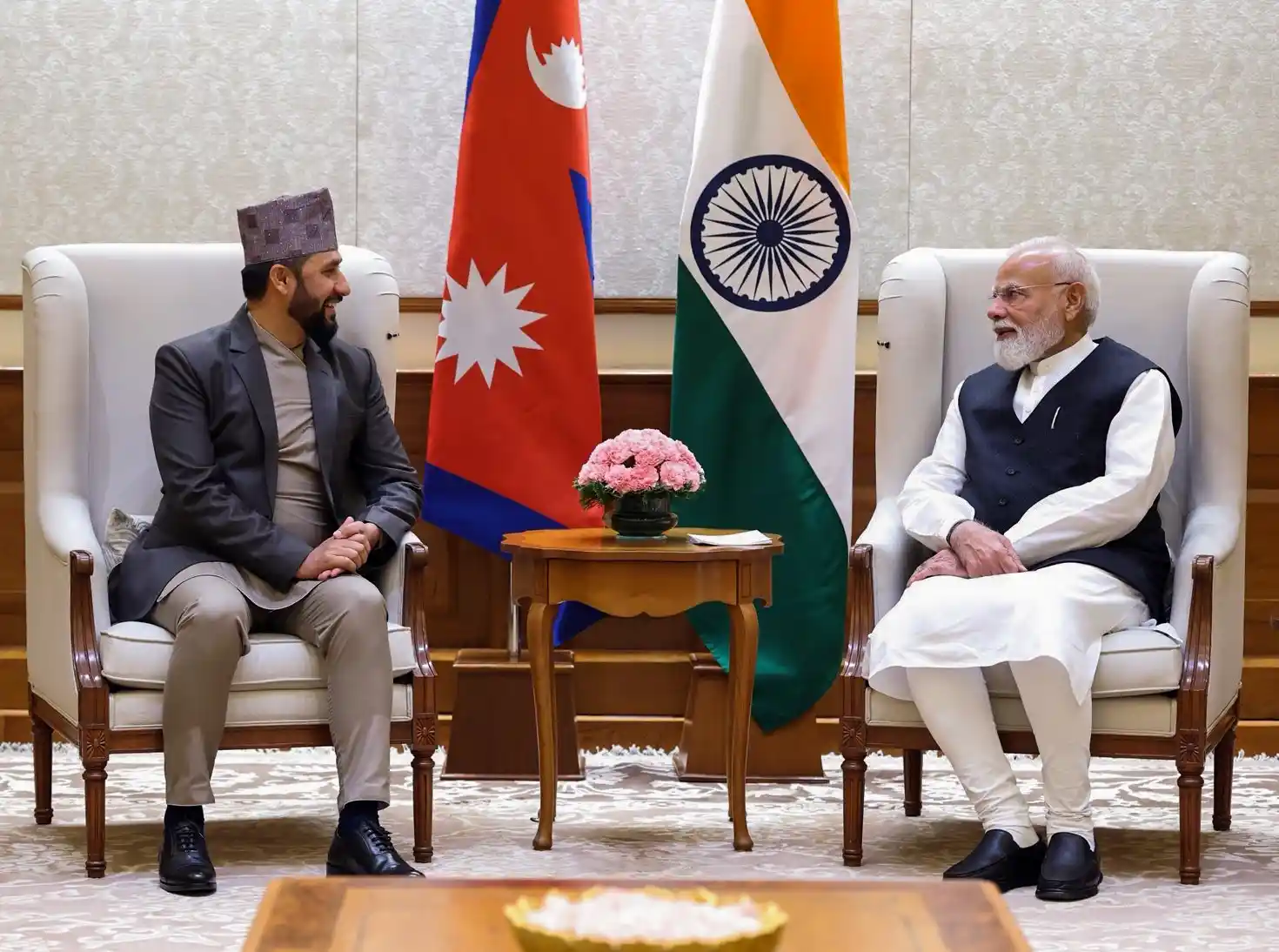
While many Nepal watchers asked this question in Delhi, what followed seemed like a promising reconfiguration in the India-Nepal ties, especially under Nepal’s ruling Rastriya Swatantra Party (RSP)-led government. At the invitation of India’s ruling Bhartiya Janta Party (BJP), RSP’s Chairman Rabi Lamichhane was on a five-day (June 01-05) visit to Delhi, where he held high-level meetings, including with Prime Minister Narendra Modi, Foreign Minister S. Jaishankar, Home Minister Amit Shah and National Security Advisor Ajit Doval. Rabi’s reception at the BJP headquarters was an exceptional welcome—grandeur reserved for special dignitaries. Following the conclusion of his visit on June 05, Nepal’s Foreign Minister Shishir Khanal arrived in Delhi on June 06.
The key question remains: What direction does Nepal plan to move with India?
Doing Away with the Traditional Way of Engagement
The spirit of ‘special relations’ between India and Nepal was fundamental to the 1950 Treaty of Peace and Friendship—a treaty that has since become the marker of modern-day India-Nepal diplomatic ties. The treaty was people-centric, with open borders and a no-visa, no-passport regime facilitating the socio-cultural, political, economic, and strategic bond. Over the past 7 decades, the two countries have undergone tremendous changes, both internally and externally, including Nepal’s transition to democracy in 2008 and the growth of the Nepalese diaspora in regions such as the Gulf.
Similarly, India stands tall as the world’s fifth-largest economy and ranks first in the global population index. While the changes have been contextualised to global events and churnings, what remained constant was the policy approach in Kathmandu and Delhi to weave 21st-century ties that were very similar to those in the 1950s. Not to say that the bilateral partnership has not evolved across different sectors, but the distinction between big and small states often dominated the conversation when it came to resetting ties or resolving disputes. While different eras warranted a reset in ties, the Gen Z Movement in Nepal has been the most notable one.
The youth-led movement against established and traditional parties and leaders, in August/September 2025, called for reforms that were not bound by the compulsion of coalitions, rather aimed at the welfare of the people, including the youth. As a result, the Gen Z Movement, after its success in forcing the grand-old parties and leaders to resign, convinced the people of Nepal to vote for leaders like Balendra Shah and his party, RSP, and the final mandate has been transformative for Nepal, mainly because it is for the first time that the youngest Prime Minister, and his party, RSP, has a close to two-thirds majority in the parliament, and there is no major coalition government so stability remains a constant element.
With this mandate, Prime Minister Balendra Shah has put forward a vision plan for the country’s internal reforms and has also made ‘Nepal First’ the guiding principle of Nepal’s foreign policy. What it entails in relation to India is basically that Nepal, as a landlocked country between India and China, would prefer to avoid a ‘pro-India/anti-China or anti-India/pro-China foreign policy. Therefore, departing from past practices in which the newly elected Prime Minister either visited India or China to set the tone and direction of foreign policy, where India mostly figured prominently.
While Prime Minister Shah has clearly indicated a focus on domestic issues and an intent not to make an immediate foreign visit, possibly for a year, he has deployed his party leadership and bureaucratic mechanisms in the government to continue engagement with both India and China. This must be seen as a two-layered foreign policy: the Prime Minister controls the country’s internal reforms and other branches, including the party, which engages externally and continues to provide momentum to bilateral, multilateral and plurilateral partnerships.
Making Development Cooperation Cardinal
With remarkable shifts and changes brought about by youth-led movements in India’s neighbouring countries, such as Sri Lanka in 2022, Bangladesh in 2024, and Nepal in 2025, Delhi has been proactive in engaging with the new political actors and parties and has conveyed India’s strong support for economic upliftment and development cooperation. This has been reflected in India’s diplomatic outreach, including Prime Minister Modi’s direct conversations with the leaders of political parties and newly elected leaders.
For the longest time, New Delhi was perceived as catering to specific parties and leadership in the neighbourhood. Still, with their eventual departure, it has now seemingly put an urgency on adopting a government- and people-centric approach. While Delhi adopts new approaches under its ‘neighbourhood first’ policy, countries like Nepal have also indicated a broader reset in ties with India.
To begin with, Chairman of Nepal’s ruling RSP, Rabi Lamichhane, during his visit to Delhi in the first week, laid down Nepal’s vision of India policy in an op-ed in one of India’s leading news dailies. Suggesting to forgo the past, and making a fresh start, Rabi wrote, “we neither have the luxury of self-indulgence, nor do we wish to hide our weaknesses behind worn-out phrases. Instead of looking solely at what our relationship has achieved, we want to make a fresh start by focusing on what it could have achieved—and what it can become.”
Towards that end, Rabi further suggests that Nepal benefit from India’s economic growth story. He emphasises the urgency of closer economic cooperation between the two countries and urges India to help Nepal build institutions such as IITs and AIIMS. Also, actualising the idea of ‘land-connected’ rather than just thinking of Nepal as a ‘landlocked country’ was an overarching thinking in Rabi’s outlook on engaging with India.
Rabi further wrote, “While India is on track to become a global leader in metro rail expansion, laying nearly 15 kilometres of railway track per day, the proposed Raxaul-Kathmandu railway line is less than 150 kilometres. The day those 150 kilometres of track are connected, it will revolutionise trade, tourism, logistics, and regional connectivity between us. Nepal does not just want to connect borders; it wants these rails to boost an entire economy.” It needs little guessing that it is a new aspiring Nepal which aims to benefit from India, growth trajectory.
Road Ahead
As two neighbours with shared history, politics, cultural heritage, and deeper economic and development cooperation, India and Nepal are blessed with a demographic dividend. While India’s median age is 29.5, Nepal’s is 26, making both countries young demographics; taking that into account, both countries have the potential to strengthen their development partnership with youth at the centre. At this point, the new generation also does not bear the ‘burden of history’; therefore, a workable idea could be to create future partnerships in areas such as technology, innovation, space, and education—something that Rabi laid down in his op-ed. Also, as Nepal begins a new journey of development, India’s extended hand of cooperation will be appreciated for a long time. Also, the good news is that on issues that cause instability in the relationship, such as territorial issues, there is a willingness to resolve them amicably and diplomatically from both sides, and if this moment is captured well, it will ensure that the past does not hold present prospects hostage, and that the present conceptualises the trajectory of the future.

