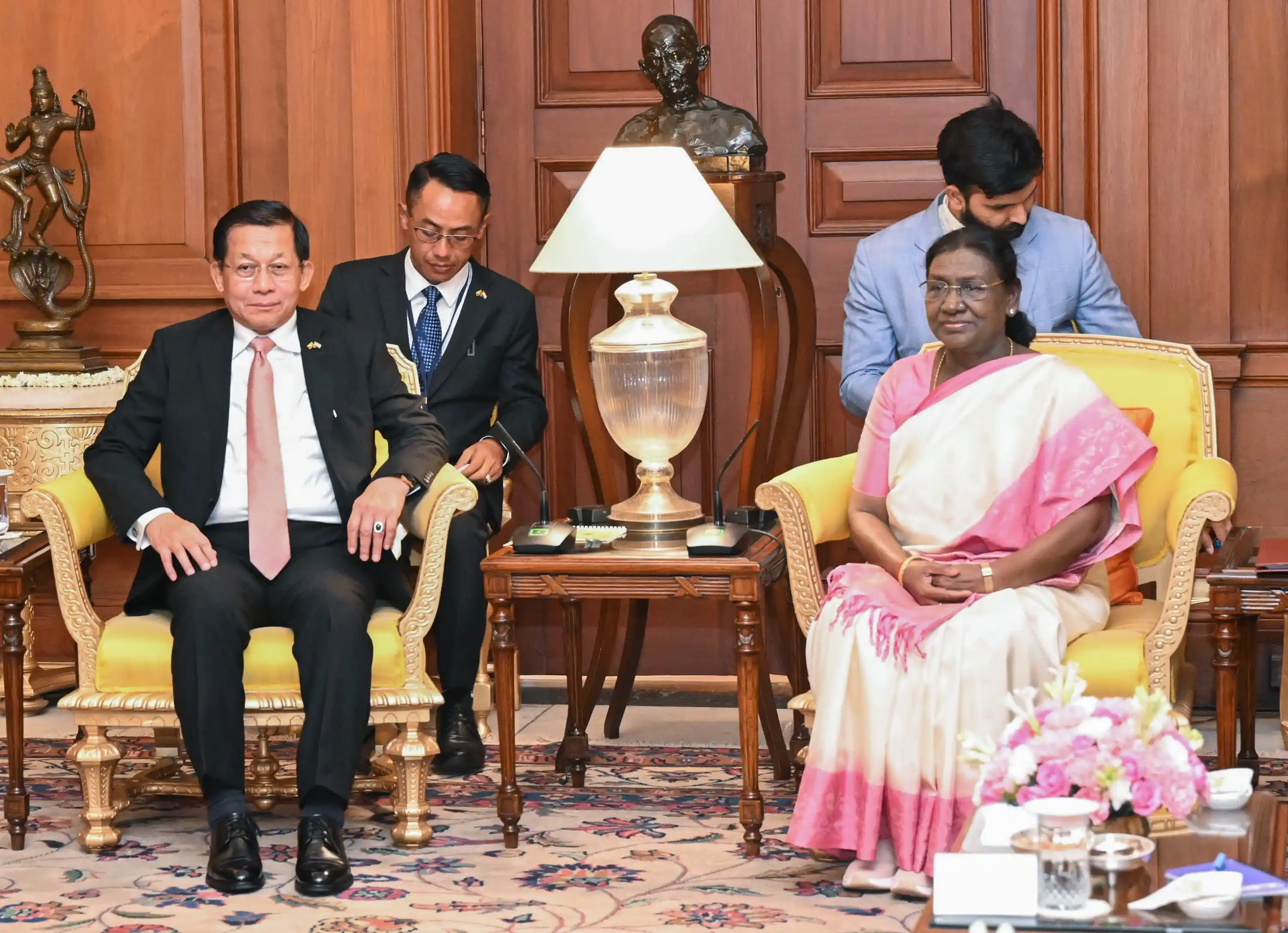
Myanmar’s President U Min Aung Hlaing arrived in India on May 30 for a five-day official visit – his first foreign trip since being sworn in as president in April 2026. While the visit was expected to be to Beijing, it could be interpreted as Naypyidaw attempting to reduce China’s influence and recognition of India’s policy of openness, while others prefer to isolate and pressure.
Between Two Powers
Since the military seized power in 2021, Myanmar has largely been isolated, with Western governments and most ASEAN countries condemning the junta and supporting the National Unity Government, which was formed by politicians who were removed from power. China has filled the resulting vacuum, becoming Naypyidaw’s principal economic and diplomatic partner. Beijing’s interest was based on securing the China-Myanmar Economic Corridor – a Belt and Road Initiative project that links Yunnan Province to the deep-water port of Kyaukpyu on the Bay of Bengal. This gives Beijing strategic access to the Indian Ocean, bypassing the Malacca Strait.
India, for its part, has maintained a policy of continued engagement. Foreign Secretary Vikram Misri, speaking after the June 1 talks, was direct: “Our engagement with Myanmar is not intended to be a commentary on the internal political arrangements in that country. We have always proceeded on the principle that sustained dialogue is what is important.” He added: “Disengagement only produces a vacuum that others go on to fill, to our detriment.”
Turn to India
The meeting between Modi and Min Aung Hlaing produced an agreement to deepen cooperation in areas such as trade, investment, connectivity, border management and, most significantly, critical minerals and rare earth elements.
Myanmar is now the world’s third-largest producer of rare earth elements, with an estimated production of around 31,000 metric tons in 2024, including dysprosium and terbium. These elements are essential for electric vehicle (EV) motors, wind turbines, and advanced defence applications. Although India holds the world’s third-largest rare earth reserves, it produces less than one percent of the global total. Currently, the vast majority of Myanmar’s rare earth output is exported to China. Most of these deposits are located in Kachin State, which borders China’s Yunnan Province. The main mining belt lacks connectivity with India, and the security of the India-Myanmar border is constantly being tested by anti-Indian groups.
Against this backdrop, it is important to note that both topics were discussed during Min Aung Hlaing’s visit. The importance of completing the Kaladan project and the Trilateral Highway was emphasised by both sides. These projects are crucial for connecting India’s northeast to Southeast Asia, and are central to India’s Act East policy. Foreign Secretary Vikram Misri acknowledged that the security situation has been the primary obstacle to both, but the Myanmar leader assured that the country’s territory would not be used against Indian interests.
It is also worth noting that cybercrime was discussed, too. India stated that it had repatriated over 2,400 of its citizens from scam operation centres controlled by Myanmar’s militia and opposition forces over the past year, with approximately 150 individuals still remaining in the country.
Dialogue as an Advantage
The core logic behind Min Aung Hlaing’s visit to India is based on a sovereign calculation. The Myanmar government has not turned away from China because its economic influence is too strong to ignore. However, it has deliberately chosen to introduce a counterweight. India is offering Naypyidaw a partnership that does not raise the same sovereignty concerns as those arising from Beijing. While Chinese investment strategically fulfils only Beijing’s interests by coming with political conditions and a growing physical presence, India’s Kaladan Corridor and the Trilateral Highway are oriented towards regional integration of Myanmar.
New Delhi has maintained working relationships with both the central government and the opposition. Rather than viewing Myanmar’s political fragmentation as a dispute to take sides in, India treats it as a practical reality to be managed. This dual-track diplomacy is now paying strategic dividends.
By contrast, ASEAN’s position is a case study in the cost of non-engagement. By excluding Myanmar’s government and refusing to engage in substantive dialogue, the bloc has forfeited its leverage. India has adopted a different approach, and the visit in June 2026 provides clear evidence of the benefits, including a strengthened position as Naypyidaw’s favoured regional partner, a critical minerals agreement that challenges China’s near-monopoly on Myanmar’s resource output, and a credible claim to regional leadership through the Act East policy.