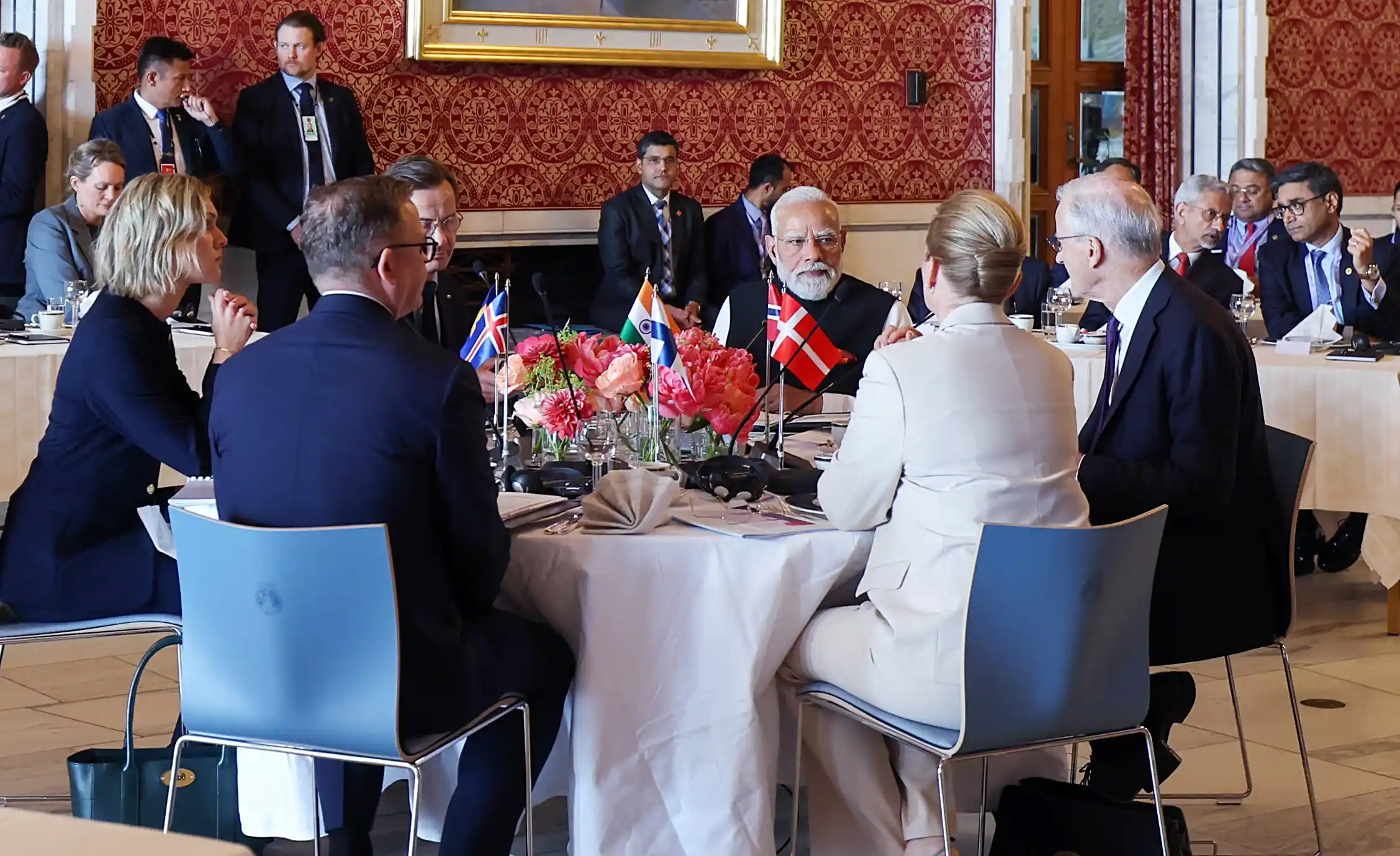
India’s presence at the third Nordic summit in Oslo is more than another multilateral photo‑op; it is a quiet but consequential re‑wiring of global technology governance, with India stepping out as a co‑author of digital and AI norms rather than a passive rule‑taker.
On paper, the India–Nordic relationship still looks modest: bilateral trade in goods and services is around 19–20 billion dollars, and just over 700 Nordic companies operate in India, with roughly 150–230 Indian firms present across the Nordic region. Yet this is precisely why the 2026 summit matters. It signals that both sides now see each other less as niche markets and more as strategic platforms: India as a continental‑scale laboratory for inclusive digital innovation, the Nordics as a compact but potent cluster of high‑tech, green‑tech and governance expertise.
By framing relations as a “Green Technology and Innovation Strategic Partnership”, Nordic leaders are essentially betting that anchoring supply chains, research collaborations and digital infrastructure in India will yield both commercial returns and geopolitical resilience in an era of fractured globalisation.
The decision to foreground “inclusive, human‑centric AI” is not rhetorical garnish; it reflects a convergence between Nordic social‑democratic tech values and India’s recent diplomatic pivot around the AI Impact Summit in New Delhi. The AI Impact Declaration, endorsed by over 90 countries and organisations, organises cooperation around seven “chakras”: human capital, inclusion, safe and trusted AI, resilience and efficiency, science, democratizing AI resources, and AI for economic growth and social good. This is a far more developmental framing than the security‑heavy debates that dominate in Washington or Brussels.
That the Nordics explicitly welcomed India’s hosting of this summit is politically significant. It acknowledges that New Delhi is no longer just implementing others’ guardrails; it is designing its own AI governance architecture, and inviting both the Global North and Global South to plug into it. In effect, the Oslo summit ties Nordic leadership in responsible tech (for example Finland’s push for “just AI”) to India’s ambition to turn inclusive AI into a global public good.
The real story underneath the AI language is digital infrastructure. Over the last decade, India has built a dense stack of digital public infrastructure (DPI)—from Aadhaar for ID, to UPI for instant payments, to open APIs that let private innovators build services atop state rails. These systems now underpin welfare delivery, financial inclusion and everyday transactions for over a billion people, and they are increasingly being exported—from open‑source ID platforms like MOSIP to vaccine certification systems across Asia and Africa.
Nordic economies, with their advanced telecom, semiconductor and cyber‑security ecosystems, are natural partners to harden and globalise this model. The 2026 roadmap’s emphasis on 6G, quantum computing, AI and semiconductors—drawing on Swedish firms like Ericsson and Saab and Finnish strengths in telecom—connects India’s scale and regulatory experimentation with Nordic hardware and R&D prowess. If this works, norms about “trusted” infrastructure, open standards and interoperability will not be written solely in Brussels boardrooms or Silicon Valley campuses, but co‑crafted in a New Delhi–Helsinki–Stockholm triangle.
There are risks: as analysts have noted, India’s DPI also raises hard questions about surveillance, exclusion and centralisation of power, and its AI ecosystem still depends heavily on foreign cloud and chip providers. Nordic partners, with their strong data protection cultures and civil‑liberties traditions, could become the necessary friction in this partnership—pushing India to align its Digital Personal Data Protection law and AI experimentation with more robust safeguards, rather than chasing speed at the expense of rights.
A bridge between two worlds, and two climates
The India–Nordic compact is also geopolitical. The Nordics are wealthy, rules‑based democracies with deep stakes in the Arctic; India is a major developing‑country voice and an Arctic Council observer since 2013, with a permanent research station in Svalbard and a growing portfolio of Arctic science projects. Bringing these two vantage points together is not just symbolism: it links the lived experience of climate vulnerability in the tropics with the planetary early‑warning system of the poles.
In Oslo, Arctic cooperation and climate finance sit alongside digital and AI cooperation, not beneath them. This is a quiet acknowledgement that the next generation of climate action will be mediated through data, sensors, AI models and digital infrastructure—precisely the domains where India and the Nordics are seeking to align. When India argues for affordable climate finance and capacity‑building for developing countries, it now does so not just as a petitioner but as a provider of tools—remote‑sensing platforms, digital MRV systems, and AI‑enabled adaptation solutions—that Nordic partners can help refine and scale.
Economically, the summit underlines a shift from India as a market to India as a platform. With trade already around 19–20 billion dollars and more than 700 Nordic firms on the ground—from Nokia and Ericsson to smaller clean‑tech and maritime players—the logic of using India as a base for Asia and the wider Global South is well underway. New Delhi’s pitch now couples this with sectoral offers: shipbuilding and green shipping, water and waste‑water solutions, defence manufacturing, and financial services hubs like GIFT City tailored for global capital and fintech.
For Nordic companies facing both cost pressures and political scrutiny over supply‑chain resilience, anchoring production and R&D in India offers diversification away from China while tapping a vast pool of STEM talent and a rapidly evolving regulatory framework on data, AI and digital competition. For India, Nordic capital and know‑how are a way to move its “Make in India” narrative up the value chain—from assembling hardware designed elsewhere to co‑designing semiconductors, communication standards and green industrial processes at home.
Seen in isolation, each of these strands—AI cooperation, DPI exports, Arctic science, green shipping—could be dismissed as technocratic jargon. Taken together, they amount to an emerging political choice. India and the Nordics are testing whether a mid‑sized coalition, anchored in both equity and advanced technology, can offer an alternative to the binary of US‑China tech rivalry and EU regulatory unilateralism.
For India, this will require humility as well as ambition: opening its own systems to external scrutiny, strengthening protections for privacy and dissent in its digital governance, and resisting the temptation to treat DPI and AI as instruments of majoritarian control. For Nordic governments, it will mean engaging with a partner that is simultaneously a democracy and a site of democratic backsliding, a champion of “human‑centric AI” and a prolific experimenter in state‑led datafication.
If both sides can live with these tensions and negotiate them in good faith, the India–Nordic Summit 2026 may be remembered not for its communiqués, but for helping shift the centre of gravity in global tech governance toward a more plural, post‑Western, yet still rights‑conscious order.