A few years ago, while presenting India’s manufacturing ambitions under the ‘Make in India’ initiative to an international audience, I was asked a question that was both simple and disarming: Why does a country with such a deep civilizational heritage struggle with basic public cleanliness? The question wasn’t asked aggressively, nor was it possibly even meant to offend. But it stayed with me, largely because I did not have a convincing answer.
That moment, in hindsight, captures a deeper challenge in India’s development narrative.
Over the last two decades, India has scored impressive achievements – 5th largest economy (recently relegated to 6th place due to weaker rupee), record number of highways built in a year, world-class airports, an ever-growing network of metro systems in many cities, a digital payments system that probably works better than in most developed countries, etc. All of this is true.
But the moment such achievements are highlighted or celebrated, the pushback is immediate. It is especially telling when foreigners with lived ground-level experience in India point to dirty streets, unusable public toilets, chaotic traffic, unsafe public spaces, and everyday friction in basic services. Especially on social media and in private conversations, the narrative quickly shifts from “India is rising” to “India is not working where it matters.”
When global observers praised the cost-efficiency of India’s space missions, public discourse quickly pivoted to basic gaps—why not invest more in sanitation? As India’s human spaceflight ambitions (Gaganyaan) gained attention, similar comparisons resurfaced. These contrasts may be unfair. But they are telling.
People instinctively measure ambition against everyday reality. When the street outside does not reflect the same level of progress, even significant achievements begin to feel distant, making it harder to convincingly tell India’s story to the world.
Take Bangalore, often described as India’s Silicon Valley. It boasts gleaming office parks, a world-class airport, expanding metro lines, and a vibrant, cosmopolitan economy.
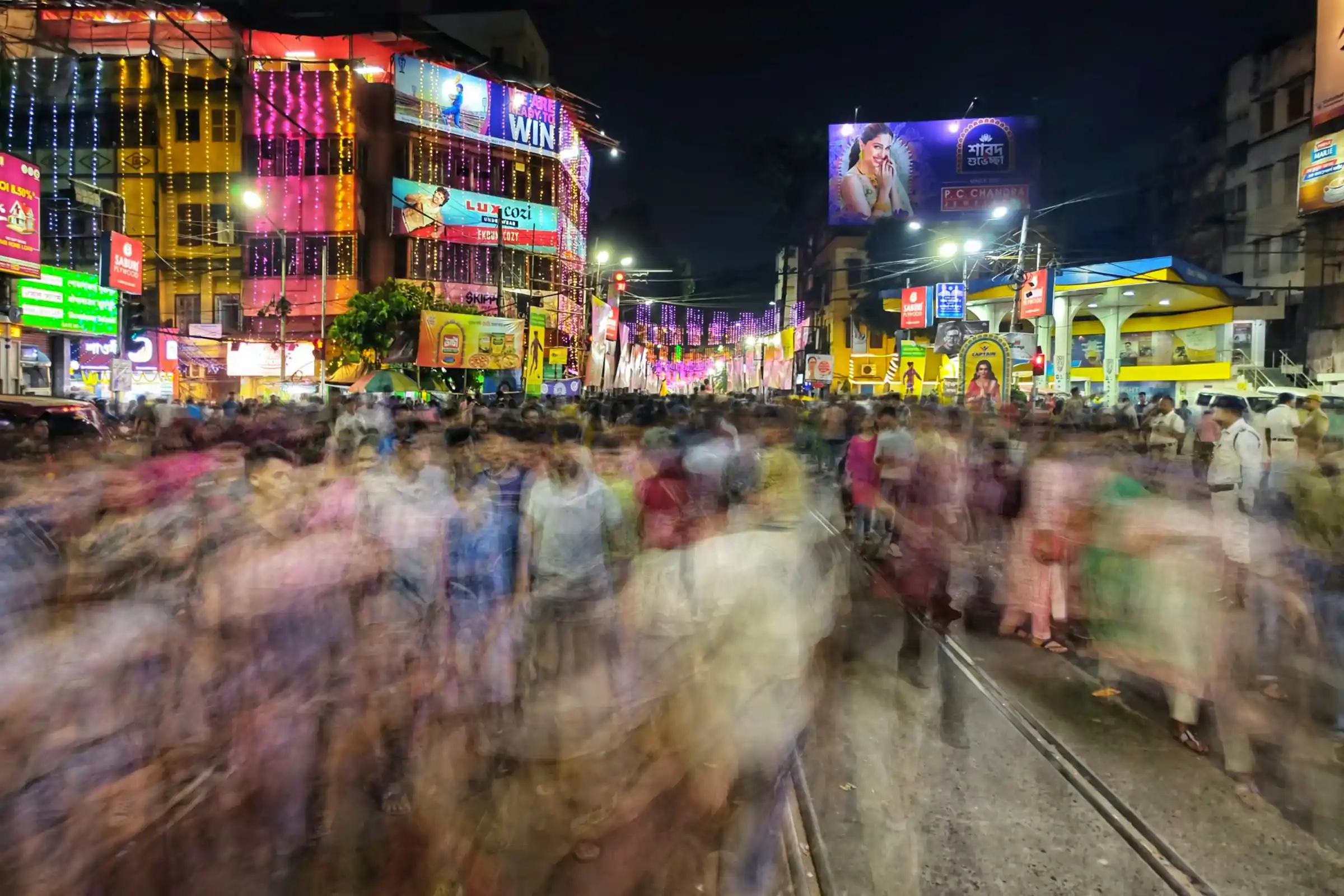
But step onto a typical street and the experience is very different. Broken footpaths are everywhere, piled up garbage, snarling road traffic, where the default instinct is to overtake at any cost and in crowded spaces, there is no such thing as a queue.
In moments that require collective responsibility, such as accidents, harassment in public transport, or street altercations, people simply become passive bystanders. There is often visible hesitation, indifference and even apathy. All these points to a widespread deficit of empathy in shared spaces.
They may be small things individually, but together, they define the everyday experience in a large metro like Bengaluru, not just to a visiting foreigner, but to us citizens as well. This can be witnessed in all our metro cities as well.
Clearly, there are two different “Indias” evolving at different speeds. On one side, there is genuine and speedy progress through centrally driven initiatives: highways, metro systems, freight corridors, airports, digital public infrastructure, Make in India, etc. On the other side is the less visible domain of public civic behaviour, enforcement, civic responsibility and everyday accountability- areas where progress has not kept pace.
This is where India’s development story hits a friction point: we are treating macro development and the softer side of infrastructure as two separate tracks. They are not, but deeply intertwined, simply because infrastructure does not operate in a vacuum. A road without lane discipline becomes inefficient; a public space without civic sense becomes unusable and a system without accountability becomes unreliable.
I have felt this contrast most sharply when returning to India after working in countries such as Vietnam, Singapore, Thailand, Indonesia, and Kazakhstan. These are not uniformly affluent societies, nor are they without their own challenges. But what stood out consistently was the quality of everyday conduct. Public spaces were used, but also respected. Traffic, though dense, was more rule-bound than instinct-driven. Noise levels were more restrained. Interactions were more predictable. The overall experience felt smoother and less adversarial.
During these periods abroad, following news of India’s rapid development raised my expectations of a higher quality of life back home, particularly in a city like Bangalore. And yet, each return felt like a reset.
For many first-time visitors, the journey beyond airports and hotels involves navigating basic frictions like uncertain transport, aggressive touting, inconsistent pricing, and limited access to clean public amenities. At heritage and touristic sites, issues of maintenance, crowd management, uncouth touts, and the poor quality of guides can dilute what should otherwise be world-class experiences.
These are not minor irritants. They shape memory. In today’s world, those memories do not remain private. They are amplified. Travel vloggers and social media influencers document their journeys in real time, and a single negative experience can reach millions within hours. These accounts, often unfiltered, carry significant influence in shaping global perception.
India is building like a middle-income country trying to leap forward, but behaving (civilly and administratively) like a lower middle-income one. India tends to optimize airports and metros, but struggles with civic and public behavioural issues.
A shift in this mindset is also essential. Public property, civic infrastructure, and natural resources require a sense of shared ownership. Where such ownership takes root, behaviour changes. Clean spaces tend to remain clean. Order reinforces itself. Systems begin to function with less friction.
The question arises as to whether it is the duty of the Government to tell people to behave civilly, or not to throw garbage on the road, and not to spit in public places? Ideally not, but globally, civic norms have been acquired over time through regulation, enforcement and public awareness. Singapore didn’t become orderly by default. It used strict fines, surveillance, and sustained campaigns. In Japan or Germany, social disapproval itself enforces civic behavior.
In India, it’s not that people don’t know better; it’s just that social norms don’t penalize violations. To add to that, legal enforcement is inconsistent and penalties are weak or negotiable. No wonder, the same Indians when in Singapore or UAE typically do not litter, follow queues and comply with traffic rules.
India has already demonstrated that it can build at scale. The next phase of its growth will depend on whether it can bring the same seriousness to how systems are used, maintained, and respected in everyday life.
Because in the end, a country is judged not only by its greatest achievements but also by its most ordinary moments. And it is in those ordinary moments that India still has work to do.