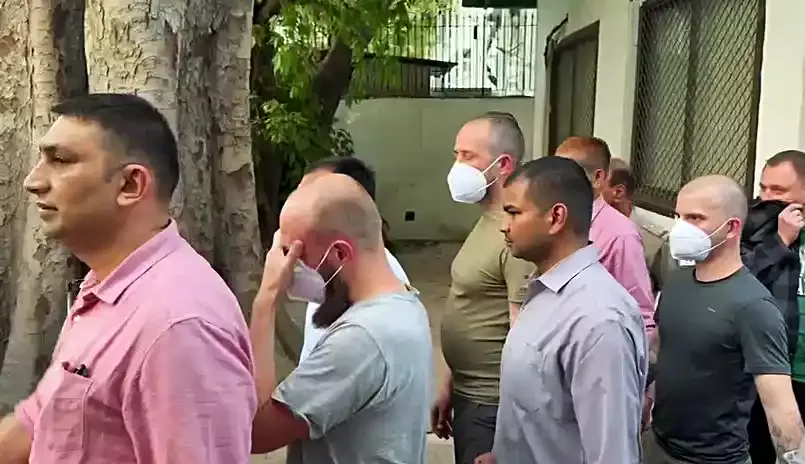
Unrest in the neighbourhood naturally has spillover effects, but it takes an insidious turn when attempts are made to associate the mayhem with a larger geostrategic game plan by the external powers. Such speculations are filling the air after reports surfaced about the National Investigation Agency (NIA) nabbing 7 foreigners- 6 Ukrainians and one American-early March. The foreigners were charged with illegally entering Mizoram without an official permit and sneaking into Myanmar, where they were training armed rebels associated with insurgent groups in India. Immediately, narratives were floated regarding the diabolical Western scheme of carving out a ‘Christian State’ composed of the contiguous Christian majority areas of northeast India, Myanmar, and Bangladesh to facilitate the establishment of a Western military base in the Bay of Bengal, a theory long dismissed as speculative but is rekindled with the arrest of the foreigners by NIA.
Myanmar has been ravaged by the unending civil war since the transfer of power by the British in 1948. The failure of Myanmar to emerge as a nation-state gradually turned it into an unruly territory divided among armed ethnic groups ruling their respective bastions and fighting the military rulers for autonomy. These ethnic factions have cross-border kinship with northeast India’s ethnic communities. The Indo–Myanmar border extends approximately 1,643 kilometers across the northeastern states. Despite the imposition of rigid political boundaries, enduring networks of kinship, trade, and cultural interaction continue to define the everyday life of the border region. The region is predominantly inhabited by Naga, Kuki, Chin, Mizo, and Meitei communities, who share cross-border linguistic affinities and clan-based kinship systems. Therefore, ethnic strife on either side of the border has spillover effects. Manipur experiences an intensified security crisis due to the deep ethnic linkages between Myanmar’s western provinces and Manipur’s Kuki-Zo and Meitei communities. Manipur chief minister’s office shared intelligence claiming over 900 Kuki rebels sneaked into the state from Myanmar to launch an attack on Meitei villages during recent clashes between the Kuki-Zo and Meitei communities in Manipur. Kuki militants aspire for a separate state for themselves, carved out of the Kuki-dominated hill districts of Manipur. On the other hand, Mizoram currently houses 38,059 refugees, the bulk of whom are from Myanmar’s Chin state fleeing conflicts between the military and the armed factions and who share ethic ties with the Mizo people.
Interestingly, the Kuki-Chin-Mizo people have, in recent years, started calling themselves collectively as ‘Zo’ people aspiring for ‘Zogam’, or a homeland for Zo people comprising large parts of the Chin state of Myanmar, the Indian state of Mizoram, Kuki-inhabited areas of Manipur, and the Bandarban district and adjoining areas of Bangladesh’s Chittagong division. After the arrest of the foreigners by the NIA, tongues have started wagging about the hatching of a larger conspiracy, taking advantage of the current volatile situation in the Indo-Myanmar border areas. The American arrested by the Indian intelligence, Matthew VanDyke, a self-proclaimed ‘freedom fighter’, holds a record of assisting rebels in Libya and Syria, as well as Indian insurgent outfits of the Northeast. In 2014, he founded Sons of Liberty International (SOLI), a self-described non-profit security firm that offers free military training, tactical advice, and equipment to ‘oppressed’ groups, funded by private donations. However, the interesting speculation surfacing is his CIA link, given his previous proximity with the American spy body, his assistance to Ukrainian fighters, and his expanding interest in confronting Russia’s global allies, which includes Myanmar. The issue is now juxtaposed with the claim deposed Bangladeshi Prime Minister Sheikh Hasina made in 2024 about a plot to establish a “Christian state like East Timor” comprising parts of Bangladesh and Myanmar. She also claimed that ‘a white foreigner’ had offered her an easy return to power if she allowed a foreign nation to build an airbase in Bangladesh, which she refused. Notably, the Hasina government collapsed within months of her revealing the story. The mention of the ‘Christian state’ is significant since the ‘Zo’ people are Protestants and evangelical and the demand for unification of all Zo-inhabited areas in the three countries, according to the intelligence sources in India and Bangladesh, is being instigated by Church bodies, especially the USA’s Baptist Church. The whole affair now brings the dead ‘Coupland plan’ out of the coffin, a 1940s secret proposal of a British-administered Crown Colony comprising all tribal areas of Northeast India, as well as the contiguous tribal areas of then Burma. The matter is raked up with claims that the current foreign minister of the BNP government, Dr. Kahlilur Rahman, has been cahooting with the USA to facilitate its military presence along the Bangladesh borders with India and Myanmar under the guise of a UN humanitarian corridor. The arrest also brings the USA’s Myanmar strategy under scrutiny.
With VanDyke’s arrest, theories propounded include a broader strategy to destabilize India with allegations against the CIA of conducting covert operations across the globe, Ukrainian involvement with President Volodymyr Zelensky insisting on special operations in foreign countries, and a link to the geopolitical tensions surrounding the Russia-Ukraine war, possibly as a consequence of India buying Russian oil. Notably, Mizoram Chief Minister Laduhoma alleged that Ukrainian war veterans sneaked into Myanmar via his state to train rebels. Parsing the background of some of the Ukrainians arrested by NIA does highlight their possible connection with the Ukrainian armed forces.
However, the immediate requirement is to augment the vigilance along the porous and sensitive Indo-Myanmar border region. In 2024, the Indian intelligence drew attention to ‘unusual Western visitors’ in Mizoram with no apparent tourism purpose and reported more than 20 suspected mercenaries leaving Indian territory undetected after crossing in from Myanmar. The security challenge from insurgency in the northeast is maturing with the rise of drone technology in neighbouring Myanmar, with reports of European hardware and Western expertise being leveraged to target critical infrastructure, including military bases, oil refineries, and hydroelectric dams, in this area. The primary concern for the Indian intelligence is the northeastern insurgents getting acquainted with this high-tech expertise due to their ties with the Myanmar rebels. The intrusion of the Western ‘tourists’ in the insurgent-infested areas of India and Myanmar is thus concerning. Even if the Coupland plan-like plot is dismissed as speculative, the very unnatural interest of the Westerners in India’s northeast is a warning signal enough to augment the security structure of the area.