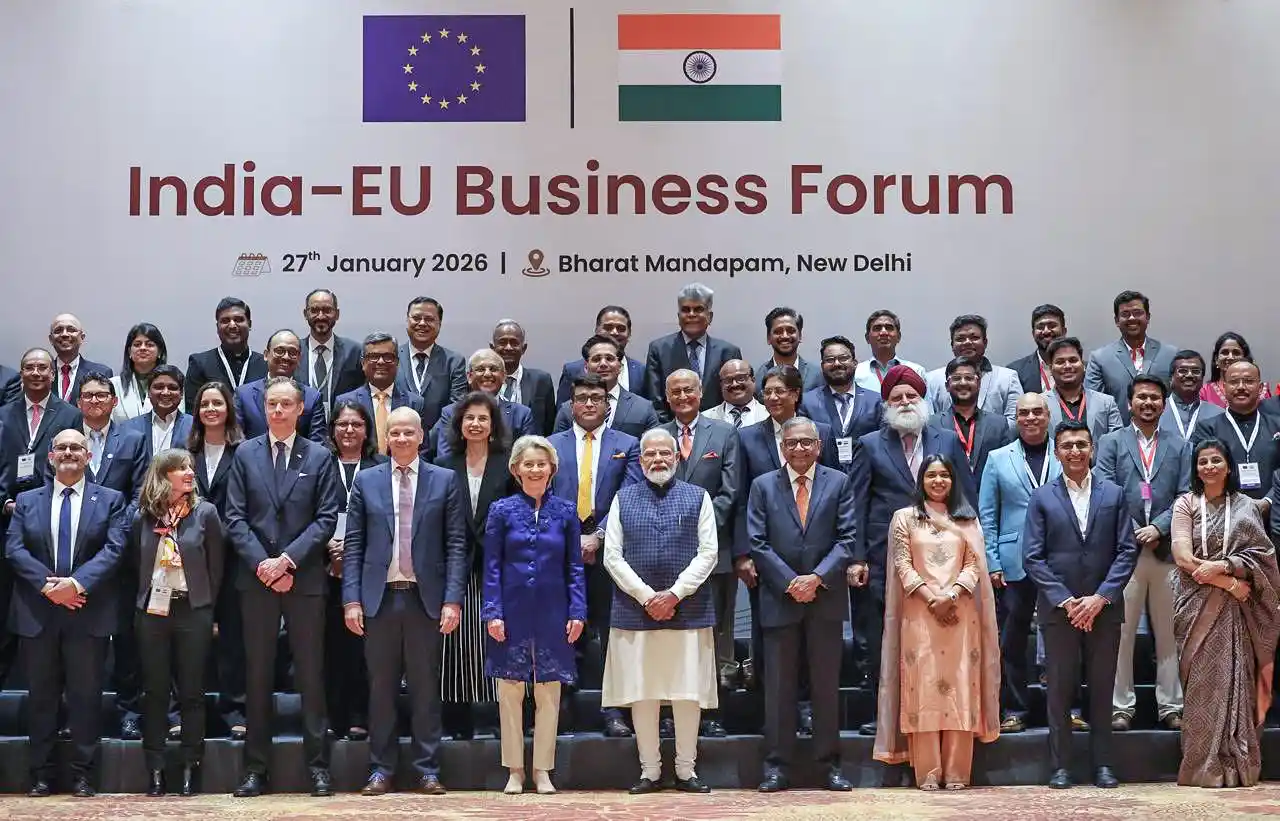
The EU–India Free Trade Agreement represents a landmark step in deepening one of the world’s most significant economic partnerships, creating a comprehensive and modern framework that goes far beyond traditional tariff reductions. By combining ambitious market access commitments with robust rules on services, digital trade, sustainability, regulatory cooperation and enforcement, the agreement seeks to unlock the full potential of bilateral trade and investment while preserving each side’s regulatory autonomy and high standards. Together, these provisions aim to foster growth, resilience and inclusiveness across the EU and India’s economies.
Trade in Goods
Bilateral trade in goods between the two partners equalled €120 billion in 2024. EU goods imports from India stood at €71 billion in 2024, while EU goods exports reached nearly €49 billion during the same year.
The EU will eliminate tariffs on over 90% of tariff lines, and 91% in terms of value and India will eliminate tariffs on 86% of tariff lines, and 93% in terms of value. Moreover, both sides will partially liberalise a significant additional number of lines, thereby bringing the overall coverage of trade liberalisation to 96.6% for India and 99.3% for the EU.
Strong benefits for key economic sectors on each side, such as:
- For the EU: agri-food, chemicals, pharmaceuticals, machinery, medical devices, avionics and automotive industries.
- For India: fisheries, chemicals, textiles, footwear and pharmaceuticals.
India will remove high duties on industrial products (which, on average, are above 16%), such as:
- Chemicals (current tariffs of up to 22%, to be removed mostly at entry into force of the agreement).
- Cosmetics (current tariffs of up to 22%, to be removed mostly after 5 or 7 years).
- Plastics (some at entry into force, many after 7 years).
- Car parts (most tariffs to be removed after 5 to 10 years).
- Textiles and apparel (most tariffs removed at entry into force)
- Ceramics (most tariffs removed at entry into force)
- Machinery (half of the tariffs liberalised at entry into force and the rest in periods of up to 10 years)
- Boats (mainly at entry into force)
These duty reductions and eliminations will facilitate EU exports of these products which could not access the Indian market so far given the high tariff barriers.
On the agri-food sector, considering the very high level of protection and the sensitivities of India, the Agreement is balanced because it opens market access in key export interests while preserving sensitivities.
The agreement will eliminate duties on several key EU agri-food exports, such as:
- Olive Oil (current tariff up to 45 %, to be eliminated at entry into force or after a 5-year staging)
- Non-alcoholic beer and several fruit juices (current tariff up to 55 %, to be eliminated in 5 years)
- Processed food such as confectionary, breads, pastry, pasta, chocolates, pet food (current tariff 33%, to be eliminated at entry into force or after staging)
- Sheep meat (current tariff 33%, to be eliminated over staging)
The agreement will also offer an important market access improvement for wine, spirits, beer, as well as fruits, such as:
- EU exports of alcoholic beverages currently subject to very high tariffs (reaching 150% in some cases) will be reduced over time to 30% for most wines, 40% for all spirits and 50% for beer;
- EU exports of fruits (e.g. kiwis and pears) will benefit from sizeable Tariff Rate Quotas (TRQs) allowing to expand EU market shares in India; and
- The agreement will establish a working group on wines and spirits, which will serve as a platform for the exchange of information and cooperation between the parties, including on oenological practices.
At the same time, the EU will protect its agricultural sensitivities, which means that no concession will be granted for sugar and ethanol, rice and soft wheat, beef and poultry, milk powders, banana and honey; and well-calibrated quotas will limit imports of table grapes and cucumbers.
In addition, as per the SPS chapter, the EU will protect its very high sanitary and phytosanitary standards and the EU’s stringent rules on animal and plant health, and food safety will be maintained with no exception.
Rules of Origin
The EU and India have agreed rules of origin that are closely aligned with those included in recent EU FTAs. They ensure that only products that have been significantly processed in one of the parties can benefit from the tariff preferences of the agreement.
The documentation on origin follows the latest standards based on self-certification by businesses to make it as easy as possible to benefit of the tariff reductions, especially for small and medium sized companies. The proof of origin will be in the form of a statement on origin as a separate document that exporters will need to upload on a portal allowing the importing party’s customs authorities to verify the authenticity of the statements on origin.
The verification of the origin is based on contacts of local customs authorities with the importer and will be followed by administrative cooperation between the customs authorities of the EU and India before the preference may be refused.
Customs and Trade Facilitation
The EU and India have agreed to
- further facilitating legitimate trade between the EU and India, so that companies legitimately trading goods between the EU and partner countries get their goods easier and faster through customs, and
- ensuring effective customs control, so that imported goods meet all the rules of the importing country including requirements related to safety, security and respect of intellectual property rights.
The chapter on Customs and Trade Facilitation includes provisions on transparency, advance rulings, simplified procedures and expedited release of goods, which reduces red tape for EU exporters.
To ensure that the customs part in this agreement is future-proof, the EU and India have also created the necessary legal basis to broaden and deepen the customs cooperation where appropriate, including on supply chain security and exchange of customs data which to strengthen the risk management and controls at the EU border.
Sanitary and Phytosanitary Measures
The provisions on animal and plant health (sanitary and phytosanitary – SPS) are comprehensive and balanced covering both EU offensive and defensive interests. They will be subject to the Agreement’s bilateral dispute settlement system. It provides for higher transparency and predictability for trade of plant and animal products, including fisheries/aquaculture products. It will notably do so by introducing clear timelines and mechanisms for important procedures such as import conditions and approvals, audits, adaptation to regional conditions for animal and plant health, listing of establishments for products of animal origin, exchange of information and certification.
All imports from India to the EU will continue to the EU’s strict SPS rules, with no exception. The EU retains its full right, where relevant scientific evidence is insufficient, to provisionally adopt sanitary or phytosanitary measures based on available pertinent information.
Technical Barriers to Trade
The Technical Barriers to Trade (TBT) chapter sets out provisions on technical measures shaving an impact on trade in goods such as standards, technical regulations and conformity assessment procedures.
This chapter incorporates the commitments under the WTO Agreement on TBT and makes them subject to bilateral dispute settlement under the FTA. In particular, it upholds key principles such as the Most Favoured Nation (MFN) and national treatment principles, enhanced information exchange and bilateral consultations, as well as promoting the use of international standards. It also provides meaningful transparency provisions, such as the requirement of 60 days for public consultations on new technical regulations and 6 months between their publication and their entry into force.
Finally, the chapter creates a dedicated Working Group on Conformity Assessment, tasked with addressing issues related to the conformity assessment procedures of each party, including the Indian system of Quality Control Orders.
Trade Remedies
The Trade Remedies chapter strikes a careful balance between advancing market openness and ensuring effective protection against unfair trade practices and import surges.
It confirms the possibility of using trade defence instruments (anti-dumping, anti-subsidy, global safeguards) to tackle unfair trade between the parties.
The agreement also includes a bilateral safeguard mechanism, which allows the EU and India to impose temporary measures in case a significant increase of preferential imports due to the FTA causes, or threatens to cause, serious injury to their domestic industry.
Services
Trade in services amounted to €59.8 billion in 2024, with EU exports amounting to €26 billion and imports amounting to €33.8 billion.
The agreement will expand opportunities for EU and India services suppliers and ensure a more stable and predictable trade environment. It introduces services rules grounded on the WTO’s General Agreement on Trade in Services (GATS) but containing numerous improvements that are found in other modern FTAs of the EU. The agreement will in particular:
- Incorporate and implement most of the rules agreed under the WTO Domestic Regulation Joint Initiative, of which India is not a member.
- Provide a framework like the Understanding on Commitments in Financial Services, which India did not follow in GATS.
- Include clear commitments related to senior management and boards of directors as well as local presence which are new for India.
- Ensure greater clarity and enforceability of India’s commitments.
- Include provisions on mobility of professionals, which are in line with the most-ambitious ones that each party has committed in the past.
Digital Trade
The Digital Trade chapter contributes to a predictable, secure, and fair digital trade environment. It provides for rules that build consumer trust and ensure legal certainty for business and support innovation while maintaining the right to regulate for public policy, privacy, and security and deepening EU–India cooperation in the digital economy.
It integrates the majority of the rules agreed under WTO Electronic Commerce Joint Initiative, of which India is not a member. Importantly, it includes rules on the protection of software source code, which protect businesses from the mandatory disclosure of source code and supports innovation of the EU technology sector. In addition, it contains rules on online consumer protection and the prevention of spam. This guarantees consumer protection in electronic commerce transactions and protects users from unsolicited direct marketing communications (spam).
Intellectual Property
The EU and India have agreed on the effective protection and enforcement of intellectual property (IP) rights. The IP chapter aims to:
- promote innovation and creativity in India and the EU;
- facilitate trade of innovative and creative goods and services between India and the EU; and
- reduce barriers to trade and incentivise investments in a manner conducive to a more sustainable and inclusive economy.
The agreement provides a high level of protection and enforcement of IP rights, in line with Indian and EU intellectual property laws. It covers a wide array of categories of IP rights, namely:
- copyright and related rights,
- trademarks,
- designs,
- protection of trade secrets and undisclosed information,
- plant varieties.
The comprehensive section on IP rights enforcement includes measures, procedures and remedies to be provided by each Party to ensure the enforcement of intellectual property rights.
The IP Chapter also specifies relevant international agreements on IP that the Parties are required to comply with.
Anticompetitive Conduct, Merger Control and Subsidies
The competition chapter provisions will ensure that each Party has a competition law that applies to all enterprises, private and public, and that is enforced by an independent authority. In case subsidies covered by the scope of the Agreement raise concerns, the EU will have the possibility to obtain further information from India in order to better assess their effects. The Agreement will also allow for cooperation between competition authorities, which will benefit the effective enforcement of competition law.
Small and Medium-Sized Enterprises
The agreement has a chapter dedicated to Small and Medium-Sized Enterprises (SMEs) and a number of other provisions which will benefit small companies.
Notably, it requires the publication of information on how to access and do business on each other’s markets. Such information is to be provided on one publicly accessible digital platform.
In addition, both sides will set up SME contact points, who will cooperate in identifying ways for SMEs to benefit from the opportunities offered by the agreement. This will ensure that SMEs can easily access all relevant and up-to-date information on doing and setting up business in the other Party, enhancing their ability to benefit from the FTA.
The tariff reductions, removal of regulatory barriers and additional transparency will help companies to reduce costs, streamline procedures, improve efficiencies, and provide business certainty and a stable regulatory environment. This is particularly beneficial for SMEs, which have less resources to deal with these issues.
Transparency
The Parties commit to ensuring a predictable and transparent regulatory environment that facilitates trade and investment, particularly benefiting small and medium-sized enterprises (SMEs). The provisions clarify how laws and regulations of general application should be published, administered, and reviewed, reinforcing commitments under the WTO Agreement.
The Transparency chapter includes ambitious provisions on the publication, administration, and review and appeal of measures of general application related to trade matters. The agreement guarantees that measures of general application relevant to the Agreement will be published via an official channel and include an explanation. In addition, it provides that such measures can be reviewed and appealed through adequate and non-discriminatory procedures.
Good Regulatory Practices
The objective of this chapter is to establish a set of Good Regulatory Practices (GRP) for the development and implementation of regulations for goods and services. These practices help making such regulations efficient, effective and of a high quality.
The GRP chapter will help making the public aware in advance of major regulatory activities and allowing it to contribute to the regulatory process at an early stage. It specifies that these opportunities are available to a wide set of interested persons and that foreign stakeholders are not discriminated. Stakeholders should be given sufficient information about the regulatory initiative for them to be able to ascertain if and how their interests could be affected by the planned regulations.
The chapter also contains provisions regarding the use of Regulatory Impact Assessments for the development of regulatory initiatives, where the Parties commit to considering the need of the regulatory act, to examining all possible regulatory alternatives and to assessing potential impacts of future regulations before issuing them in accordance to their rules and procedures.
Sustainable Food Systems
The Sustainable Food Systems chapter creates a framework to cooperate on strengthening policies and defining programmes that contribute to the development of sustainable, inclusive, healthy and resilient food systems and to jointly engage in the transition towards sustainable food systems.
Trade and Sustainable Development
The Trade and Sustainable Development (TSD) chapter sets out a comprehensive framework on trade and sustainable development, which:
- enhances environmental protection and addresses climate change
- protects workers’ rights
- supports women’s empowerment
- provides for a platform for dialogue and cooperation on trade related environmental and climate issues
- ensures an effective implementation mechanism
It protects both parties’ right to regulate and makes sure that the parties will not weaken, waive, or fail to enforce their laws in order to encourage trade or investment.
The agreement also offers civil society organisations an active role to monitor the implementation of the agreement.
Trade, environment and climate – supporting global governance and the green transition
Both parties commit to the work towards the implementation of the Multilateral Environmental Agreements (MEAs) that each party has ratified, such as:
- the Paris Agreement,
- the Convention on Biological Diversity,
- the Convention on International Trade in Endangered Species of Wild Fauna and Flora
The Agreement commits the EU and India to work together on climate change issues, such as renewable energies or reducing emissions in the maritime sector, as well as on sustainable management of natural resources, including marine natural resources and forests. It also promotes cooperation to encourage the shift to a circular and resource-efficient economy.
The EU-India FTA includes dedicated provisions on the protection and management of natural resources, setting commitments with respect to:
- Forest conservation
- Conservation and sustainable use of biodiversity
- Combatting illegal wildlife trade
- Combatting illegal logging and related trade
- Combatting Illegal, Unreported, and Unregulated (IUU) fishing
Through its market access commitments, the deal will make trade and investment in low carbon goods, services, and technology easier. This includes reduced tariffs on green goods and liberalisation of services sectors of relevance for the green transition.
These goods and services contribute to achieving environmental and climate goals by preventing, limiting, minimising or remediating environmental damage to water, air and soil and by contributing to the dissemination of technologies that serve to mitigate climate change.
Trade and workers’ rights
The deal requires the respect of the core International Labour Organization (ILO) principles covering subjects such as:
- freedom of association and the right to collective bargaining,
- the elimination of all forms of forced and compulsory labour,
- the abolition of child labour,
- non-discrimination at work,
- a safe and healthy working environment.
The TSD chapter has a broad range of commitments and cooperation provisions on issues such as decent working conditions, labour inspection, social dialogue, the promotion of responsible business conduct.
Gender equality and women’s empowerment
The EU-India FTA contains provisions regarding the relevant UN and ILO conventions advancing women’s economic empowerment and gender equality, including promoting cooperation in international fora to advance these objectives.
Dialogue and cooperation
The chapter also includes a complementary set of provisions focused on dialogue and cooperation, on regulatory and other sustainability issues.
Enforceable commitments
Commitments on trade and sustainable development are legally binding and enforceable through a dedicated consultation mechanism.
A time-bound and transparent mechanism has been set-up, which will involve technical experts and political decision-makers. This will provide an avenue to address labour, environmental and gender equality issues in a sustainable and inclusive matter, so that improvement is achieved on the ground, and not just on paper.
Taken as a whole, the agreement establishes a balanced, future-oriented architecture for EU–India economic relations—one that promotes open and fair trade, strengthens supply chains, supports small and medium-sized enterprises, and embeds sustainability, transparency and good governance at its core. With strong institutions, enforceable commitments and effective dispute settlement, the FTA provides long-term certainty for businesses and citizens alike, positioning the EU and India as strategic partners in shaping global trade rules and advancing a greener, more inclusive and rules-based international trading system.