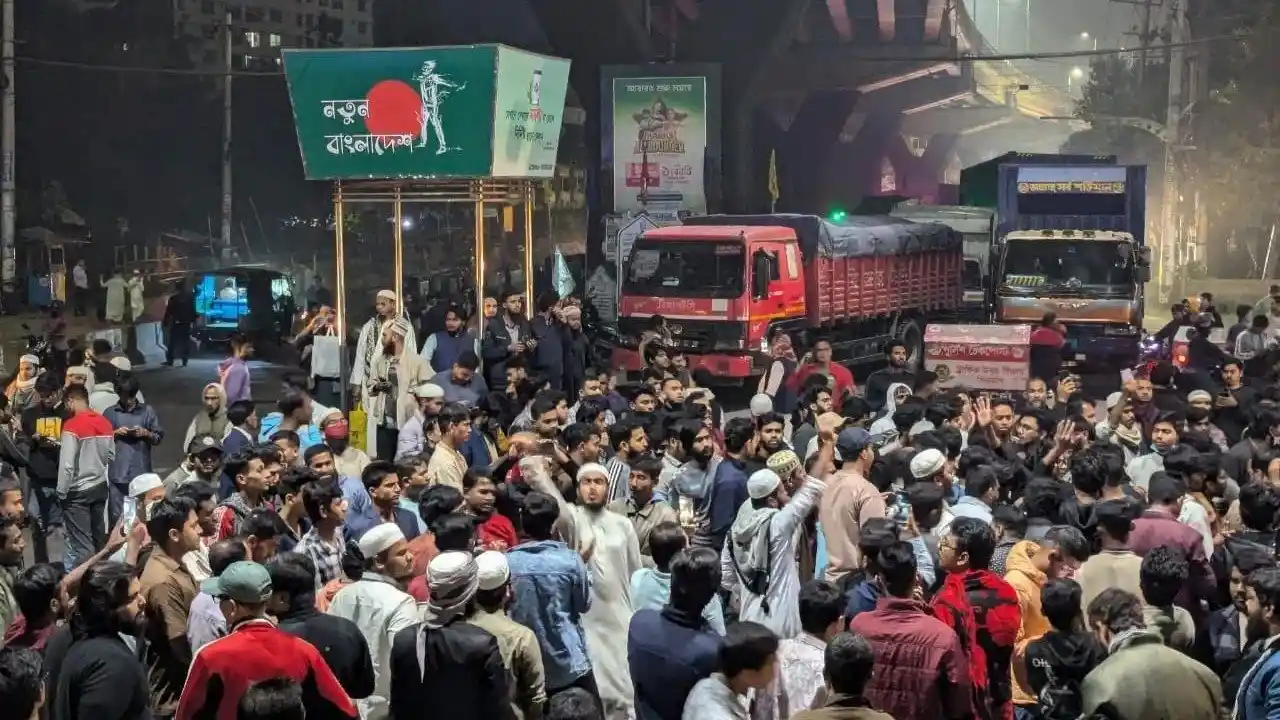
The US secret report on the Bangladesh Liberation War prophesied on 6th December 1971, just days before Pakistan surrendered to the Indian Army, that the propensity of extremism, radicalism, and violence would manifest itself in the future South Asian state of Bangladesh. Fifty years later, the anarchical situation in Bangladesh is turning that prophecy into reality. The rampant vandalism and hooliganism in the capital Dhaka and other cities, which occurred on 18th December night, is the burning proof of the neighbouring country fast sliding into anarchy, throwing the current interim regime’s competence as administrator down to the gauntlet.
The latest violence was triggered following the murder of youth leader Sharif Osman Hadi, who was attacked by masked assailants on 12th December. Hadi was the product of the 2024 unrest against the Sheikh Hasina government, which rose to prominence soon due to his radical and aggressive political rhetoric, especially for his diatribe against India. This extremist was a supporter of the ‘Greater Bangladesh’ scheme, a political daydream of the anti-India radical elements of the country of a ‘Bangladesh empire’ incorporating adjacent parts of India. More precisely speaking, Hadi was the representative of the radical elements who had a significant presence in the unrest of 2024, negating the claim that the agitation was a spontaneous event organized by the ‘students, workers, professionals, and intellectuals alike.’ Resultantly, the unfortunate nation is now slipping into the hands of the Islamist radicals.
It is a fact that the anti-India Islamist radicalism has been revitalized since the fall of the Hasina regime, and new ‘youth icons’ like Hadi are the products of this development. Thus, the death of Hadi promptly turns into anti-India rhetoric, with the Indian High Commission in the country being targeted. The regular and consistent anti-India stand of the current interim regime of Muhammad Yunus also establishes that fact that the constitution of this regime also had a conspiratorial angle to it. Since taking over charge, the regime, and especially its Chief Advisor Muhammad Yunus, never hid his proclivity to rankle India with his controversial comments. He alleged that India ‘never liked what the students have done,’ presumably referring to the 2024 unrest, implying that India is against his regime. Thus, Yunus’ regime is venting its anger with India by holding India responsible for its failure to rein in the Frankenstein. Hence, it urged India to arrest and hand over the attackers of Hadi, even as the Dhaka Metropolitan Police said there was no verified evidence that the shooters had crossed into India.

Unfortunately, the current interim regime of Bangladesh has been throwing a spanner in the otherwise good neighbourly relations that were prevalent between India and Bangladesh for the last two decades. It seems the regime is more committed to proving its credentials, especially in the eyes of the anti-India radical elements who played their part in engineering the downfall of the previous regime and its enthronement, as a true and viable alternative to the ousted government. And while doing so, the regime is pushing Bangladesh to the lap of the radical Islamists, as exemplified in the arson attacks on the media and the cultural institutions of the country following Hadi’s death.
Such a diabolical mission of the regime and its supporters casts its shadow over the South Asian region. The interim regime in Dhaka feels its anti-Hasina credibility must be displayed externally as well. Thus, it cahoots with the anti-India elements, both internal as well as external, while its chief advisor bats for stronger ties with Pakistan. Indeed, when it is the sovereign right of one country to formulate its foreign policy, the Yunus regime is inclined to exercise a pressure tactic against India and thus contemplates to join Pak-proposed anti-India axis in the region. However, what is more concerning is the appetite of the interim regime to play hand in glove with Islamabad to help the latter open another warfront against India in Bangladesh. Recent reports of Pakistan planning to facilitate the return of separatist ULFA chief Paresh Baruah to Dhaka from his current hideout in China are execrable when juxtaposed with provocative remarks of Bangladeshi leaders on northeast India with impunity and without dissuasion from the regime.
Bangladesh is rightly termed as a ‘strategic challenge’ for India since the 1971 war by the Parliamentary Committee on External Affairs, given its current foreign policy inclination vis-à-vis India. The reference to the 1971 war is significant, implying that the country is donning the role of East Pakistan as a security challenge to India. It is more so given its location adjacent to northeast India, which has traditionally been restive with separatist activities. Bangladesh had been a safe haven for the separatists for a long time, until it was wiped out by the Hasina government, which was trained and armed in their hideouts there by Pakistan’s ISI, sometimes in collaboration with China. The Parliamentary Committee report identifies the threat as deeper and long-term in the strategic context, with implications for regional stability and the neighbourhood policy of India. India, however, is prudently handling affairs with the interim regime, inviting it for the Colombo Security Conclave meeting this November, even after the Bangladesh court awarded a death sentence to former premier Sheikh Hasina, and the regime insists on her immediate extradition as another tool of pressure tactic.
Bangladesh falling in the wrong hands is most undesirable in the context of regional economic and connectivity development, including that of northeast India, both bilaterally and through BIMSTEC. The strategic location of the country between South and Southeast Asia holds enormous potential for regional connectivity and economic prosperity. The Bangladesh regime needs to understand this and resist any enticement to ‘bleed the neighbour with a thousand cuts’. Besides, nurturing the radical and Islamist elements like Osman Hadi and Jamat-Islami just to prove its credibility to them internally pushes the country, founded on secular cultural and linguistic nationalism rather than communal lines, to the cliff where the symbols of secular and plural culture like cultural institutions become targets. The coming election is vital in this context, which will decide the future identity of the South Asian nation and the prospects of the regional geopolitics.