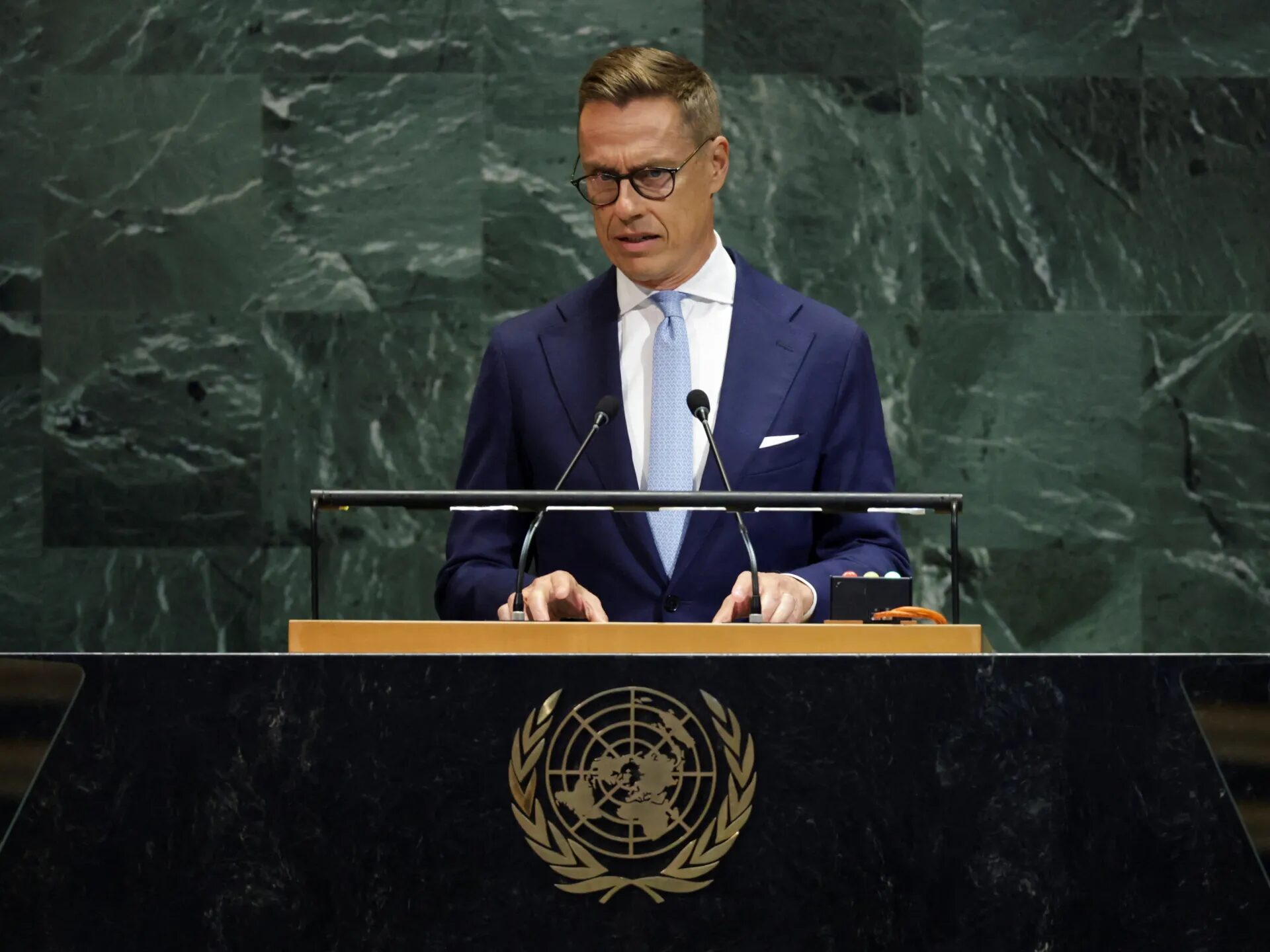
Alexander Stubb, Finland’s President, while addressing the United Nations General Assembly in September 2025, highlighted the importance of the principles of multilateralism, legitimacy, and rules-based international order. For India, his intervention sounded not only refreshing but also timely, as the European leader consistently argued that global governance structures still remain trapped in the realities of 1945. In this regard, he stated, “The composition of the UN still largely reflects the world of 1945”. While there are differences in approach and emphasis, his speech resonates strongly with India’s concerns, with multiple points of alignment that reinforce New Delhi’s worldview.
At its core, President Stubb’s speech argues that global politics must balance values, interests, and power. He expressed this with a simple proposition, “In its simplest form, foreign policy is based on three pillars: values, interests, and power”. This triad is no stranger to Indian diplomacy. For decades, New Delhi has had to navigate between its normative commitments, such as democracy, non-alignment, and sovereignty, and its interests in security and development, all while simultaneously acknowledging the power asymmetries of a world dominated by major powers. When Stubb underlined the idea that transactional foreign policies must be grounded in enduring values, he articulated a framework that India itself often employs, whether in climate negotiations, trade diplomacy, or its partnerships in the Indo-Pacific Region.
Moreover, Stubb’s call for reform of multilateral institutions in his speech directly echoed India’s long-standing demand for a seat at the global high table at the United Nations Security Council (UNSC). His critique that “the composition of the UN still largely reflects the world of 1945. As the world has changed drastically, so should the decision-making at the UN” resonates with India’s stance concerning the United Nations. For New Delhi, the UNSC’s exclusion of countries representing vast populations and sufficiently unrepresented areas of Asia, Africa, and Latin America is indefensible in the twenty-first century. Thus, Stubb’s suggestion of new permanent seats and limitations on veto power dovetails with India’s own reform agenda for the global organisation, seeking to democratise global governance and to ensure that legitimacy flows from representativeness, and not from the privileges of a bygone era.
Equally important was Stubb’s recognition of the rise of the Global South and the shift in power towards the South and the East. India has been consistently portraying itself as a voice of the Global South, emphasising issues of equity, development, and representation in global governance forums while seeking to bridge the gap between developed and developing nations. The Finnish President’s emphasis on the equal agency of small powers is particularly resonant in the Indian context. New Delhi has long argued that multipolarity cannot mean domination by a handful of powers, but it must allow diverse states to shape outcomes in ways that safeguard their autonomy and seek equitable development.
Furthermore, Stubb’s defence of sovereignty, territorial integrity, and prohibition of the use of force also resonates with India’s geopolitical dilemmas. India has consistently framed its diplomacy around these core principles of international law, whether in facing cross-border terrorism, in navigating border disputes, or in voicing concerns over unilateral interventions. Thus, India’s own security concerns are underscored by such reaffirmations of sovereignty in a world where territorial aggression, from Ukraine to West Asia, has destabilised regional orders.
Nevertheless, there are limits to such resonances. Much of the Finnish President’s speech was rooted in Europe’s strategic anxieties, especially in the context of Russia’s aggression against Ukraine. For India, while the principle of ‘aggression must not be rewarded’ stands valid, its diplomatic reality is far more complex. New Delhi’s practice of the principle of strategic autonomy underscores maintaining ties with Moscow even when it strengthens its partnerships with Washington and European powers. Therefore, from an Indian perspective, the universality of the principle should be acknowledged, but not at the expense of pragmatic balancing and securing its interests in an unpredictable world.
However, what India can embrace is the Finnish President’s lament over the erosion of multilateralism. He stated, “It seems to me that there is a growing tension between those who promote multilateralism – an order based on the rule of law – and those who speak the language of multipolarity or transactionalism”. Stubb’s insistence that the UN must be strengthened to mediate conflicts, to deliver humanitarian aid, and provide platforms for accountability aligns with India’s critique that global governance is failing the most vulnerable. For instance, the pandemic, climate change, and food security have shown that without credible and representative multilateral institutions, global public goods are left to the mercy of Great Power rivalry. India’s own activism in pushing for vaccine equity and climate justice is evidence of its commitment to bridging the gap.
To conclude, the Finnish President’s speech attempts to illustrate a rare convergence between Europe and India. This convergence signals a recognition that underlines that multipolarity without legitimacy is unstable and that legitimacy without reforms would look hollow. India can draw on Stubb’s arguments to amplify its own case for global governance reforms while underlining perspectives rooted in the lived realities of the Global South in terms of developmental inequality, climate vulnerability, and digital exclusion.
As new narratives about global order emerge from both the North and South, New Delhi must seize opportunities to build coalitions that cut across geographies. Finland’s intervention at the UNGA should not be looked at as an isolated European voice, but as a part of a growing recognition that the crisis of legitimacy of multilateralism threatens all. If India can translate such convergences into actionable coalitions, it can move closer to realising its long-standing ambition of not merely being a rule-maker, but a rule-shaper in a truly multipolar world. Finland and India may come from different geographies, but their perspectives on global governance, multipolarity, and legitimacy overlap significantly, highlighting the fact that concerns about reforms are now widely shared.