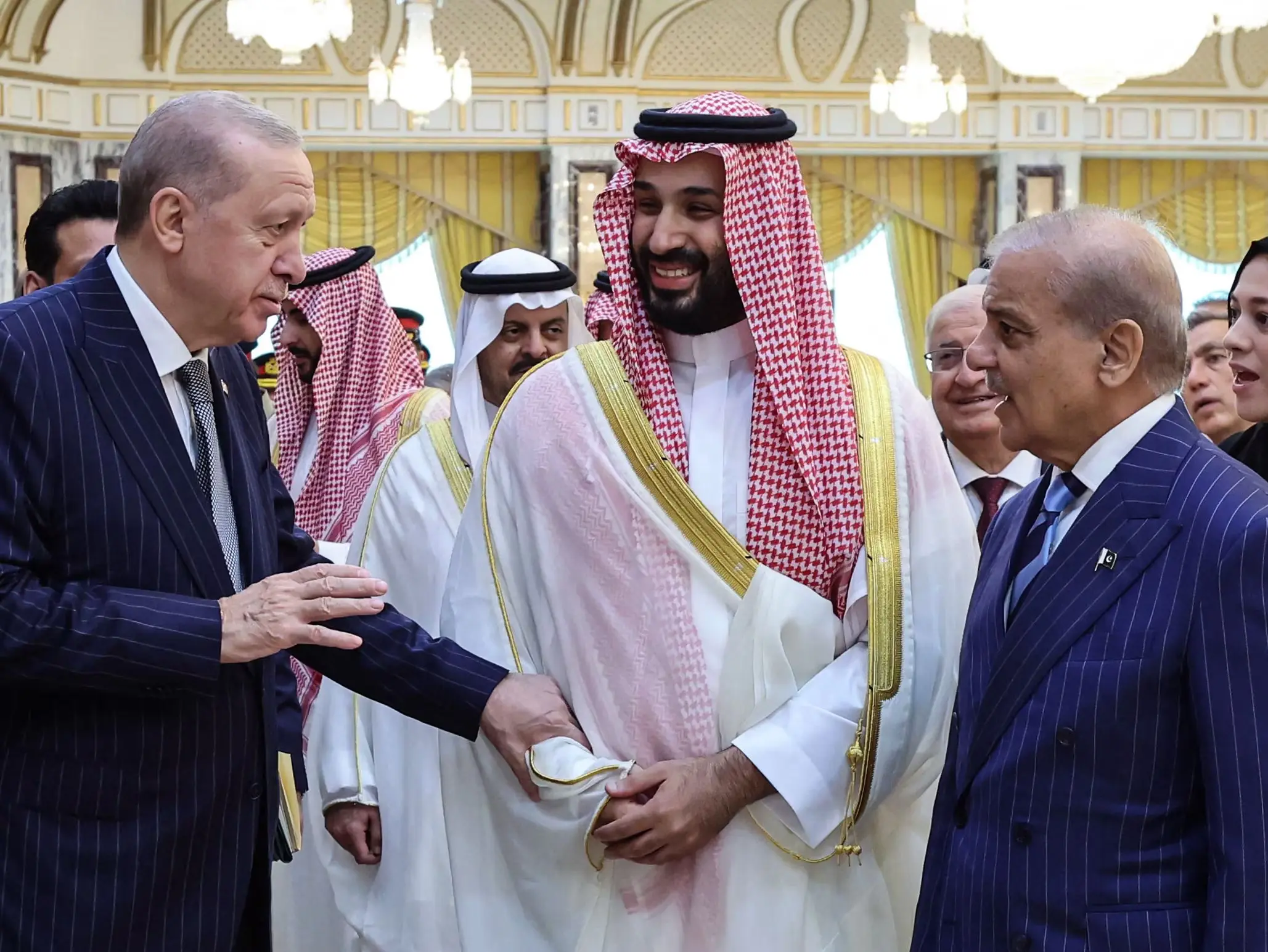
The signing of the Mecca Joint Defence Agreement by Saudi Arabia, Türkiye and Pakistan on 07 August 2026 marks an important development in the changing security architecture of West Asia. The agreement establishes the idea of collective defence. It also includes greater cooperation in deterrence, defence, counterterrorism and related areas. The three countries bring different capabilities to this arrangement. Saudi Arabia provides economic and financial heft, Türkiye possesses substantial conventional military capabilities and an increasingly sophisticated defence industry, while Pakistan contributes extensive military experience and, uniquely among the three, nuclear-weapons capability. In case of India, the significance of Mecca agreement cannot be said to have an immediate emergence however at the same time it cannot be dismissed as another symbolic grouping. New Delhi’s initial response to this agreement reflects that caution. The Ministry of External Affairs has said India is examining the agreement’s implications for national security and regional peace and stability, and will take necessary measures to safeguard its interests.
Mecca Agreement brings together three countries whose relationships with India are markedly different. Pakistan remains India’s major security challenge. Türkiye’s relationship with New Delhi has become more complicated because of Ankara’s political support for Pakistan on issues concerning India and its expanding defence relationship with Islamabad. Saudi Arabia, by contrast, has developed an increasingly substantive partnership with India including energy, investment, trade, political engagement and security cooperation. India and Saudi Arabia already possess an institutional defence relationship after signing of defence cooperation memorandum in 2014 which includes military training, arms and equipment, defence technology, exchanges of personnel and experts, and established a Joint Defence Committee. In this context, the significance of Mecca agreement lies partly in bringing these diverse bilateral relationships into a common security architecture. In terms of Indian strategic calculus, the critical issue is Pakistan’s position within that architecture. Pakistan has close military relations with Saudi Arabia, including training and security cooperation. Its relationship with Türkiye has also expanded substantially in terms of defence and military-industrial context. The Mecca Agreement gives these relationships a trilateral institutional framework. This new arrangement possibly embeds Pakistan more deeply within the security politics of West Asia.
An important concern involves defence-industrial cooperation. Türkiye has developed a significant indigenous defence-industrial ecosystem, especially in terms of unmanned systems or drones, missiles, naval platforms and electronic warfare. Pakistan possesses a large military establishment and an established defence-industrial relationship with Türkiye, while Saudi Arabia has the financial resources and a strong interest in expanding domestic defence manufacturing. This agreement, therefore, has an industrial dimension in addition to the agreement’s collective defence language. For India, the relevant question is not whether a unified Saudi-Turkish-Pakistani military-industrial complex will develop. The more immediate issue is whether trilateral cooperation can accelerate technology transfers, joint production, training, interoperability and procurement among the three militaries. These are measurable areas that India will need to follow closely as the agreement develops.
Another important aspect is that Pakistan is the only nuclear-armed member of this agreement. This inevitably gives the agreement a nuclear dimension, but analytical caution is necessary. However, there are no known provisions of the Mecca Agreement that establish that Pakistan has extended a formal nuclear guarantee to Saudi Arabia or Türkiye. Earlier debate surrounding the 2025 Saudi-Pakistani Strategic Mutual Defence Agreement similarly generated discussion of a possible Pakistani nuclear umbrella, even though the available text did not explicitly mention nuclear weapons. It is therefore necessary for India to distinguish between nuclear capability and an established nuclear commitment. Pakistan’s possession of nuclear weapons affects perceptions of deterrence surrounding any alliance in which it participates, but that is different from demonstrating that Pakistani nuclear forces have been incorporated into a trilateral deterrence doctrine. So, conclusions about extended nuclear deterrence would remain premature.
Another implication concerns India’s relationship with Saudi Arabia. New Delhi has invested considerable diplomatic capital in developing Riyadh as an independent strategic partner rather than viewing Saudi Arabia through the traditional India-Pakistan prism. Saudi participation in the Mecca Agreement does not erase the structural foundations of India-Saudi relations. At the same time, Kingdom’s contemporary foreign policy is characterised by diversified relationships rather than exclusive alignments. Riyadh maintains important relations with the United States while expanding engagement with China, India and other Asian powers. Participation in the Mecca Agreement can be understood within Kingdom’s quest for regional security autonomy, especially amid uncertainty surrounding traditional external security guarantees. This means India faces a diplomatic challenge of compartmentalisation. New Delhi will have to protect its security interests concerning Pakistan while dealing with Saudi Arabia after the signing of the Mecca agreement. Treating Riyadh simply as an extension of Pakistan’s strategic position would ignore the depth of Saudi interests and India’s own bilateral relationship with the Kingdom.
Türkiye presents a different challenge for India. Ankara and New Delhi have significant economic interaction, but strategic differences have become more visible in the past few years. Türkiye’s defence cooperation with Pakistan and its political positioning related to India have already created friction. So, Pakistan’s participation in a formal trilateral defence framework along with Türkiye gives greater strategic relevance to an existing trend rather than creating an entirely new one. India will consequently have to assess Turkish-Pakistani defence cooperation within the evolving regional environment after this pact rather than purely as a bilateral relationship.
The agreement reflects the continuing regionalisation of security in West Asia. Saudi Arabia, Türkiye and Pakistan possess longstanding relationships with Western security providers but the creation of this kind collective defence framework indicates an interest in developing security hedging mechanisms. The Mecca agreement, therefore, forms part of a wider debate over how regional states are responding to uncertainty in the West Asian security order.
For India, this matters because West Asia is no longer simply a region for India to supply energy or diaspora diplomacy. It has become integrated into New Delhi’s strategic calculus through energy security, investment, maritime security, connectivity, defence cooperation and projects like IMEC. A significant transformation of West Asian security architecture can have direct implications for Indian interests. The most important implication for India is therefore not an immediate military threat but the emergence of a new strategic variable connecting South Asian and West Asian security dynamics. Pakistan now participates in a trilateral defence arrangement with two influential regional powers, wherein Saudi Arabia is an important Indian partner and Türkiye has close defence relations with Islamabad. So, New Delhi, official stance to study the agreement rather than immediately characterise it as hostile is appropriate.
One important aspect is that strategic significance of the Mecca Agreement will ultimately depend on its institutionalisation. Whether collective defence remains primarily declaratory or develops into joint planning, exercises, intelligence coordination, defence-industrial integration and interoperable military capabilities remains to be seen in future. For India, the central challenge is of strategic differentiation i.e., Pakistan, Türkiye and Saudi Arabia cannot be treated as a single geopolitical entity merely because they have signed a common defence agreement. Yet India can no longer analyse its relationships with these countries entirely in separate compartments either. The Mecca Agreement creates an institutional bridge between Pakistan’s South Asian security role and the evolving strategic order of West Asia. That bridge and not assumptions about an imminent new military bloc is what makes the agreement significant for India.
The views expressed are those of the author and do not represent the institution.