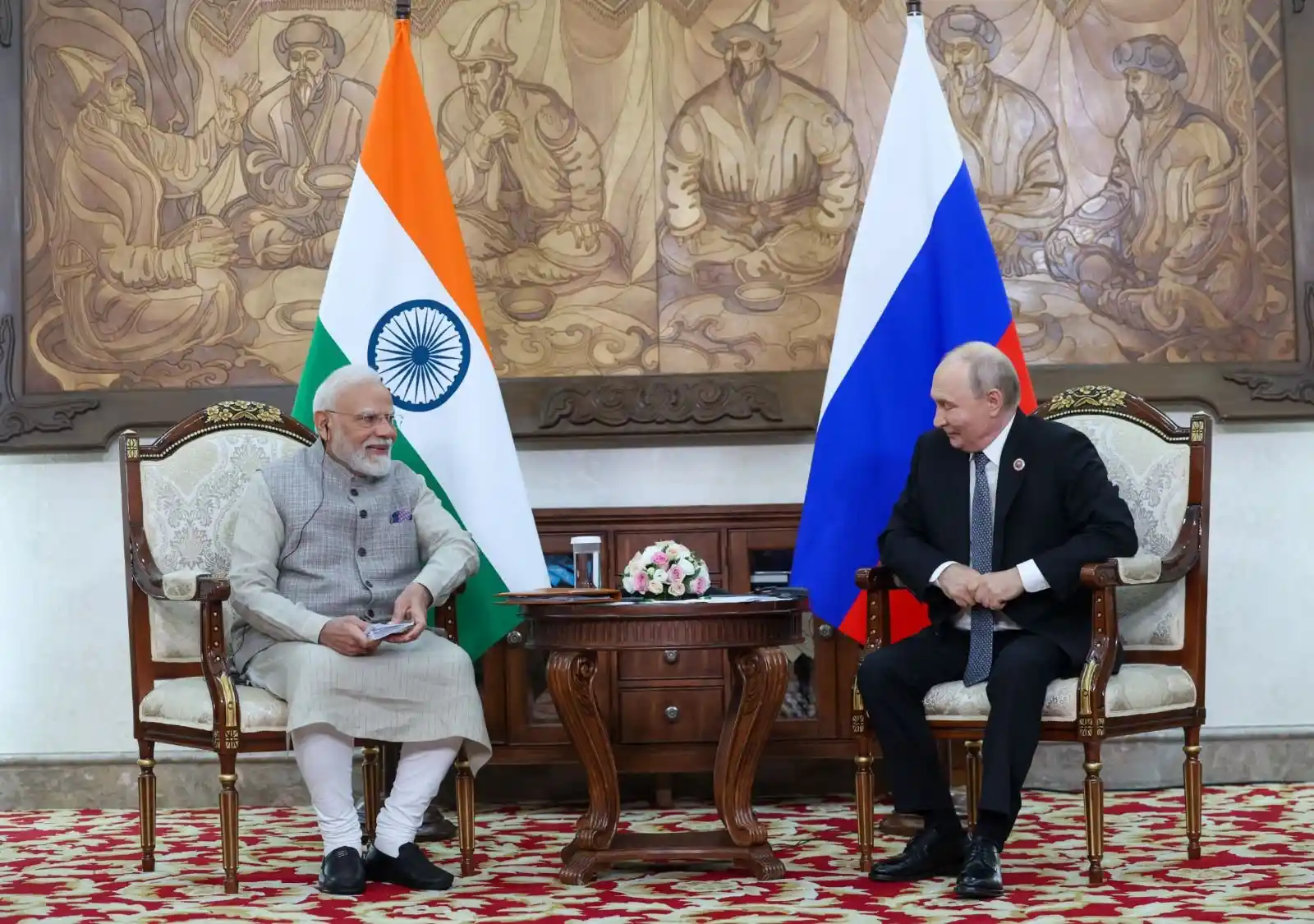
Prime Minister Narendra Modi’s meeting with Russian President Vladimir Putin on the sidelines of the Shanghai Cooperation Organisation summit in Bishkek carried significance well beyond the optics of another India-Russia bilateral. Together with Modi’s visits to Uzbekistan and Kyrgyzstan, it represented a carefully structured Eurasian diplomatic engagement: one that sought to reinforce India’s strategic autonomy, expand its presence in Central Asia, secure economic and energy interests, and retain meaningful dialogue with Russia amid a deeply polarised international environment.
The central message was clear. India does not see its engagement with Russia as incompatible with its partnerships with the United States, Europe, Japan or other Indo-Pacific partners. Nor does it believe that Central Asia should remain peripheral to Indian strategic thinking. The Tashkent-Bishkek visit demonstrated New Delhi’s intention to treat Eurasia as an important arena of trade, connectivity, energy security, counterterrorism and geopolitical competition.
At the same time, the visit revealed the persistent gap between India’s strategic ambitions and the logistical constraints confronting its continental outreach. The political intent is evident; the practical test will be whether India can turn high-level diplomacy into functioning trade routes, diversified commercial ties, defence-industrial cooperation and sustained regional presence.
The Bishkek Meeting: Continuity With Purpose
The Modi-Putin meeting came at a time when the international system is marked by overlapping crises: the unresolved Russia-Ukraine war, intensifying strategic competition between the United States and China, instability across West Asia, pressures on global energy markets, and renewed contestation over trade routes and technology supply chains.
Against this setting, Modi’s exchange with Putin was important for two reasons. First, it reaffirmed that the India-Russia relationship retains strategic relevance. Second, it showed that New Delhi is prepared to engage Moscow while continuing to articulate a position in favour of peace in Ukraine.
Modi stated that India supports all peaceful efforts to resolve the Russia-Ukraine conflict and argued that the world must move “from endless war towards an end to the war.” The formulation was notable for its balance. India did not dilute its long-standing emphasis on dialogue and diplomacy, yet it did not abandon engagement with Russia in favour of public confrontation.
This has been the defining feature of India’s Ukraine policy. New Delhi has resisted being drawn into a binary framework that requires countries to choose between endorsing Russia or subscribing to a Western political vocabulary. Instead, India has stressed respect for the United Nations Charter, the importance of sovereignty and territorial integrity, humanitarian consequences of war, and the necessity of negotiated settlement.
Critics frequently characterise this approach as ambiguity. That assessment is incomplete. India’s position is better understood as a conscious attempt to preserve diplomatic access and strategic flexibility. A country that seeks to influence outcomes, rather than merely register disapproval, must retain channels of communication with all principal actors.
India’s ability to speak to Moscow while maintaining close relationships with Washington, European capitals, Kyiv and the wider Global South gives it a diplomatic position few major powers can replicate. That does not mean India can single-handedly mediate the war. It does mean that India remains relevant to any larger conversation about a politically sustainable peace.
For Russia, Modi’s engagement was evidence that Moscow is not entirely isolated outside the Western world. For India, it was an assertion that national interests—not alliance discipline—will determine its diplomacy.
India-Russia Relations: From Legacy to Adaptation
India-Russia ties retain considerable strategic depth, but they are no longer sustained merely by Cold War-era sentiment or the historical legacy of Soviet support. The relationship must now be judged by its ability to respond to contemporary Indian interests: energy security, defence preparedness, technology access, trade diversification and Eurasian connectivity.
Energy: The immediate strategic dividend
Energy cooperation remains the most visible economic pillar of the partnership. Russian crude has become a major source of supply for India since 2022, enabling New Delhi to diversify procurement at a time of global market uncertainty. For a country that remains heavily dependent on imported energy, the ability to access multiple suppliers is not a geopolitical luxury; it is an economic necessity.
India’s Russia engagement also extends beyond oil. It includes fertilisers, coal, liquefied natural gas, nuclear cooperation, potential investment in upstream energy assets, and commercial opportunities in the Russian Far East and Arctic. India-Russia discussions have previously covered cooperation in areas ranging from food safety and healthcare to maritime links, mobility and trade facilitation.[editorji]
The larger significance is that India’s energy strategy must remain diversified. Excessive dependence on any one producer, region or transport route leaves the country exposed to price shocks, sanctions, conflict and supply disruptions. Russian energy may fluctuate in commercial attractiveness over time, but it will remain strategically relevant so long as it contributes to India’s energy security and bargaining power in global markets.
Defence: Retain capability, reduce dependence
Defence cooperation remains the most sensitive and durable component of India-Russia relations. A substantial share of India’s legacy military inventory remains of Soviet or Russian origin. This includes combat aircraft, armoured platforms, air-defence systems, naval equipment, missiles and other systems whose operational viability depends on maintenance, repairs, upgrades, spares and ammunition.
India cannot abruptly sever this dependence without creating avoidable vulnerabilities in military readiness. But neither can it allow old dependencies to constrain its future choices.
The appropriate policy is adaptation. India should preserve essential defence ties with Russia while shifting the relationship towards co-production, technology transfer, domestic maintenance facilities, licensed manufacture and localised supply chains. The emphasis must move from buyer-seller transactions to resilient defence-industrial collaboration.
This is especially important because Russia’s own defence-industrial capacity is under pressure from the Ukraine war, while sanctions and payment restrictions have complicated military commerce. India’s growing procurement from France, the United States, Israel and domestic manufacturers reflects an overdue diversification. Yet diversification should complement—not automatically replace—those Russian capabilities that remain necessary to India’s armed forces.
The strategic objective should be straightforward: maintain operational continuity today while reducing external dependency tomorrow.
Trade: Correcting an unsustainable imbalance
The expansion of India-Russia trade in recent years has been driven heavily by Indian imports, particularly energy. That growth is welcome, but it has also created a pronounced imbalance. A relationship dominated by one-way oil purchases cannot become a fully mature economic partnership.
India must therefore seek to expand exports of pharmaceuticals, agricultural products, processed food, chemicals, engineering goods, textiles, machinery, information-technology services and medical equipment. Russian demand, especially where Western suppliers have withdrawn or reduced engagement, can create openings for Indian businesses. But opportunities will remain limited unless the two sides resolve persistent operational barriers.
The most immediate challenges are payment settlement, banking access, shipping insurance, currency arrangements, customs procedures and transport logistics. Trade targets acquire strategic meaning only when firms can receive payments, move goods predictably and obtain insurance at viable cost.
The next phase of India-Russia economic engagement must be less about announcing ambitious numbers and more about building the architecture that makes commerce routine.
Uzbekistan: India’s Strongest Central Asian Opening
The Uzbekistan leg of Modi’s visit may prove more consequential in the long run than the headlines generated by the Putin meeting. India and Uzbekistan elevated their relationship to a Comprehensive Strategic Partnership and announced an ambition to increase bilateral trade to $5 billion.
This was a meaningful upgrade. Uzbekistan is Central Asia’s most populous state, its geographic heartland and an increasingly influential regional actor. Its economic reforms, growing external engagement and interest in diversifying partnerships make it a particularly important country for India’s regional strategy.
Under President Shavkat Mirziyoyev, Uzbekistan has sought to expand regional cooperation, encourage investment, modernise economic institutions and avoid overdependence on any single external power. India fits naturally into this diversification strategy. Unlike China, it does not bring overwhelming economic asymmetry; unlike Russia, it does not carry the political complications of a former imperial relationship; and unlike Western partners, it is not generally perceived as attaching political conditionality to engagement.
For India, Uzbekistan offers a strategic entry point into Central Asia on terms that can be mutually beneficial.
The agenda reportedly covered trade and investment, digital cooperation, defence, education, energy and connectivity. The effort to connect India’s Viksit Bharat 2047 vision with Uzbekistan’s Uzbekistan-2030 development agenda suggested an attempt to place the partnership on a long-term, development-centred footing.[thehindu]
This is important because India’s engagement with Central Asia has often been rich in historical and cultural symbolism but limited in commercial scale. Shared civilisational linkages—through trade routes, Persianate culture, Sufi traditions and historical mobility—can create goodwill. But they do not by themselves produce supply chains, investment, mineral access or transport infrastructure.
The Tashkent visit pointed towards a more substantive model.
Critical minerals and uranium
Two sectors deserve special attention: uranium and critical minerals. India welcomed progress in a long-term arrangement for uranium supply from Uzbekistan and also highlighted cooperation in critical minerals.
For India, uranium matters because its civil nuclear energy programme is likely to play an increasingly important role in the country’s long-term clean-energy transition. A reliable and diversified supply of uranium is therefore strategically valuable.
Critical minerals are equally important. Technologies central to modern economic and military power—electric vehicles, batteries, renewable-energy infrastructure, semiconductors, precision electronics and advanced defence systems—depend on access to minerals such as lithium, cobalt, rare earths and other strategic resources. The contest over these supply chains is becoming a defining feature of twenty-first-century geopolitics.
If India can develop credible partnerships with Uzbekistan and other Central Asian states in this area, it would strengthen both its industrial strategy and supply-chain resilience.
The trade target: ambition versus execution
The $5 billion trade target is politically useful, but the harder question is how it will be achieved. India and Uzbekistan do not share a border, direct overland trade is constrained by regional geography, and air and rail links remain limited.
The gap between ambition and execution can be narrowed only through a focused programme: direct freight connectivity, trade facilitation, banking channels, warehousing, sector-specific business forums, pharmaceutical approvals, digital commerce and regular ministerial review. India should also use its private sector more effectively. Diplomatic agreements are necessary, but companies must see viable commercial returns.
Tashkent offers promise. Delivering on that promise will require logistical imagination and institutional discipline.
Kyrgyzstan and the SCO: A Platform, Not a Bloc
Kyrgyzstan’s importance during the visit derived from its role as host of the SCO summit as well as its location within the wider Central Asian security environment. Bishkek is situated in a region shaped by Chinese economic reach, Russian security influence, Afghanistan-related anxieties, cross-border extremism, fragile transport networks and complex domestic political currents.
The SCO remains useful to India, but it should not be romanticised. India became a full member in 2017; Iran joined in 2023 and Belarus in 2024. The organisation now includes India, China, Russia, Pakistan, Iran, Belarus and the Central Asian states, giving it impressive geographic reach but also substantial internal divergence.[editorji]
The SCO is not an alliance. It is not a coherent anti-Western bloc. Nor is it a mechanism through which India can easily shape regional outcomes. Its member states differ sharply on China, terrorism, Afghanistan, connectivity, sanctions, Pakistan and the desired balance of power in Eurasia.
Its value for India lies elsewhere: access, dialogue and diplomatic presence.
For New Delhi, the SCO provides an institutional venue to engage Central Asian states collectively; maintain channels with Russia and China; press its concerns on terrorism and extremism; and participate in deliberations on Afghanistan and regional economic connectivity. It also ensures that India is not absent from a forum where important Eurasian conversations are taking place.
But India must remain alert to proposals that compromise its principles, particularly on connectivity. New Delhi has consistently argued that connectivity must respect sovereignty and territorial integrity, be transparent, financially viable and based on consultation. This position remains especially relevant given India’s objections to projects passing through Pakistan-occupied Kashmir.
The SCO can serve India’s interests if it is used as a pragmatic forum. It would be counterproductive if India were to view it as a substitute for bilateral diplomacy, Indo-Pacific engagement or its partnerships with Western and regional powers.
The Wider Eurasian Strategy
The Modi-Putin meeting and the Uzbekistan-Kyrgyzstan visits should be seen as elements of a larger Indian effort to build strategic depth across Eurasia. For too long, Central Asia has occupied a paradoxical place in Indian foreign policy: culturally familiar, strategically important, but physically difficult to access and economically under-engaged.
That is changing. India’s interest in the region is now shaped by four strategic imperatives.
• Connectivity: India needs alternatives to routes constrained by Pakistan or vulnerable to maritime disruption. The International North-South Transport Corridor, Chabahar port, Caspian linkages and prospective eastern maritime routes all deserve sustained investment.
• Energy and minerals: Central Asia can contribute to India’s energy security, nuclear fuel requirements and critical-mineral diversification.
• Security: Afghanistan’s future, terrorism, radicalisation, narcotics flows and the stability of continental Asia directly affect Indian security interests.
• Geopolitical balance: A deeper Central Asian role allows India to avoid being strategically confined to South Asia and the Indian Ocean alone.
Russia remains relevant to this agenda, particularly as an energy supplier, defence partner and Eurasian actor. But New Delhi should avoid allowing its Central Asian policy to become dependent on Moscow’s preferences or capacity. Russia’s influence remains substantial, yet it is being reshaped by the war in Ukraine, sanctions pressure and China’s rising regional economic weight.
India’s most effective strategy will be a diversified one: deepen bilateral partnerships with Uzbekistan, Kazakhstan, Kyrgyzstan, Tajikistan and Turkmenistan; strengthen links through Iran and the International North-South Transport Corridor; sustain SCO engagement; and work with Russia where interests converge.
The Verdict
The Modi-Putin meeting in Bishkek reaffirmed the enduring importance of the India-Russia relationship, but its principal value lay in the message it sent about Indian foreign policy. New Delhi will maintain engagement with Moscow, protect its energy and defence interests, advocate peace in Ukraine and refuse to become captive to the geopolitical priorities of any external power.
Modi’s statement that the world must move from “endless war” to an “end to the war” captured India’s preferred diplomatic posture: principled without being performative, engaged without being aligned, and realistic about the limits of external influence.[editorji +1]
The Uzbekistan visit, meanwhile, offered the more forward-looking component of the tour. The elevation of ties to a Comprehensive Strategic Partnership, the $5 billion trade ambition, and cooperation on uranium and critical minerals placed India’s Central Asian policy on a more substantive footing.
Kyrgyzstan and the SCO gave the tour its regional setting. They highlighted both the opportunities and limitations of Eurasian multilateralism. India can use the SCO to maintain presence and dialogue, but it must continue to rely on bilateral partnerships, connectivity initiatives and economic statecraft to make its regional role meaningful.
The broader conclusion is that India’s diplomacy is increasingly being conducted across multiple strategic theatres at once. The Indo-Pacific will remain central to India’s maritime and security outlook. Relations with the United States, Europe, Japan and other partners will remain essential for technology, investment and balancing China. Yet Eurasia and Central Asia are becoming more important to India’s energy security, continental access and geopolitical flexibility.
The Bishkek meeting did not transform the regional order. Nor did it resolve the structural constraints facing India’s engagement with Russia and Central Asia. But it demonstrated an important strategic truth: in a fragmented world, India’s strength will lie in expanding options rather than narrowing them.