
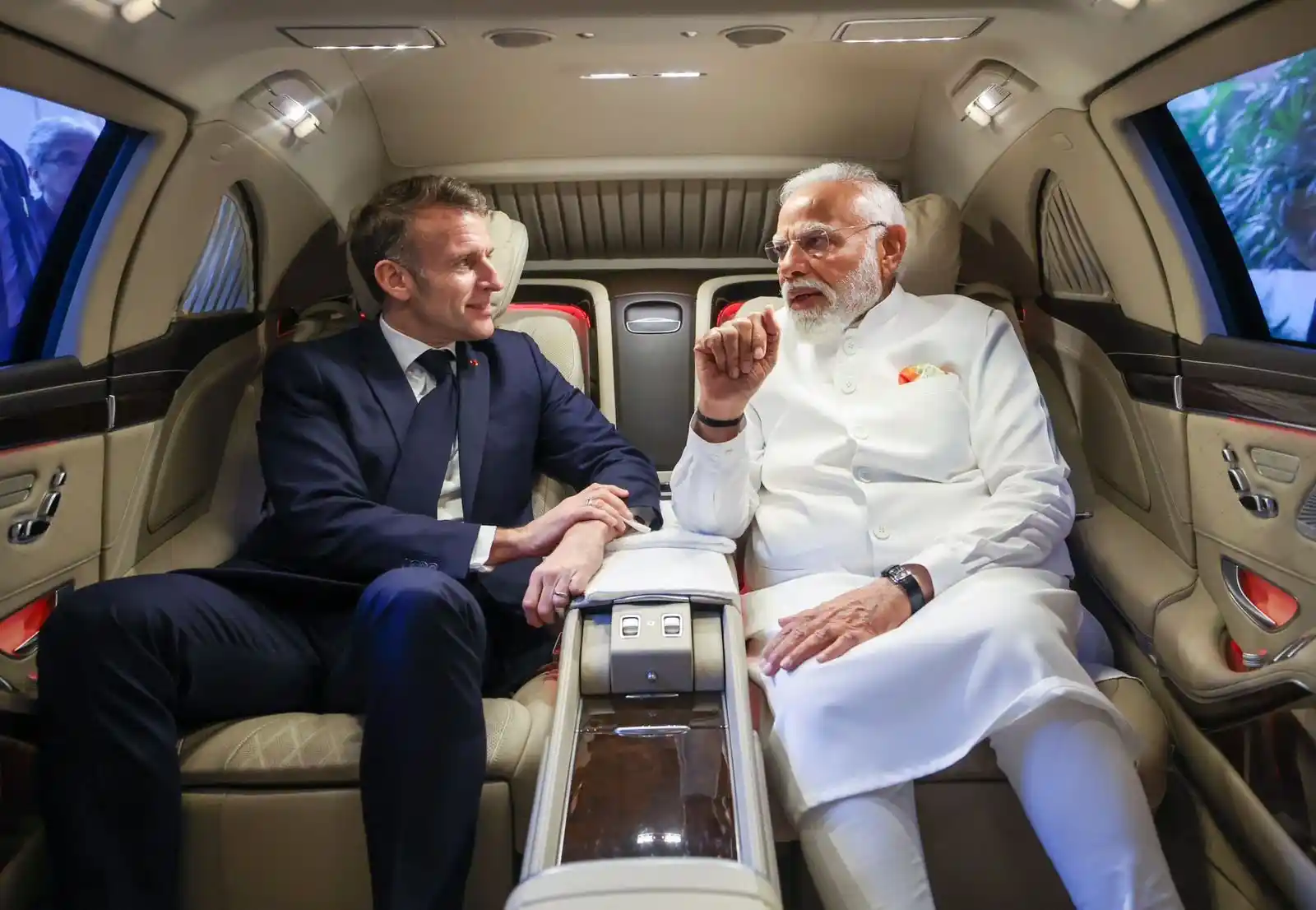
With French President Emmanuel Macron’s visit to India, both countries announced an elevation of their ties to a “Special Global Strategic Partnership”, signalling that Paris is moving into the very top tier of India’s foreign policy relationships, with cooperation structured not just around bilateral trade or defence deals, but around long‑term, global coordination on technology, security and economic resilience.
India and France have decided to elevate their strategic partnership to the level of a Special Global Strategic Partnership.
— Emmanuel Macron (@EmmanuelMacron) February 17, 2026
In diplomacy, that means a great deal.
What this new label actually means
“Special Global Strategic Partnership” is not a standard diplomatic category; it is a political signal that the existing “strategic partnership” (in place since 1998) is being deepened and globalised.
In practice, it means three things:
- India and France see each other as long‑horizon partners in a multipolar world, not just transactional buyers and sellers of arms.
- Their cooperation is explicitly framed as a “force for global stability” amid wars, great‑power rivalry and economic fragmentation.
- The relationship is being institutionalised through new dialogues (for example, an annual foreign ministers’ review linked to the Horizon 2047 roadmap) so that it survives leadership changes and electoral cycles.
For India, this places France in a small group that already includes the United States and Russia at the level of “special” or “privileged” strategic partners, but with the distinctive advantage that France also anchors India’s broader relationship with the European Union.
Why the 21 agreements matter
The 21 agreements and documents signed during President Emmanuel Macron’s visit are the operational backbone of this upgraded partnership, turning rhetoric into specific sectoral projects.
They span defence production, critical minerals, high technology and AI, energy transition and health, reflecting a deliberate attempt to de‑risk India’s dependence on a few suppliers and to plug into French and European value chains.
Key strands include:
- A defence cooperation pact and a joint venture between Bharat Electronics Ltd (BEL) and Safran to produce HAMMER air‑to‑ground missiles in India, taking Make in India in defence a step beyond licensed assembly into more sophisticated manufacturing.
- An agreement for reciprocal deployment of officers in each other’s land forces establishments, which deepens interoperability and shared doctrine.
- Frameworks on critical minerals, aimed at jointly exploring and processing resources like lithium and rare earths at a time when India is seeking alternatives to Chinese‑dominated supply chains.
- New understandings on renewable energy, nuclear collaboration and advanced technologies, building on earlier civil nuclear and clean‑energy partnerships.
This package is less about one “big bang” deal and more about knitting together multiple domains into a coherent, long‑term economic and security ecosystem.
Sectoral impact: defence, minerals, tech, energy, health
In defence, France is already one of India’s most important suppliers, from Mirage and Rafale aircraft to Scorpène submarines; co‑producing systems like the HAMMER and inaugurating an Airbus H125 helicopter assembly line in Karnataka shifts this towards joint manufacturing and exports from India.
That industrial footprint gives India more leverage, technology absorption and jobs, while giving France a politically trusted production base in Asia at a time when some Western partners still hesitate on high‑end transfers to India.
On critical minerals, partnering with France aligns with New Delhi’s wider push to secure inputs for batteries, electronics and renewables through diversified deals with countries such as Brazil and Canada.
France’s mining, processing and regulatory expertise helps India move up the value chain instead of remaining a raw‑material taker in a decarbonising global economy.
In high technology, the launch of the “India‑France Year of Innovation 2026” is meant to broaden the relationship beyond state‑to‑state projects into start‑ups, researchers and private firms in areas like AI, space, quantum and clean tech.
That “people‑centric” innovation focus, stressed by Prime Minister Narendra Modi, is designed to create networks of co‑development that endure beyond any single government contract.
On energy and climate, France has been central to India’s International Solar Alliance and civil nuclear cooperation, and the new commitments on renewables and advanced reactors extend that partnership into the next phase of the energy transition.
Health cooperation, while less headline‑grabbing, matters for pharmaceutical supply chains, vaccines and joint research, which proved crucial during the pandemic and will remain relevant as both countries diversify medical sourcing.
The geopolitical signal
The timing and language of the upgrade are aimed at a world marked by wars in Europe and West Asia, sharpening US‑China rivalry and debates on economic security.
Both Modi and Macron framed the partnership as a response to “uncertainty” and to any form of “hegemony,” underlining a shared preference for a multipolar order where middle powers coordinate more closely.
For India, a stronger French anchor in Europe balances its ties with the US and Russia and gives it greater room for manoeuvre on issues ranging from defence procurement to digital regulation.
For France, India is a gateway to the Indo‑Pacific and the broader Global South, where Paris wants to show it can work with non‑aligned partners rather than simply aligning behind Washington.
What to watch next
Three follow‑through tests will show whether this “Special Global Strategic Partnership” is more than a label:
- Whether defence co‑production moves quickly from announcements to scale production and exports from India.
- Whether critical minerals and energy agreements translate into actual projects that reduce India’s dependence on a narrow set of suppliers.
- Whether the Year of Innovation and new institutional dialogues produce durable tech and research linkages rather than one‑off events.
If these pieces come together, India‑France ties will increasingly resemble a comprehensive, long‑term alignment that shapes not just bilateral trade but the wider rules and coalitions of the emerging world order.

