
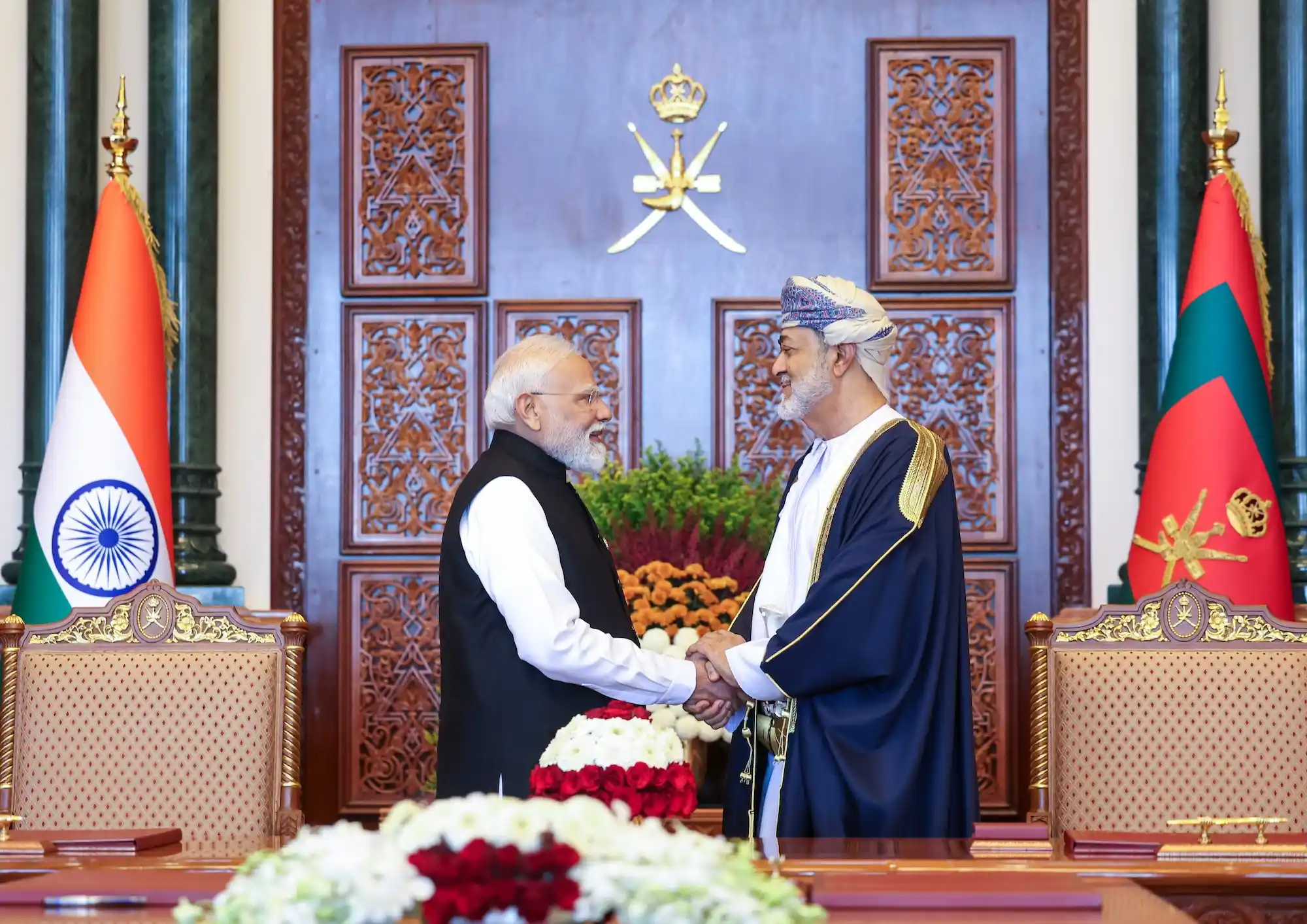
Indian Prime Minister Narendra Modi’s visit to Oman in December 2025 has turned a traditionally steady Gulf partnership into a more ambitious, trade‑ and security‑focused relationship, crowned by the signing of the India–Oman Comprehensive Economic Partnership Agreement (CEPA). The trip also fits into New Delhi’s broader push to secure energy, diversify supply chains and deepen strategic footholds across West Asia and the western Indian Ocean.
Why this visit matters
- The visit came as the final leg of PM Modi’s three‑nation tour to Jordan, Ethiopia and Oman, timed with the 70th year of diplomatic ties between New Delhi and Muscat.
- For Oman, partnering more closely with India helps diversify beyond oil and gas and anchor itself to a large, fast‑growing Asian market.
- For India, Oman is a crucial Gulf partner for energy supplies, fertilisers and maritime access astride key sea lanes from the Strait of Hormuz down to the Arabian Sea.
The bestowal of The First Class of the Order of Oman award is an acknowledgement of Prime Minister Modi’s steadfast commitment towards strengthening the 🇮🇳-🇴🇲 partnership.
— Dr. S. Jaishankar (@DrSJaishankar) December 18, 2025
It is also an honour for all Indians worldwide and a recognition of the close people-to-people bonds that… pic.twitter.com/ndFVWbGaji
Key outcomes of the Muscat talks
According to the joint statement, both sides reviewed the entire spectrum of ties, from energy and trade to defence and maritime security.
- Defence and security: The two countries agreed to deepen joint exercises, training, high‑level defence exchanges and information‑sharing to counter piracy and other maritime crimes, with an emphasis on enhancing maritime domain awareness.
- Energy and renewables: New Delhi and Muscat signalled intent to move from a buyer–seller equation to joint investments and collaboration in exploration and production, as well as green hydrogen and green ammonia projects aligned with sustainable energy goals.
- Wider agenda: The visit also involved discussions on technology, agriculture, culture and people‑to‑people exchanges, including planned outreach to the sizeable Indian diaspora in Oman.
The India–Oman CEPA trade deal
The centrepiece of the visit was the signing of the India–Oman CEPA, a free trade agreement that both sides had negotiated since 2023 and politically cleared by India’s Cabinet just before the trip.
Under the leadership of Prime Minister @NarendraModi ji and His Majesty Sultan Haitham bin Tarik, India and Oman have inked the India-Oman Comprehensive Economic Partnership Agreement (CEPA), marking a significant milestone in India's strategic engagement with the Gulf region.… pic.twitter.com/VI2RzSpO2O
— Piyush Goyal (@PiyushGoyal) December 18, 2025
- Formal signing: The pact was inked in Muscat in the presence of PM Modi and Sultan Haitham bin Tarik, with India’s Commerce and Industry Minister Piyush Goyal and Oman’s Commerce, Industry and Investment Promotion Minister Qais bin Mohammed Al Yousef as signatories.
- Tariff cuts: CEPA provides immediate or phased tariff elimination on about 98 per cent of tariff lines in Oman, covering over 99 per cent of India’s current exports by value, a huge concession for labour‑intensive sectors.
- Beneficiary sectors: Indian exporters in textiles, leather, footwear, gems and jewellery, engineering goods, plastics, furniture, agriculture, pharmaceuticals, medical devices and automobiles are expected to gain from near‑zero duties and better market access.
Strategic features and safeguards in CEPA
New Delhi has pitched this agreement as “ambitious but balanced”, mixing aggressive market access with clear protections.
- Rules of origin: The deal includes strict rules of origin to prevent third‑country products, particularly from China, from being rerouted through Oman merely to exploit duty concessions into the Indian market.
- Services opening: Oman has offered wide commitments across 127 services sub‑sectors, including computer services, professional and business services, audio‑visual, R&D, education and health, creating room for skilled Indian professionals.
- Investment and FDI: The agreement enables 100 per cent foreign direct investment by Indian companies in major services sectors in Oman, encouraging Indian firms to use Oman as a base into the Gulf and wider region.
- Regulatory cooperation: Provisions on faster pharma approvals, mutual recognition of halal and organic certifications and standards cooperation aim to lower non‑tariff barriers that often quietly choke trade.
Bigger picture: Beyond oil to a Gulf gateway
The signing of historic Comprehensive Economic Partnership Agreement (CEPA) between India and Oman marks a significant milestone in the bilateral economic relations between the two countries, and showcases India’s growing economic stature as the world’s fourth largest economy… pic.twitter.com/uTfEPxRktR
— Hardeep Singh Puri (@HardeepSPuri) December 18, 2025
The Muscat stop is part of a deliberate recalibration of India’s West Asia and Africa outreach, where trade deals sit alongside security and connectivity.
- Gulf positioning: With bilateral trade around the ten‑billion‑dollar mark and dominated by petroleum gases and fertilisers, CEPA is meant to broaden commerce into manufactured goods and services, reducing over‑reliance on hydrocarbons.
- Regional play: Oman’s location near the Strait of Hormuz and facilities like Duqm port dovetail with India’s interest in secure sea lanes, logistics access and a stronger presence along the Arabian Sea–Red Sea arc.
- Domestic narrative: For New Delhi, the deal showcases an outward‑looking trade strategy after other recent FTAs, framed as a way to boost exports, support MSMEs and women‑led enterprises, and create jobs at home while tightening strategic partnerships abroad.
PM Modi’s Oman visit and the signing of the India-Oman CEPA mark a pivotal upgrade in bilateral ties, transforming a reliable energy partnership into a multifaceted alliance spanning trade, defence, and strategic maritime security. This agreement not only unlocks preferential market access for Indian exporters in key sectors like textiles, pharmaceuticals, and engineering goods but also fortifies supply chain resilience amid global uncertainties, with robust rules of origin shielding against transshipment risks. As India eyes Oman’s Duqm port and green energy prospects, the Muscat moment signals New Delhi’s maturing West Asia strategy—diversifying beyond oil, securing sea lanes, and positioning itself as a Gulf gateway for mutual prosperity in an era of multipolar geopolitics.

