
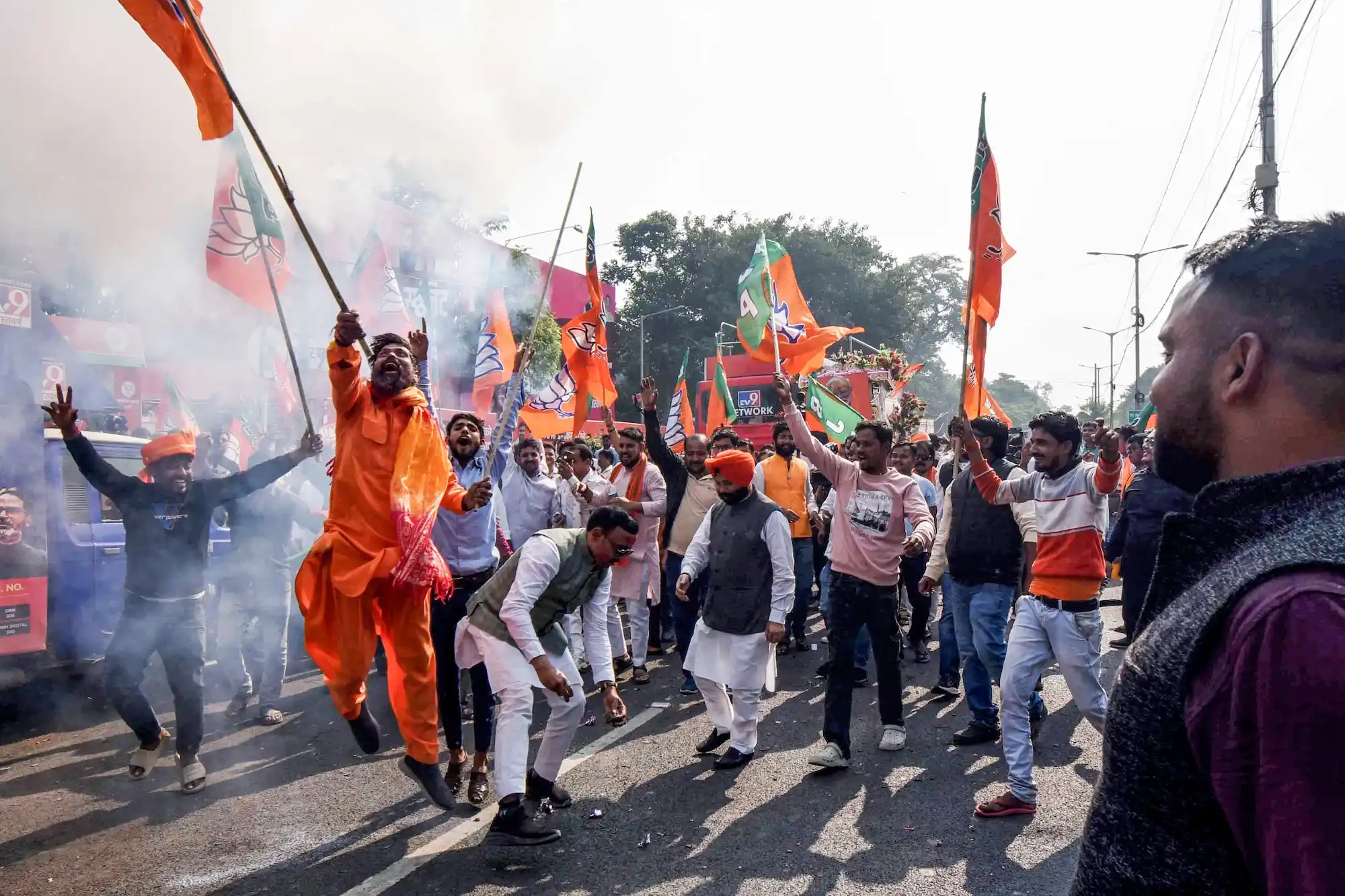
Bihar has delivered a resounding mandate to the ruling National Democratic Alliance (NDA), signalling not just continuity but a deeper consolidation of support for the coalition led by the Bharatiya Janata Party (BJP) and Janata Dal (United) (JD(U)). In a state known for its heightened political awareness and decisive voting patterns, the verdict is both emphatic and instructive — not only for Bihar but for the broader national political landscape.
The opposition Mahagathbandhan, comprising the Rashtriya Janata Dal (RJD) and the Congress, has suffered a significant setback. Their promises, strategies and messaging failed to hold ground against a carefully calibrated campaign by the NDA that combined governance, welfare, caste calculations and leadership stability. As the dust settles, several key themes emerge that help explain why Bihar’s electorate chose once again to rally behind Nitish Kumar and his allies.
The Make-or-Break ‘Mahila’ Factor
One of the most striking takeaways from this election is the assertive role played by women voters. Bihar witnessed higher turnout from women than men, reinforcing a trend that has been shaping the state’s politics for nearly two decades.
Nitish Kumar was among the first leaders to recognise the electoral and social significance of women’s participation. His 2005 decision to provide bicycles and uniforms to school-going girls was not just a welfare initiative — it was a social transformation project. The results were dramatic: enrolment of girls soared, dropout rates dipped, and a new cohort of empowered young women emerged.
The 2016 liquor ban, though controversial, similarly tapped into women’s concerns. Faced with rising domestic violence and alcohol-related distress, many women viewed the prohibition as a protective measure. While critics pointed to enforcement failures and the rise of illicit trade, Nitish Kumar earned deep goodwill among women — goodwill that has endured.
This election saw both alliances aggressively wooing women voters.
- The NDA relied on schemes like the Mukhyamantri Mahila Rozgar Yojana (MMRY), offering a ₹10,000 start-up grant and additional aid up to ₹2 lakh.
- The RJD, led by Tejashwi Yadav, countered with the Mai Bahin Maan Yojana, promising ₹2,500 per month to women from poor and backward communities.
But despite these similar offerings, women returned overwhelmingly to the NDA fold. The reason? Trust. Welfare schemes targeted at women have been central to NDA’s victories in other states — the Ladli Behen Yojana in Madhya Pradesh and Ladki Bahin Yojana in Maharashtra contributed directly to the BJP’s electoral success in recent years. Bihar women voters appear to have chosen continuity over experimentation.
Given the decisive role women played, political analysts believe these cash transfer schemes may become a nationwide template ahead of major upcoming elections in West Bengal, Assam, Tamil Nadu, Kerala (2026) and Uttar Pradesh (2027).
Caste Math That Adds Up
Caste remains the backbone of electoral strategy in Bihar. No party wins without careful coalition-building among its diverse communities. This election reaffirmed that principle.
Although political strategist Prashant Kishor sought to build a development-first alternative through his Jan Suraaj Party (JSP), the results show Bihar is not yet ready to abandon caste-based political mobilisation. The JSP failed to win a single seat, underscoring the entrenched nature of identity politics in the state.
The caste survey released in 2023 revealed the population distribution clearly:
- Extremely Backward Classes (EBCs): 36.01%
- Other Backward Classes (OBCs): 27.12%
- Scheduled Castes: 19.65%
- Scheduled Tribes: 1.68%
This makes the EBCs the single-largest demographic bloc — a fragmented yet critical group that has emerged as a decisive electoral force. Nitish Kumar has spent years nurturing support among EBCs through targeted welfare and political representation. Journalist Neerja Chowdhury describes Bihar as “a laboratory for political empowerment” of EBCs, calling them the “X factor” in North Indian elections.
The NDA’s ability to harmonise support across EBCs, OBCs, and upper castes gave it a decisive edge. In contrast, the Mahagathbandhan could not expand meaningfully beyond its core Muslim-Yadav base — a limitation that proved costly.
The Bihar results may well become a bellwether for other states due for elections next year. Analysts believe the outcome will influence strategies in West Bengal, Assam, Tamil Nadu and Kerala, where caste and community alliances also play defining roles.
Blow to Opposition Unity?
Perhaps the most significant national implication of the Bihar results lies in what they mean for opposition unity. The INDIA bloc, already fragile, is likely to face renewed internal questioning. Bihar was seen as a potential morale booster — an opportunity to demonstrate that issues like unemployment, inflation and governance failures could be powerful unifiers against the BJP.
Tejashwi Yadav campaigned hard on job creation, attracting enthusiasm from young voters. Yet he could not expand his appeal across communities. Analysts note that he remains confined within the identity mould of a Muslim-Yadav leader — a perception the Mahagathbandhan failed to shake off.
The alliance’s messaging was inconsistent and overly dependent on Tejashwi’s personal appeal. In contrast, the NDA projected stability, experience and targeted welfare — a combination that resonated more effectively.
The defeat weakens the opposition’s collective negotiating power and may reopen rifts over leadership, strategy and resource-sharing within the INDIA bloc. Had the Mahagathbandhan won in Bihar — India’s poorest state — it would have signalled that bread-and-butter issues could override political identity. Instead, the result suggests the opposition is yet to craft a narrative compelling enough to challenge the NDA’s coalition of welfare, identity and governance.
What Bihar Means for India’s Political Future
As India heads into another busy election cycle, Bihar’s verdict is likely to shape national politics in several ways:
- Women-centric welfare politics is here to stay, with Bihar reinforcing a model already gaining traction.
- EBCs will continue to be the political fulcrum in northern states, influencing alliances and agendas.
- Opposition unity remains uncertain, with Bihar sharpening existing tensions.
- BJP–JD(U) chemistry remains electorally potent, despite past fractures.
Ultimately, Bihar’s electorate has sent a clear message: performance, welfare, and community trust matter — and structural political advantages cannot be overturned by rhetoric alone.
In the grand theatre of Indian politics, Bihar has again played its role as a trendsetter. The question now is: who will learn the most from its verdict?

