
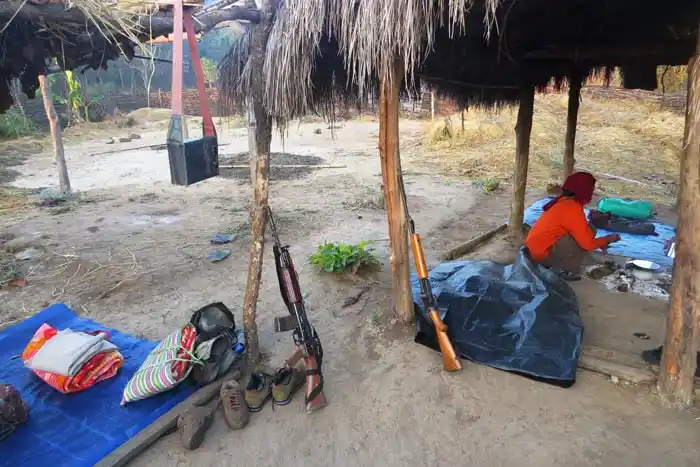
In the deep-green vastness of Chhattisgarh’s Bastar region—where the forest canopy once echoed with Maoist gunfire, and where the language of progress was spoken only in hushed hypotheticals—women lived at the uneasy intersection of ideology and survival. For years, the insurgency wrapped itself in the romance of revolution, yet for the women beneath the red banners, especially those from Scheduled Caste and Scheduled Tribe communities, life bore the unmistakable imprint of deprivation. Rights were theories. Autonomy, a rumor. The insurgents promised liberation; what they delivered was a more intimate, more insidious variety of control.
By 2025, that grip has loosened. Security operations have grown sharper; surrenders have become routine, even unceremonious. And so Chhattisgarh stands at an inflection point, an emblem of the painstaking crawl from conflict to something resembling normalcy. Its slow, uneven transformation suggests a truth rarely admitted in the revolutionary pamphlets of yesteryear: empowerment requires not rifles or manifestos but infrastructure, schools, clinics, and the quiet regularities of governance.
Nowhere was the insurgency’s paradox more plainly visible than in its assault on education. In districts like Dantewada and Bijapur, from the mid-2000s onward, Maoist commanders came to view schools as Trojan horses—state power wearing the mask of chalk dust. They razed some, commandeered others, and by sheer intimidation shut down hundreds more. After the combustible summer of 2005, when the anti-Maoist Salwa Judum movement surged and collided with insurgent forces, the educational map of Bastar resembled a battlefield more than a bureaucracy. Twenty schools were reduced to rubble; over 260 were folded into distant institutions, leaving more than two hundred villages without even a primary school.
Girls paid the highest price. Displacement fractured family routines, and classrooms dissolved into memory. In camps like Dornapal and Errabore, canvas tents flapped mutely where schools once stood; attendance thinned until it resembled absence. A handful of teenagers—girls among them—abandoned their studies after eighth grade and signed up as Special Police Officers. There is a distinctive tragedy in the image of a schoolchild exchanging notebooks for a rifle; it is the kind of tragedy the insurgency both exploited and perpetuated. Elsewhere, girls as young as six were ushered into children’s wings of the Maoist apparatus, assigned sentry work, and instructed in the movement’s catechism. Childhood became a strategic asset to be spent, not a phase to be protected.
For those displaced to neighboring Andhra Pradesh, bureaucracies provided their own obstacles: missing documents, unfamiliar languages. In one mandal alone, 450 girls dropped out—an exodus too large to be described as incidental.
And yet the ground is shifting. In 2024 and 2025, as Maoist strongholds crumbled and commanders surrendered or were arrested, the state began stitching its school system back together. Roads, at long last, reached villages previously accessible only by rumor. Classrooms reopened. A 2025 state initiative to upgrade school quality did more than refurbish buildings—it signaled a symbolic turning outward, a refusal to cede education to the logic of conflict. Women’s literacy programs have enrolled more than 12,000 in just half a year, and the effects are measurable: where educational attainment rises, teen pregnancy falls, by as much as 35 percent nationally. In Bastar, too, the correlation is more than statistical. It is visible in the steadier gait of girls walking to school, in parents who imagine futures larger than the radius of a paddy field.
Healthcare, another essential scaffold of autonomy, fared little better under Maoist shadow. Clinics were blown up or silently abandoned. Vaccination drives were thwarted. In 2001, over a thousand interior villages were left without even the most rudimentary services. In camps like Jagargonda, women faced the kind of compounding miseries that would feel excessive if they appeared in a dystopian novel: malaria carried by the swampy air, smoke from cooking fires trapped indoors, rations meager enough to blanch even the hardiest stomach. Children slipped into severe undernutrition; some never climbed back out.
The plight of female Maoist cadres was harsher still. Forced abortions, shared cloth strips used as makeshift sanitary pads, rules barring them from water sources during menstruation—the rhetoric of equality dissolved upon contact with the practicalities of insurgent life.
But here, too, the post-insurgency horizon brightens. Expanded maternal care, vaccination access, and mobile clinics now reach deeper into the forested interiors. Improved national health policies have trickled into state rankings, and surrendered women receive medical support under the government’s 2025 rehabilitation plan. These are not glamorous interventions, but they are life-saving ones—and they articulate, perhaps more convincingly than any speech, the difference between governance and guerrilla rule.
Economics, meanwhile, provided the insurgency’s most powerful trap. In a region that produces three-quarters of India’s mineral wealth, it was ironically poverty—deep, structural, humiliating—that drove many women toward the Maoists. Families displaced by violence or by suspicion lost access to land and forests. In camps, cultural life thinned: no festivals for years, no work worth naming, no wages to narrow the gulf between men’s earnings and women’s meager 70 percent.
The present tells a different story. Welfare schemes like the Mahtari Vandan Yojana now deposit small but steady amounts into the accounts of more than seven million women, reaching villages where insurgent diktats once prohibited such engagement. Bastar’s improved roads have lured industries and tourists, and surrendered women receive financial assistance meant to bridge the gap between survival and reintegration.
Violence—sexual, custodial, ideological—was the insurgency’s most viciously gendered legacy. Women were assaulted by both state auxiliaries and Maoist cadres. Even within the rebel hierarchy, where women were said to constitute up to 40 percent, they found themselves deployed first as symbols of equality, then as shields, and finally as cautionary tales. The NCRB logged nearly 85,000 crimes against women in affected states in 2019; countless more never touched a police register.
The decrease in violence today is fragile but real. Rehabilitation programs offer something rare in Bastar’s recent history: the possibility of safety not built on allegiance, but on rights.
For decades, Maoists promised a classless utopia while practicing a hierarchy that left women at the bottom rung. Now, as Chhattisgarh tugs itself toward a different future, the task is not merely to fill the gaps the insurgency left behind, but to construct—slowly, deliberately—a society where empowerment isn’t a concession but a guarantee.
The forests of Bastar are quieter now. In that quiet lies an opening, and perhaps even the beginnings of a promise: that no woman will again be asked to choose between survival and dignity.

