
India’s cultural landscape is richly woven with the threads of oral tradition—the art of storytelling that predates written scripture and printed pages. From the vibrant plains of Rajasthan to the coastal hum of Karnataka, the country’s folk storytellers have long upheld the wisdom and wonder of generations, carrying history, morality, and myth through melodious voices and meticulous movement. Their performances, deeply rooted in the land and its people, speak not only of ancient epics but also of the collective soul of India.
In Rajasthan, the Kavadiya Bhats of Bassi embody this continuity. For over 400 years, they have travelled from village to village, carrying Kavads—portable wooden shrines with folding panels painted in vivid hues. Just as a book opens to reveal its story, each panel is unveiled by the storyteller, guiding the audience through legendary sagas of gods, battles, and moral dilemmas. These mobile temples were once the spiritual lifeblood for communities without permanent places of worship, shaping faith and folklore into a layered narrative.
Further east, the mellifluous strains of Bengal’s Baul singers rise above village fields and urban plazas. These mystic minstrels, recognized by UNESCO as part of the world’s intangible heritage, roam freely with their ektaras and dotaras, singing of divine love and transcendence. Drawing from Sufi and Vaishnav traditions, Baul music is devotional yet rebellious—a reflection of the nonconformist spirituality that has long shaped Bengal’s artistic and intellectual ethos.
In Andhra Pradesh, the compelling cadence of Burra Katha has echoed for centuries. It’s a form that thrives on synergy: part narration, part music, part social commentary. A lead storyteller, the Kathakudu, guides the audience through epics, local tales, and contemporary critiques—often to the beat of a burra, a traditional drum. During movements like the Telangana Rebellion, Burra Katha emerged as a powerful tool of resistance, carrying revolutionary ideas through rhythm and rhetoric.
The plains of Punjab bring forth the moving tradition of Dhadi Jathas, where troupes sing ballads recounting the valor of Sikh warriors, saints, and Gurus. Accompanied by the sarangi and dhadd drum, they bridge the gap between religious devotion and historical memory, offering a sonic tapestry of courage, sacrifice, and spiritual strength. Born in the era of Guru Hargobind, their performances still resonate in gurdwaras and community gatherings across the region.
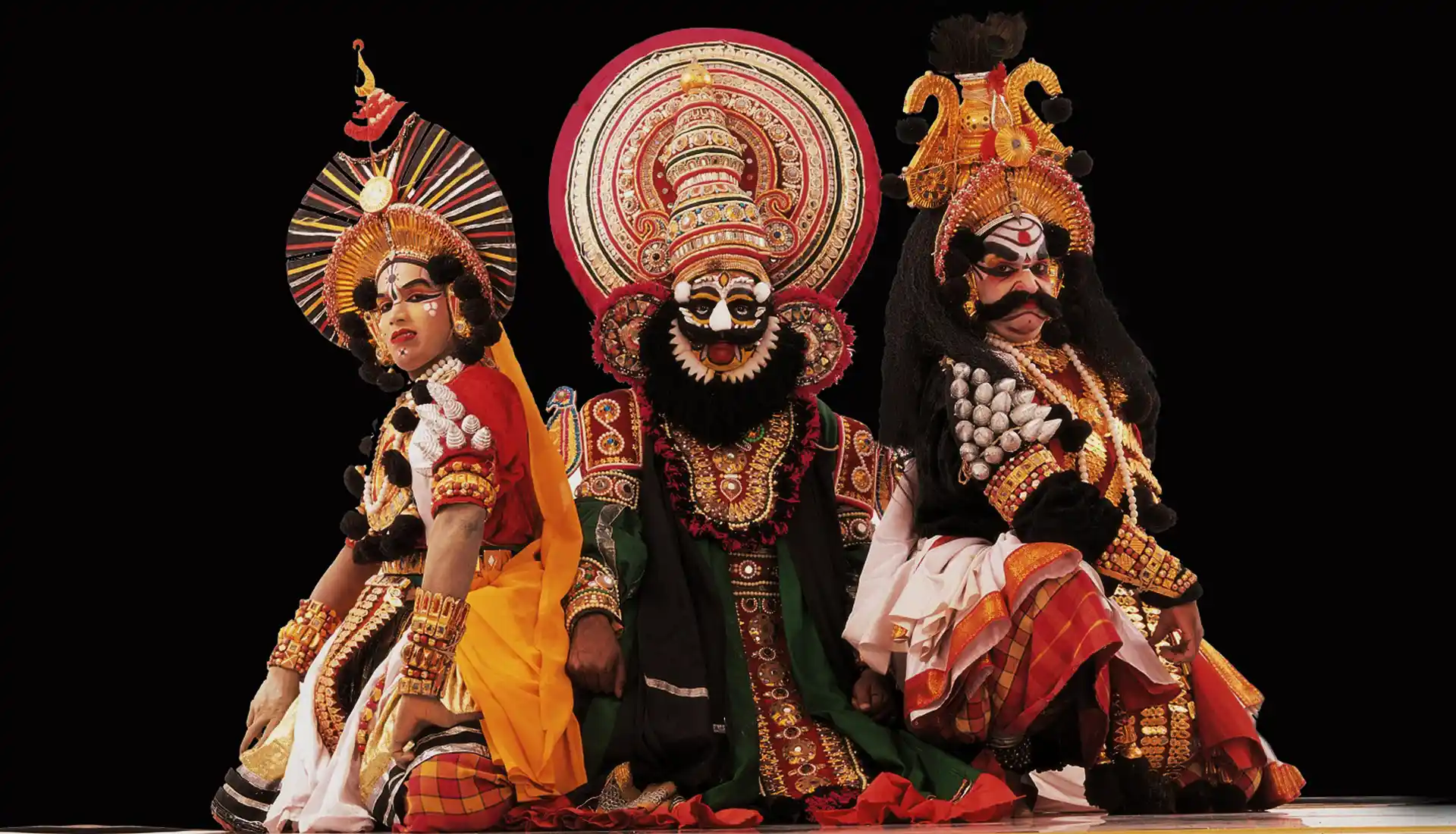
On the western coast of Karnataka, the open-air stages of Yakshagana blaze with energy. This theatrical tradition blends dance, dialogue, music, and elaborate costumes into immersive narratives drawn from the Ramayana, Mahabharata, and local lore. Performances, often lasting through the night, blur the line between spectator and story, illuminating the forested shorelines with vibrant expression. Once the preserve of men, Yakshagana now increasingly features women performers, reflecting evolving cultural spaces.
In the heart of Chhattisgarh, Pandavani brings the trials of the Mahabharata’s Pandava princes to life. Through expressive recitation and dramatic storytelling, often with just a simple string instrument in hand, solo performers unravel epic tales with emotional intensity. Teejan Bai, one of the most celebrated Pandavani exponents, has transported this form to global stages, demonstrating its universal appeal and thematic depth.
Tamil Nadu’s storytelling pulse beats equally strong through Therukoothu, a street theatre tradition where myth, song, and dance collide under the open sky. Part performance, part communal ritual, Therukoothu transforms village squares into sacred arenas where ancient tales unfold in vivid costumes and booming voices. Its cousin, Villupattu, relies on the resonant vibrations of a massive bow-shaped instrument—the villu—to punctuate stories from epics and local history. Both forms thrive on participation and rhythm, turning spectators into custodians of cultural memory.
In Gujarat, the 700-year-old tradition of Bhavai blends satire with symbolism. In village squares or temple courtyards, Bhavai troupes perform skits that poke fun at social customs, politics, and human folly. With expressive gestures, improvised dialogue, and lively music, these plays invite both laughter and reflection. Though male actors often play female roles, the stories transcend gender, creating a shared space for wisdom and wit to mingle.
Across the subcontinent, these traditions share a common thread: the power of oral storytelling to preserve, provoke, and inspire. Whether sung, danced, enacted, or narrated, each performance is a living archive—an evolving testament to India’s layered identity. In a country where modernity and myth often collide, folk storytellers remain vital keepers of the past, carrying its wisdom into the future, one tale at a time.

