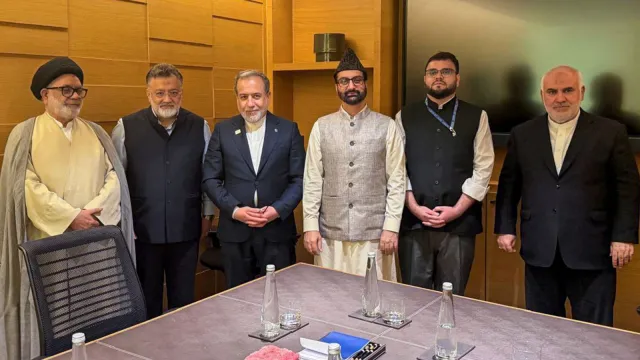
On Friday, 11 September, Kashmir’s chief cleric Mirwaiz Umar Farooq flew to New Delhi, posed at an Iranian embassy exhibition, and sat down with President Masoud Pezeshkian on the sidelines of the BRICS summit. The next night he met Foreign Minister Abbas Araghchi and handed over a letter preaching “dialogue,” “restraint”, and “statesmanship.” He then told cameras that “peace can only be established when there is justice,” and that what is happening to Iran is “absolutely wrong.”
He did not mean the massacre of Iranian protesters. He meant American and Israeli strikes. That single act of selective vision is the whole story.
The uprising that began in Iran on 28 December 2025 produced one of the bloodiest crackdowns in the country’s modern history. Tehran’s own figure is 3,117 dead. Independent tallies run far higher: HRANA has verified more than 7,000 fatalities; medical networks cited by Time and The Guardian have spoken of 30,000 or more; Iran International put the number near 36,500. The UN Human Rights Council has already called it a violent crackdown that killed thousands, including children. Exact accounting is deliberately impossible because the state shut the internet while it shot people.
The killing did not stop when the streets emptied. It moved to the gallows. A UN fact-finding mission in July demanded an immediate halt to protest-related executions after two men from an Isfahan case were hanged and ten more were in the queue. Human Rights Watch reported on 10 September — one day before Mirwaiz’s handshake — that between March and the end of August Iran had announced 29 protest-linked executions and at least 59 politically motivated hangings, several of them teenagers. Scores more sit on death row. This is not ancient history. It is this year’s machinery.
Pezeshkian is not a visiting poet. He is the civilian face of the system that did this. Meeting him and then sermonising about “humanity” is not interfaith courtesy. It is moral laundering.
Iranian women have paid for this uprising twice: first in 2022 under the banner Woman, Life, Freedom, then again in the winter revolt that followed. Compulsory hijab, morality police, prison, torture, the noose. UN High Commissioner Volker Türk told the same Human Rights Council this month that Tehran is using war as a pretext for “even more brutal oppression,” including a spike in national-security executions and business closures tied to hijab rules.
Listen for those women in Mirwaiz’s Delhi remarks. You will not hear them. You will hear Palestine, Lebanon, “imposed war,” and the sacral language of the ummah. In March he led Kashmiri clerics to the Iranian embassy to mourn Ayatollah Khamenei and called Kashmir Iran-e-Sagheer — “Little Iran.” After Israel killed a senior Iranian security official, he praised “the resilience of the people of Iran and their leadership” as “the spirit of a true Muslim nation.” The leadership in that sentence is the same leadership hanging 18-year-olds.
This is not an accident of phrasing. It is a hierarchy of victims. Muslim women shot by an Islamic republic do not count. A cleric who can thunder that a Bihar chief minister pulling a doctor’s veil is a “grave moral violation” can stand in a five-star hotel with the president of a state that beats and kills women for refusing the veil, and feel no contradiction. That is not piety. It is a covert anti-women politics that defends the costume of female honour while ignoring the corpses.
Kashmir’s separatist high command has always been a men’s club. Hurriyat’s platforms, Friday pulpits and “resolution” committees were built by and for male clerics and politicians. A short-lived women’s magazine associated with the Mirwaiz household folded after a few issues; the harder subjects — domestic violence, inheritance for half-widows, the right to dissent from religious diktat — never became the movement’s business. Solidarity travels outward to theocratic capitals. It does not travel inward to Kashmiri women trapped between militants, family law and the sermon.
Mirwaiz now markets himself as a “resolution seeker, not separatist.” He dropped “Hurriyat chairman” from his X bio last winter after the conglomerate’s constituents were banned under UAPA, then insisted his convictions had not changed “even by a comma.” That is the method: keep the creed, lose the letterhead, collect the invitation. Hardliners in the Valley called it a sell-out. He calls it dialogue. Both can be true. What matters is which foreign altar still gets the pilgrimage.
Hurriyat was never a seminar on federalism. From 1993 it wrapped a secessionist claim in UN resolutions while the gun culture it refused to isolate emptied Hindu neighbourhoods, shuttered schools and turned shutdown calendars into a governing tool. The Kashmiri Pandits — the Valley’s indigenous Hindu community — were hunted, threatened and driven out in 1989–90. That ethnic cleansing is not a debating point. It is the human cost of a politics that treated Islamist militancy as “the boys” and treated Hindu presence as expendable. A leadership that still seeks prestige from the Islamic Republic, still recites Little Iran, still mourns Khamenei before it mourns Iranian girls, is telling you which civilisation it thinks Kashmir belongs to.
This is not a claim that every Kashmiri Muslim shares that project. It is a claim about the men who claim to speak for them in Delhi hotel ballrooms. They want the dignity of statesmen without the discipline of a single standard. Justice for Gaza. Silence for Evin Prison. Dialogue with New Delhi when the file is hot. Romance with Tehran when the cameras are on.
India can host Pezeshkian for BRICS without endorsing his hangmen; states deal with ugly counterparts. A hereditary cleric who built his career on moral speech does not get that excuse. He chose the exhibition of Iranian child victims of foreign bombs and skipped the far larger exhibition of Iranian child victims of Iranian bullets. He wrote a letter about “painful consequences of prolonged tensions” to a president whose judiciary is still listing names for dawn hangings. He used the word justice as if it were incense.
If the test of a leader is whose graves he visits, Mirwaiz visited the graves his host wanted seen. The graves of women who shouted Woman, Life, Freedom, the graves of protesters in Isfahan and Qom, the unmarked graves behind the official 3,117 — those remain outside the sermon. Until that changes, the Delhi handshake is not peacemaking. It is communion with a theocracy, performed by men who have never granted Kashmiri women, let alone Kashmiri Hindus, the same sacred urgency they grant the Islamic Republic.