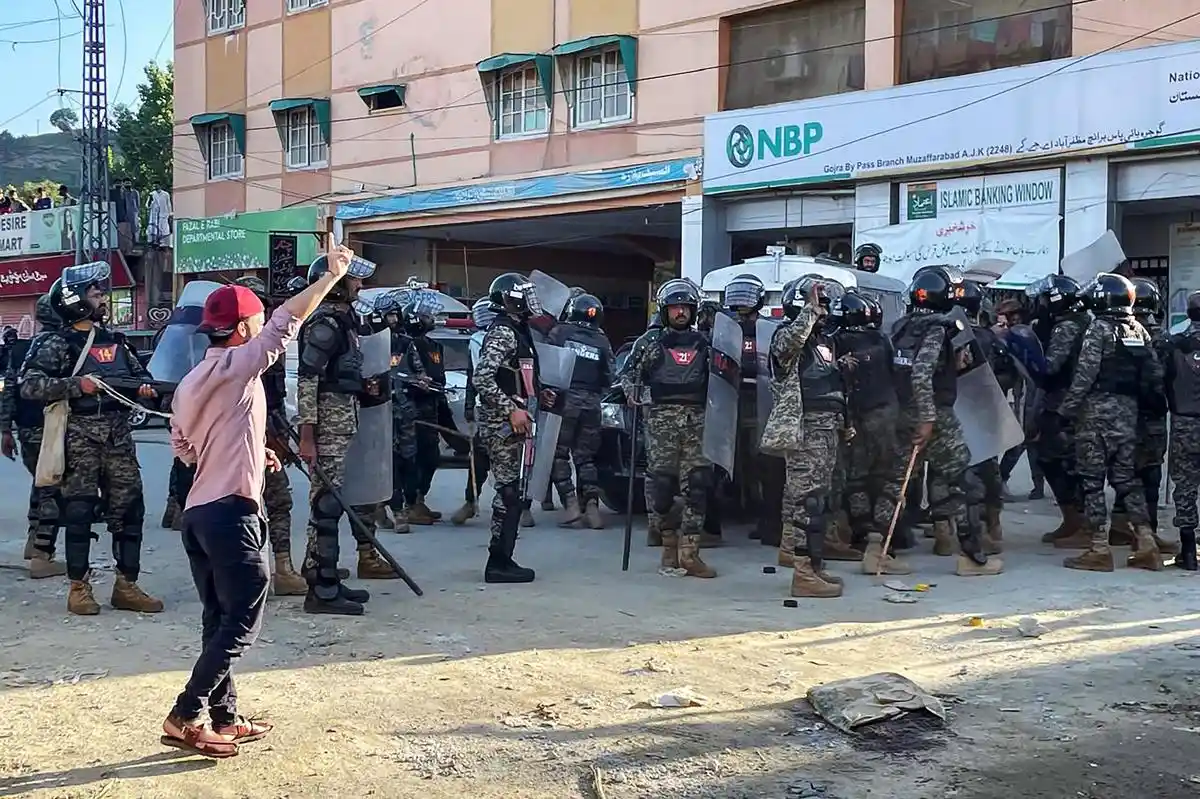
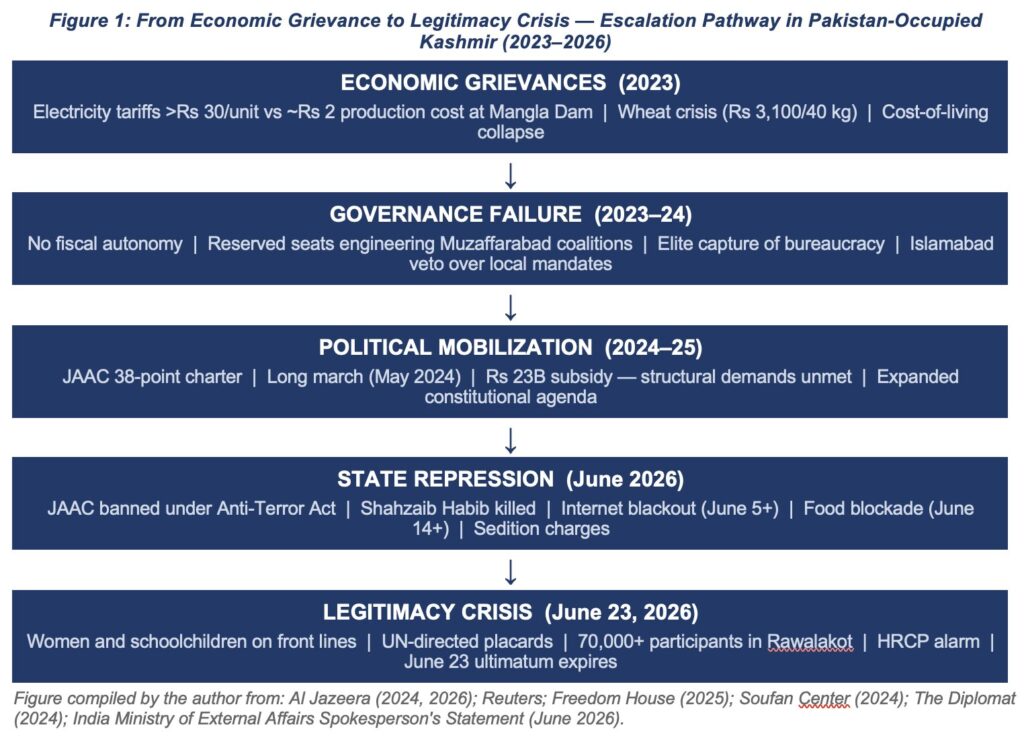
On June 23, 2026, a deadline issued by Pakistan-Occupied Kashmir’s Joint Awami Action Committee (JAAC) expired without resolution, pressing a question Islamabad has long preferred to defer: when does persistent governance failure cross into a crisis of legitimacy? What began in 2023 as organized grievances over electricity tariffs and wheat prices has evolved, within three years, into the most sustained civil resistance the region has witnessed in decades. The trajectory — from subsidy demands to constitutional challenges, from localized sit-ins to a twenty-day lockdown paralyzing the administrative capital — reflects a deeper structural fracture. This paper argues that the current unrest is not a protest movement in the conventional sense but a structural referendum on the foundations of Pakistan’s administrative authority: one that coercive responses cannot resolve and tactical concessions cannot permanently suppress.
From Economic Protest to Political Mobilization
The JAAC emerged in 2023 as a coalition of traders, transporters, lawyers, and students responding to two simultaneous economic shocks: a severe wheat crisis that drove flour to Rs 3,100 per 40-kg bag and sharply escalating electricity tariffs that compressed already strained household budgets. The electricity grievance carried particular symbolic force. Pakistan-Occupied Kashmir contributes approximately 3,500 megawatts of hydroelectric capacity to Pakistan’s national grid — roughly ten percent of total installed capacity — primarily through the Mangla Dam situated in Mirpur district. Yet residents were paying over Rs 30 per unit for electricity whose production cost at the Mangla source hovered near Rs 2. The perception of systematic extraction — a resource-rich periphery subsidizing a mainland that then sold the region’s own electricity back at a steep markup — transformed diffuse resentment into organized civil resistance.
By May 2024, this grievance produced mass mobilization: a long march toward Muzaffarabad ended in violent clashes with paramilitary Rangers, leaving at least three civilians and one police officer dead. Pakistan responded with a Rs 23 billion ($83 million) emergency subsidy package, reducing domestic electricity to Rs 3 per unit and cutting wheat prices significantly. The concession calmed the streets but resolved nothing structurally. AJK lacked the fiscal autonomy to guarantee the arrangement without ongoing federal authorization, and residents recognized this immediately. When the JAAC returned in 2026 with an expanded 38-point charter — covering legislative representation, administrative accountability, constitutional reform, and the resource-sharing framework — the movement had definitively outgrown its origins.
The immediate 2026 trigger was the AJK Supreme Court’s ruling that twelve seats in the 45-member Legislative Assembly reserved for Kashmiri refugees settled in mainland Pakistan were constitutionally protected and removable only through formal amendment. JAAC leaders had long argued these reserved seats allowed Islamabad to engineer governing coalitions in Muzaffarabad regardless of local electoral outcomes, a form of proxy-voting that effective autonomy cannot accommodate. The court’s ruling closed the legal pathway, leaving mass mobilization as the only remaining avenue.
Governance Failure and the Political Economy of Discontent
Pakistan-Occupied Kashmir occupies a peculiar constitutional limbo. Under the 1974 Interim Constitution, it is neither a province of Pakistan nor an independent polity: defence, foreign affairs, currency, and communications remain under Islamabad’s control, while an AJK Council chaired by the Pakistani Prime Minister retains executive and legislative authority across critical policy domains. Freedom House, in its 2025 Freedom in the World report, assigned Pakistani Kashmir a composite score of 30 out of 100 — categorized as ‘Not Free’ — with a Political Rights score of 9 out of 40 and a Civil Liberties score of 21 out of 60. The accountability deficit is not incidental to the current crisis; it is its constitutional architecture.
The reserved-seat controversy is symptomatic of deeper subordination. When thirteen percent of the legislature is controlled by voters living outside the territory, local political agency becomes conditional and reversible. The displacement of PTI-led governments in both AJK and Gilgit-Baltistan following Imran Khan’s 2022 ouster demonstrated precisely this dynamic: local electoral mandates proved subordinate to federal preference. With youth unemployment in AJK running at approximately double the rate in Pakistan’s provinces, a large constituency has accumulated strong reasons to regard institutional channels as ineffective. When governance failures on pricing, representation, and resource-sharing are structurally imposed rather than locally generated, they acquire a qualitatively different character — they become evidence that the authority demanding compliance lacks the consent-based legitimacy that would make such compliance politically sustainable.
Comparative Analysis: Peripheral Resistance and State Legitimacy
The structural parallels between PoK and Gilgit-Baltistan are analytically precise. GB has never achieved constitutional recognition within Pakistan’s federal framework, governed instead through executive orders that provide no pathway to National Assembly or Senate representation. It contributes an estimated 40,000 megawatts of hydroelectric potential while residents in Skardu and Gilgit endure up to twenty-one hours of daily load-shedding in winter. GB’s Awami Action Committee mounted comparable demands in 2024 — on electricity, wheat, taxes, and governance autonomy — and its leaders faced terrorism and cybercrime charges as a result. The same institutional template was subsequently applied to the JAAC in June 2026. Both cases reflect a consistent logic: peripheral territories are expected to contribute resources to the Pakistani state while receiving governance and representation conditional on Islamabad’s strategic preferences, not on their residents’ expressed political agency.
The Balochistan comparison reveals both continuity and a critical divergence. Three decades of civic protest politics there gradually gave way to armed insurgency — the BLA’s Operation Herof 2.0 in January 2026 illustrated that terminal trajectory. The PoK movement has remained emphatically civic: JAAC leaders consistently rejected armed action and anchored their demands in rights, governance, and constitutional reform. Yet Islamabad’s response — anti-terrorism designation, security operations, internet blackouts, and sedition charges — applied essentially identical counter-insurgency logic to a fundamentally peaceful movement. This conflation does not merely misread the opposition; it risks producing the radicalization it claims to preempt.
The Northern Ireland experience offers a more constructive comparative lesson. Civil rights mobilizations from 1968 onward were initially peaceful demands for political inclusion and equitable governance. Escalating state violence — including Bloody Sunday in January 1972 — transformed the political landscape and generated insurgent momentum that civic protest had not. Resolution came only through the Good Friday Agreement of 1998, which built meaningful political inclusion for previously excluded communities. The analytical lesson is not that trajectories are predetermined but that coercive responses to civic mobilization are constitutive political acts with consequences that outlast any particular protest cycle.
Table 1: Comparative Dimensions of Peripheral Resistance Movements
| Case | Primary Grievance | State Response | Outcome | Relevance to PoK |
| Gilgit-Baltistan (Pakistan, 2023–24) | Constitutional exclusion; electricity/wheat tariffs; land seizures under CPEC | Anti-terrorism charges; tactical subsidies; media blackouts; political displacement of elected governments | Ongoing stalemate; AAC campaign persists; no constitutional reform enacted | Structurally identical extraction-without-representation pattern; same coercive institutional counter-template |
| Balochistan (Pakistan, 1947–present) | Resource exploitation (CPEC/Gwadar exclusion); enforced disappearances; fiscal marginalisation | Sustained military operations; enforced disappearances; BLA classified terrorist; Operation Herof 2.0 (Jan 2026) | Armed insurgency now entrenched; BLA operational across decades of counter-operations | Demonstrates the endpoint of Pakistan’s coercive trajectory when civic channels are fully and repeatedly closed |
| Northern Ireland (UK, 1968–1998) | Political exclusion; sectarian discrimination; denial of civil and voting rights | Security operations; internment without trial; Bloody Sunday (Jan 1972); escalating counter-insurgency | Good Friday Agreement (1998); power-sharing institutions; structural political accommodation | Demonstrates that state violence radicalises civic protest; only genuine structural reform resolves legitimacy deficits |
Sources: Freedom House, Freedom in the World 2025; International Crisis Group; Al Jazeera; The Print; CLAWS; BBC (Good Friday Agreement, 1998); MEMRI (Gilgit-Baltistan, 2025).
Crisis of State Legitimacy
The June 2026 protests crossed thresholds that distinguish a governance crisis from a legitimacy crisis. The base of participation was the first signal: the incorporation of schoolchildren aged ten to twelve, women, and entire family units into sustained sit-ins at Rawalakot’s Eidgah Ground indicated that protest had migrated from organized civil society into the social fabric of ordinary life. Organizers reported over 70,000 participants in Rawalakot alone, with demonstrations extending across multiple towns and villages simultaneously. The object of demands had shifted as well: placards directed at the United Nations and slogans demanding ‘Pakistani forces out’ signify a challenge to the legitimacy of administrative presence itself, not merely the quality of its service delivery.
The state’s own responses confirmed the nature of what it was confronting. Banning the JAAC under anti-terrorism legislation on June 5, filing sedition charges against its leaders, imposing an internet blackout since June 5, and reportedly restricting food supply convoys since June 14 — these are not instruments deployed against a consumer grievance. They are instruments deployed when a state has exhausted its persuasive and administrative repertoire and has defaulted to coercion as a first rather than a last resort.
Legitimacy crisis arrives analytically when coercive pressure generates solidarity rather than submission. The killing of JAAC member Shahzaib Habib on June 5, 2026, became a catalyst for wider mobilization rather than a deterrent — a precise inversion of the intended coercive calculus. The Human Rights Commission of Pakistan’s own expression of ‘deep alarm’ at the application of anti-terror law to a civic organization acknowledged, however cautiously, that the state’s framing was analytically unsustainable even by Pakistan’s domestic institutional standards. When the legitimacy question is raised not only by protesters but by the state’s own watchdog bodies, the threshold into structural crisis has been crossed.
Future Trajectories
Three scenarios present themselves with differing probabilities and implications.
In the first — managed de-escalation — Islamabad enters credible negotiations offering a constitutional amendment pathway on the reserved-seat question, legally guaranteed electricity pricing anchored to Mangla Dam’s actual production cost, and an independent fiscal review of AJK’s resource-sharing arrangements with the federation. This requires Pakistan’s military establishment to accept diminished informational control over AJK’s political outcomes, a concession without recent institutional precedent. The May 2024 experience demonstrates that rapid concessions are achievable when pressure becomes acute; the question is whether structural, rather than tactical, concessions are within the military’s political comfort zone.
In the second — prolonged stalemate — moderate economic adjustments are extended without constitutional reform. The JAAC ban remains; the movement fragments but retains its social base. With each successive cycle of mobilization, concession, and rollback, a younger cohort grows progressively harder to reach through the same instruments. The Human Rights Commission of Pakistan’s response suggests that even within Pakistan’s institutional landscape, the coercive approach is being recognized as analytically unsustainable.
In the third — escalatory confrontation — continued lethal force, communications suppression, and the alleged humanitarian blockade push a civic movement toward a breakdown of administrative normalcy in Muzaffarabad, inviting diaspora mobilization in London and other cities, sustained UN attention, and international pressure that materially constrains Pakistan’s operational latitude. The JAAC’s stated June 23 ultimatum — threatening a march of over 100,000 people from Rawalakot to Muzaffarabad — represents an explicit articulation of this threshold.
Chart 1: Electricity Tariff Structure in Pakistan-Occupied Kashmir vs. Production Cost at Mangla Dam (2022–2025)
| Tariff Category | Pre-Protest 2024 (Rs/unit) | Post-Concession May 2024 (Rs/unit) | Revised Rate 2025 (Rs/unit) | Source |
| Mangla Dam — generation cost (hydro) | ~Rs 2 | ~Rs 2 | ~Rs 2 | The Diplomat (2024); Soufan Center (2024) |
| AJK domestic — first slab (up to 100 units) | >Rs 30 | Rs 3 (subsidized) | Rs 32.69 | Arab News (May 2024); Express Tribune (Apr 2025) |
| AJK domestic — second slab (101–300 units) | >Rs 30 | Rs 5 | Rs 32.69 | AJK Electricity Department; Arab News (2024) |
| Pakistan national average tariff | ~Rs 32 | N/A (AJK specific package) | Rs 37.64 | NEPRA; Express Tribune (Apr 2025) |
| AJK hydropower contribution to Pakistan grid | ~3,500 MW | ~3,500 MW | ~3,500 MW | Soufan Center (2024) — approx. 10% of Pakistan’s installed capacity |
Sources: Soufan Center (2024); The Diplomat (2024); Arab News (2024); AJK Electricity Department; NEPRA; Express Tribune (April 2025); ProPakistani (April 2025).
Conclusion
The movement that began over electricity bills has arrived at a point where its original grievance is nearly incidental to its political significance. What people in Rawalakot and Muzaffarabad articulate in June 2026 is a contest over whether administrative authority can be considered legitimate — not merely effective, not merely coercive, but genuinely consensual. Pakistan’s responses, alternating between subsidy packages and anti-terrorism designations, have not addressed this contest; they have accelerated it. A settlement offering only economic relief without structural reform will continue to generate cycles of unrest, each more politically sophisticated than the last. The deeper question — whether a governance arrangement sustained primarily through institutional asymmetry and, increasingly, through coercion can survive generational political change — admits no comfortable answer within the current constitutional framework.
Bibliography
Al Jazeera. “Deadly protests in Pakistan-administered Kashmir: What’s going on?” June 9, 2026. https://www.aljazeera.com/news/2026/6/9/deadly-protests-in-pakistan-administered-kashmir-whats-going-on.
Al Jazeera. “Unrest in Pakistan-administered Kashmir: What’s behind the recent protests?” May 14, 2024. https://www.aljazeera.com/news/2024/5/14/unrest-in-pakistani-kashmir-whats-behind-the-recent-wave-of-protests.
Arab News. “Azad Kashmir reduces flour, electricity prices after Pakistan okays $83 million subsidies.” May 13, 2024. https://www.arabnews.com/node/2509156/pakistan.
AJK Electricity Department. “Electricity Tariff.” Government of Azad Jammu and Kashmir. https://ajked.gok.pk/electricity-tariff/.
Centre for Land Warfare Studies (CLAWS). “Strategic Depth, Strategic Decay: The Unravelling of Pakistan’s Periphery.” June 2026. https://claws.co.in/strategic-depth-strategic-decay-the-unravelling-of-pakistans-periphery/.
Express Tribune. “How much will you pay under new electricity tariffs announced by PM?” April 3, 2025. https://tribune.com.pk/story/2537710.
Freedom House. Pakistani Kashmir: Freedom in the World 2024. Washington, DC: Freedom House, 2024. https://freedomhouse.org/country/pakistani-kashmir/freedom-world/2024.
Freedom House. Pakistani Kashmir: Freedom in the World 2025. Washington, DC: Freedom House, 2025. https://freedomhouse.org/country/pakistani-kashmir/freedom-world/2025.
Human Rights Commission of Pakistan (HRCP). Statement on protests and JAAC ban in Azad Jammu and Kashmir. June 2026.
India Ministry of External Affairs. Spokesperson’s Statement on Pakistan-Occupied Kashmir. June 2026. https://mea.gov.in.
MEMRI. “Pakistan Considers Gilgit-Baltistan A Burdensome Part Of Its Periphery — The Enduring Fallout of the Karachi Agreement.” July 25, 2025. https://www.memri.org/reports.
Outlook India. “Pakistan-Occupied Kashmir Unrest: 11 Killed After JAAC Ban Sparks Violent Clashes.” June 2026. https://www.outlookindia.com/international/pakistan-occupied-kashmir-unrest-11-killed-after-jaac-ban-sparks-violent-clashes.
Pakistan Today. “AJK sets new electricity rates after violent protests.” July 21, 2024. https://www.pakistantoday.com.pk/2024/07/21/ajk-sets-new-electricity-rates-after-violent-protests.
ProPakistani. “Here’s a Complete Breakdown of New Electricity Unit Prices After Latest Relief.” April 4, 2025. https://propakistani.pk/2025/04/04.
Research Society of International Law Pakistan (RSILPAK). “The Gilgit-Baltistan Constitutional Crisis.” October 2022. https://rsilpak.org/2022/the-gilgit-baltistan-constitutional-crisis/.
Soufan Center. “IntelBrief: Protests Erupt in Kashmir Over Affordable Electricity.” May 31, 2024. https://thesoufancenter.org/intelbrief-2024-may-31/.
The Diplomat. “Making Sense of Recent Mass Protests in Pakistan-Occupied Kashmir.” May 20, 2024. https://thediplomat.com/2024/05/making-sense-of-recent-mass-protests-in-pakistan-occupied-kashmir/.
The Print. “PoK protests are a challenge to Pakistan’s military establishment.” June 2026. https://theprint.in/opinion/newsmaker-of-the-week/pok-protests-pakistan-kashmir/2958714/.