
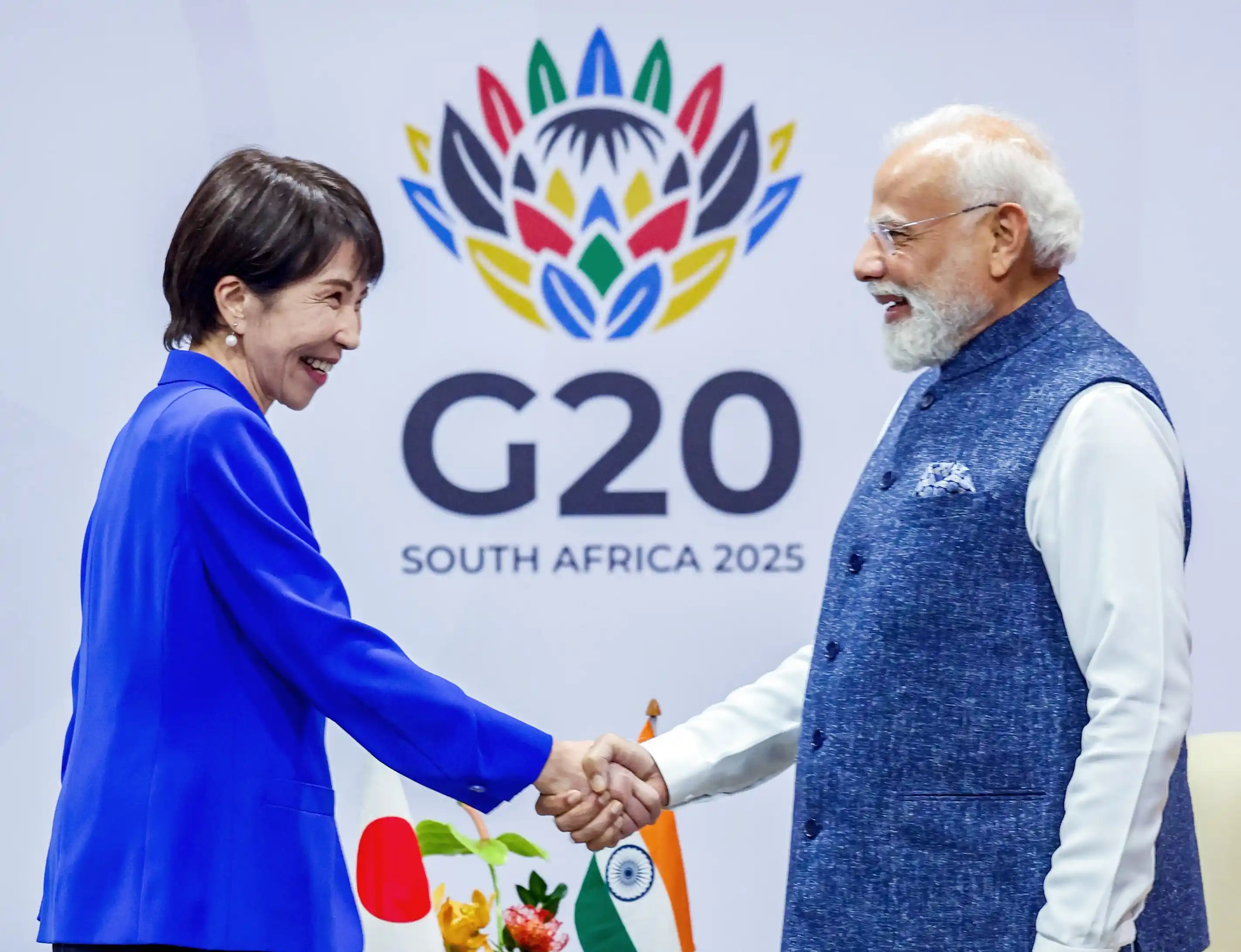
In an era when the Indo-Pacific is fast becoming the world’s main arena of contestation, India and Japan are the rare Asian powers that can shape its rules rather than merely endure them. Anchored in a “Special Strategic and Global Partnership” and a shared commitment to a free, open and rules‑based Indo-Pacific, New Delhi and Tokyo today stand at a historic inflection point: either they fuse their economic weight, technological strengths and maritime reach to co‑author a new regional order, or they leave the script to be written by others.
The Indo‑Pacific is no longer a quiet periphery but the theatre where economic interdependence collides with great‑power rivalry, especially as China militarises maritime claims and weaponises trade dependence. India and Japan have already framed their response in mirror concepts—India’s Indo‑Pacific Oceans Initiative and SAGAR (“Security and Growth for All in the Region”), and Japan’s Free and Open Indo‑Pacific (FOIP) vision—which explicitly commit them to an open, rules‑based maritime order.
Both governments now formally describe their relationship as a “Special Strategic and Global Partnership” and have adopted a joint “Japan and India Vision 2025” that positions them as central pillars of peace and prosperity in the Indo‑Pacific. That is diplomatic code for something blunt: either India and Japan work together to set the norms of the region, or they will live in a region whose norms are set for them.
Shared values, converging interests
Unlike many other Indo‑Pacific actors, India and Japan are both robust democracies that explicitly anchor their regional visions in sovereignty, territorial integrity, peaceful settlement of disputes and freedom of navigation and overflight. Their joint statements underline a commitment to a “free, fair and open trade and investment system,” and to resolving differences through dialogue rather than coercion.
This normative convergence is not abstract rhetoric; it underpins cooperation in hard security, technology standards, digital governance and connectivity, where rule‑setting today will determine strategic space tomorrow. In an era when both Washington’s attention span and European capacity are uncertain, an India‑Japan axis offers exactly what the Indo‑Pacific lacks: an Asian centre of gravity that is neither authoritarian nor hegemonic.
Security and sea lanes as a shared lifeline
For Japan, the sea lanes through the Indian Ocean and the Malacca Strait are existential; for India, the Indo‑Pacific is the primary theatre where Chinese naval power is pressing up against its core interests. Recognising this, the two sides have built an increasingly dense web of defence cooperation—joint declarations on security cooperation (2008), a memorandum on defence cooperation and exchanges (2014), and an Acquisition and Cross‑Servicing Agreement (ACSA) that now allows mutual logistics support for their armed forces.
Mechanisms such as the annual Defence Ministerial Dialogue, the “2+2” Foreign and Defence Ministers’ meetings, Maritime Affairs Dialogues and regular staff talks have turned what was once symbolism into operational habit. Their navies exercise together not only bilaterally (JIMEX/JAIMEX) but also in the Malabar quadrilateral exercises with the United States and Australia, embedding India‑Japan cooperation inside a wider Indo‑Pacific balancing architecture.
If India and Japan want a new Indo‑Pacific order where coercion at sea is costly, they need to go further: integrated maritime domain awareness, coordinated patrols in the Indian Ocean and Western Pacific, and joint capacity‑building for smaller littoral states from the Bay of Bengal to the South Pacific.
Economic interdependence with unrealised potential
Despite deep strategic convergence, the economic relationship is still playing catch‑up with its political ambitions. Japan’s bilateral trade with India reached about 22.85 billion US dollars in FY 2023‑24 and is reported at 27.47 billion US dollars in FY 2025‑26, with India exporting roughly 5–6 billion and importing over 17–21 billion. Japan accounts for around 2 percent of India’s total trade, and India remains just one of Japan’s mid‑tier partners by trade volume.
On investment, the picture is more promising but still under‑leveraged. Cumulative FDI equity inflows from Japan to India between 2000 and December 2024 amount to around 43.3 billion US dollars, making Japan India’s fifth‑largest source of FDI with about 6 percent of total inflows. Over 1,400 Japanese companies now operate in India across automobiles, electronics, industrial equipment, trading and finance, reflecting a dense production base that can be the backbone of Indo‑Pacific supply chains.
A new Indo‑Pacific order that is genuinely multipolar needs precisely this kind of cross‑investment between non‑Western partners; scaling India‑Japan trade and FDI is not just about growth, it is about reducing the gravitational pull of any single great power on regional economies.
Supply chain resilience as strategic statecraft
The pandemic exposed how dangerous it is for any region to rely on a single country for critical inputs, from APIs and electronics to rare earths. In response, India, Japan and Australia launched the Supply Chain Resilience Initiative (SCRI) in April 2021, a trilateral framework aimed at diversifying sourcing, sharing best practices and promoting investment for more resilient Indo‑Pacific supply chains.
Japan has put money behind this strategy, earmarking around 2.2 billion US dollars in its stimulus package to incentivise manufacturers to relocate or diversify production away from China. For India, whose Atmanirbhar Bharat agenda is about de‑risking without decoupling, Japanese firms bring both capital and know‑how in sectors like electronics, automotive components, chemicals and industrial machinery.
If India and Japan jointly position themselves as the “rebalancing engine” of Indo‑Pacific manufacturing—India offering scale and labour, Japan offering technology and finance—they not only secure their own supply chains but give ASEAN, Africa and the Middle East a third option beyond “Made in China” and “Made in America.”
Semiconductors: from vulnerability to partnership
Few sectors illustrate the security‑economics nexus better than semiconductors. In July 2023, India and Japan signed a Memorandum of Cooperation on a Japan‑India Semiconductor Supply Chain Partnership, designed explicitly to strengthen their role in global chip supply and leverage complementary strengths. The agreement covers government‑to‑government and business‑to‑business cooperation in manufacturing, research, design and talent development, with an initial five‑year horizon.
Japan brings decades of expertise in materials, equipment and advanced process technologies, while India offers a fast‑growing market, a large engineering talent base and ambitious fiscal incentives for fabrication and packaging. If properly executed, an India‑Japan semiconductor corridor—anchored in joint R&D, design centres in Bengaluru and Hyderabad, and Japanese fabs or OSAT facilities in Indian industrial corridors—could become a critical node in a “China‑plus‑many” chip ecosystem.
In a new Indo‑Pacific order where data is the new oil and chips the new crude, this partnership is not a luxury; it is insurance against technological blackmail.
Green energy and the hydrogen–ammonia axis
Energy transition is another domain where India’s scale meets Japan’s technological edge. In 2022, the two countries launched the India‑Japan Clean Energy Partnership, covering electric vehicles, battery storage, solar and wind, green hydrogen and ammonia, LNG, carbon capture and more. The partnership explicitly aims to build resilient and trustworthy clean‑energy supply chains as both countries pursue their decarbonisation plans.
By 2025, New Delhi and Tokyo had gone further, issuing a Joint Declaration of Intent on clean hydrogen and ammonia cooperation and committing to establish a hydrogen–ammonia trade corridor between India and Japan. India’s National Green Hydrogen Mission targets production of 5 million metric tonnes of renewable hydrogen by 2030, while Japanese firms and agencies are already investing in demonstration projects such as ammonia co‑firing at coal plants and large‑scale renewable ammonia production in Odisha, with an offtake agreement of around 400,000 tonnes per year to Japan from 2027 onward.
In an Indo‑Pacific order increasingly organised around green value chains and carbon markets, an India‑Japan clean‑energy axis can set standards for fuels, certification and carbon credits that reflect Asian realities rather than imported templates.
Infrastructure and connectivity as rule‑setting tools
Japan is already India’s most important infrastructure partner. The Mumbai‑Ahmedabad High‑Speed Rail (MAHSR) project—India’s first bullet train corridor, about 508 kilometres long—is being built with Japanese technical and financial assistance. The total estimated project cost is roughly 1.08 trillion rupees, of which the Japan International Cooperation Agency (JICA) is financing 81 percent (around 880 billion rupees) at an interest rate of 0.1 percent with a 50‑year repayment period and 15‑year moratorium.
JICA’s cumulative commitment to MAHSR alone has reached about 1.05 trillion yen (roughly 59,000 crore rupees), its largest loan amount for any single project worldwide. Beyond high‑speed rail, Japanese ODA and private investment are financing metro systems, freight corridors, industrial townships and port‑related connectivity across India.
These are not just economic projects; they are vectors for exporting safety standards, procurement norms, debt practices and environmental safeguards that stand in deliberate contrast to opaque lending and politically conditional infrastructure elsewhere in the Indo‑Pacific. An India‑Japan connectivity compact extended to Southeast Asia, the Bay of Bengal and East Africa could be the backbone of a genuinely transparent and sustainable regional infrastructure order.
Sectoral synergies: autos, chemicals and beyond
Japanese firms dominate India’s automobile landscape, from Maruti‑Suzuki and Toyota to Honda, and are now using India as a base for exports to Africa, Latin America and Southeast Asia. In chemicals, cumulative Japanese FDI reached about 43.1 billion US dollars by late 2024, with Japan ranking among the top investors in India’s chemicals sector, reflecting deep integration into India’s industrial value chains.
Bilateral trade data show that key Indian exports to Japan include organic chemicals, vehicles and aluminium products, while imports are dominated by machinery, vehicles, electrical equipment and iron and steel. That pattern of trade—India exporting raw materials and some intermediate goods, Japan exporting complex machinery—captures the current state: complementary but asymmetric.
A new Indo‑Pacific order would see India and Japan consciously move up the value chain together, co‑producing EVs, advanced chemicals, batteries and industrial equipment in India for the wider region, and tying these production hubs into SCRI‑style resilient chains.
Regional architecture: Quad, ASEAN and beyond
India‑Japan cooperation is not a closed club; it is designed to plug into wider regional architectures. Both are central members of the Quad alongside the United States and Australia, where they have already institutionalised cooperation on vaccines, critical technologies, climate and maritime security. Their joint Vision 2025 explicitly calls for aligning Japan’s FOIP with India’s Act East Policy through enhanced maritime security, better connectivity, stronger cooperation with ASEAN and sustained strategic dialogues.
At the supply‑chain level, the SCRI now interacts with the broader Indo‑Pacific Economic Framework’s Supply Chain Resilience Agreement (Pillar 2), in which both India and Japan participate with 11 other countries to de‑risk and diversify regional sourcing. This layered architecture—India‑Japan at the core, Quad as a minilateral, ASEAN‑centric forums and IPEF‑style economic coalitions—offers a template for an Indo‑Pacific order that is neither dominated by a single power nor paralysed by lowest‑common‑denominator consensus.
What a joint India–Japan Indo-Pacific order should prioritise
If India and Japan are serious about co‑authoring the region’s rulebook, they need to move beyond declaratory statements to an operational agenda with clear sectoral pillars.
First, in security, they should institutionalise joint maritime domain awareness, regularised logistics‑enabled deployments in each other’s primary theatres, and coordinated capacity‑building for smaller Indo‑Pacific navies and coast guards, especially in the Indian Ocean and Western Pacific chokepoints.
Second, in economic security, they should make the semiconductor MoC, SCRI and clean‑energy partnerships mutually reinforcing—using Japanese capital and technology to anchor Indian manufacturing clusters, while India’s market and labour pool make those clusters globally competitive.
Third, in connectivity, they should jointly finance and implement high‑standard infrastructure projects in South and Southeast Asia and along the African rim of the Indian Ocean, explicitly marketing these as transparent, sustainable alternatives that avoid debt traps and embed local capacity.
Fourth, in norms and governance, India and Japan should co‑sponsor Indo‑Pacific standards on data flows, AI ethics, cyber security and digital public goods, drawing on India’s experience with digital infrastructure and Japan’s strength in industrial standards.
None of this is automatic. It will require Tokyo to accept that a rising India will often insist on strategic autonomy, and New Delhi to invest political capital in a partnership that ties India more deeply into a web of mutual obligations. But for both, the alternative is starker: an Indo‑Pacific where they are rule‑takers, not rule‑makers. In that sense, working together on a new Indo‑Pacific order is not just a strategic choice for India and Japan—it is a strategic necessity.

