
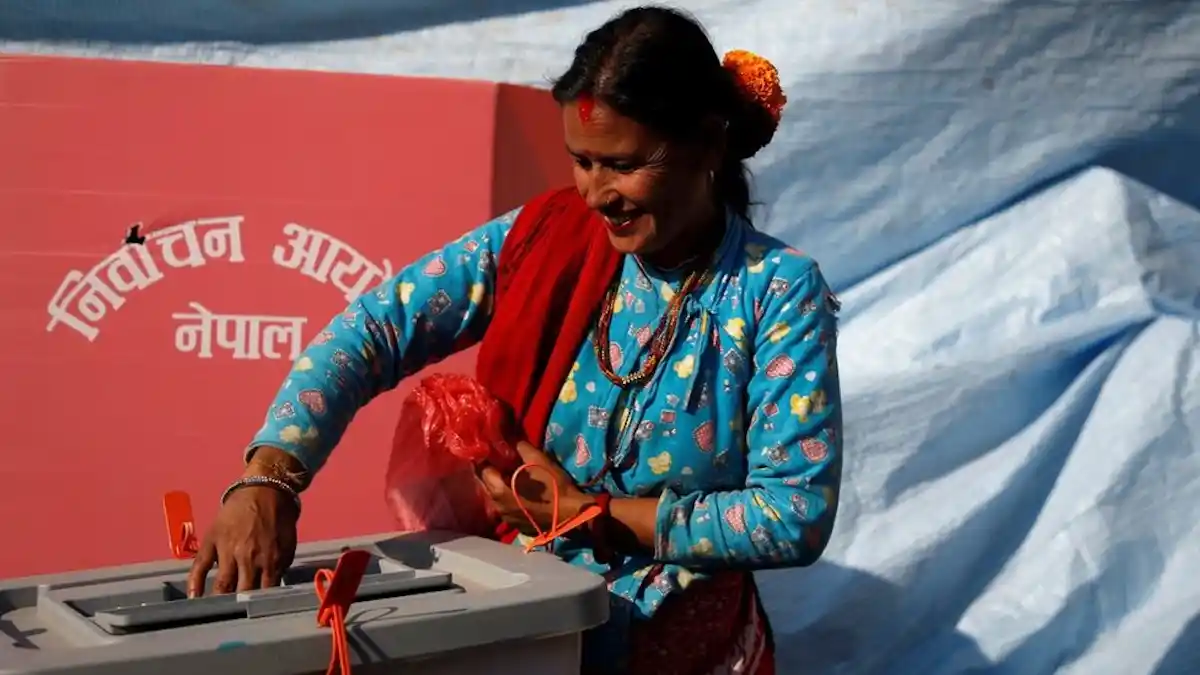
Nepal is set to hold snap elections on 05 March 2026 with 19 million voters, and 3,400 candidates for 165 seats in the lower house of the parliament—House of Representatives. Since the advent of democracy in 2008, Nepal has held four parliamentary elections, and this will be the fifth time the people of Nepal will exercise their adult franchise to elect the government. This election is unique in Nepal’s electoral and political history, as it was prompted by a Gen Z movement that forced an elected government to resign. In September 2025, a disgruntled youth protested the government’s decision to ban 26 social media applications, including popular ones such as Facebook, WhatsApp, Instagram, and YouTube, causing inconvenience for technology- and social media-savvy youth.
Nepal has undergone a few political transitions, from an absolute monarchy to a constitutional monarchy and then to a democratic state, and the people’s aspirations prompted each transition. But there has never been a change by a particular age group, and the Gen Z youth aged 18-25 did so in September 2025. Meanwhile, Nepal is not the first country to witness a Gen Z-led movement. Still, across Asia and the globe, countries have been seeing growing participation by Gen Z youth in opposition to failures of governance, corruption, and authoritarianism. In Asia alone, Sri Lanka, Bangladesh, Indonesia, and the Philippines witnessed Gen Z-led protests, but Nepal became the first country to topple a government.
While the social media ban was the trigger, underlying factors such as nepotism, corruption, unemployment, and political instability contributed to the magnitude of the Gen Z Movement. What was supposed to be a peaceful protest under the garb of a social media campaign—Nepal Against Corruption—triggered violence resulting in loss of lives. The protests culminated in a nationwide movement demanding a change of guard from the old to the new, with youth in leadership roles. Why?
The old guard has, unfortunately, not succeeded in providing even one stable government in the last 17 years of Nepal’s democratic history—no government has completed a five-year term, making Kathmandu the youngest capital to have had more than 10 prime ministers in that period. However, given the uniqueness of the Gen Z Movement and the demands of an aspiring youth becoming the agenda, would the forthcoming elections be about anything new or any change?
The Electoral Race: Old v/s New
While the Gen Z Movement was supposed to bring in party reforms, and an ageing leadership was supposed to deliver a new generation of leaders, former Prime Minister and Chairman of the Communist Party of Nepal-UML (CPN-UML), KP Oli, has tackled every form of dissent in the party and is hoping for a comeback to the Office of the Prime Minister. However, at the party convention held in 2025, Oli won his third consecutive term. The CPN-UML has found it difficult to sit in opposition and has been known to join hands with political rivals, such as Puspa Kamal Dahal alias Prachanda of the Maoist Centre, to form a government in the past. And in this election, CPN-UML will seek reelection, even as it faces not only political opponents but also public sentiment and a united youth demanding change. In 2022, CPN-UML was the second-largest party in the 2022 parliamentary elections. However, Oli’s obsession with the power centre could cost his party and himself, as he seems to be in denial about the aspirations of youth. The second key party is the Nepali Congress, which has recently undergone a leadership change despite resistance from its senior leadership. Former Prime Minister and party President, Sher Bahadur Deuba, avoided holding a special convention in January to decide on the new leadership as the elections approached, but finally, the convention was called, and the party’s General Secretary, Gagana Thapa, was elected unopposed as the new President of the party in January 2026. As the oldest and largest party in the 2022 parliament, the change in leadership is expected to deliver under Thapa’s youth-centric political appeal. While the Nepali Congress could face anti-incumbency and the ire of the youth, a change in leadership might yield better results, considering Thapa has been advocating leadership and youth-centric politics even before the Gen Z Movement prompted it.
In the traditional stronghold of political parties and leadership, the Prachanda-led Maoist Centre has joined hands with 26 big and small parties to form the new united left, the Nepal Communist Party (NCP), with Prachanda as the party’s convener, reiterating his potential candidacy for the prime minister’s post. This shows the difficulties the old guard faces in relinquishing power and leadership. While Prachanda is known for his political ambitions, he managed to lead a coalition government even with only 32 seats in a house of 275. Historically, Prachanda had held meagre but crucial numbers in parliament that he could use to bargain for the top office, and 2022 was no different.
Rashtriya Swatantra Party: A Game Changer?
Meanwhile, the Rashtriya Swatantra Party (RSP) has notably emerged as the leading contender for the office. Founded in 2022 by a journalist turned politician, Rabi Lamichhane, as an alternative force against the traditional parties. The unique appeal of RSP lay in its youth representation and the merit of its young candidates, who, despite being debutants in the 2022 elections, won 20 seats. With no majority of its own in 2022, the party joined the Prachanda-led coalition, and Rabi became Nepal’s Deputy Prime Minister and Home Minister. However, the party ran into trouble after accusations of fraud during his journalism days surfaced, and his citizenship was also in question, leading him to resign from office.
But RSP has made a comeback after the Gen Z Movement, and its biggest masterstroke is the candidature of Balendra Shah, also known as Balen Shah, as the party’s Prime Ministerial candidate. The 35-year-old Balen has a track record of defeating the traditional party candidates in the 2022 Kathmandu City mayoral elections, earning him popularity amongst youth. In addition to winning with a huge vote margin, Balen won the Mayrol post as an independent candidate. By inducting Balen into the RSP, Rabi hopes to benefit from Balen’s popularity among youth and his Madhesi identity. Balen was among the leading choices of Gen Z youth to be nominated as Interim Prime Minister in September 2025, a role he declined. Balen is contesting from Jhapa 5—a stronghold constituency of the former Prime Minister KP Sharma Oli. This constituency is seen as a vital contest between a traditional party with a senior leader and a newbie party with younger leadership.
Way Forward
Nepal stands at a crucial transition point, where the political and electoral contest between the old guard and the new will be essential in shaping a forward-looking future for the Himalayan nation. Although the traditional political parties are still unwilling to let go of power, the impact of an aspiring youth, their grievances, and their quest for change would certainly matter. Also, in Nepal’s brief democratic history, the Gen Z Movement and the forthcoming snap elections are about change within the democratic order, which is a positive development and a marker of an evolving democracy. In recent years, protests and demands by a select segment of Nepalese society for the restoration of the monarchy made headlines, but they quickly subsided. However, as a warning sign, governance will remain a key responsibility for any government that comes to power.
The opinions expressed in this article are those of the author alone and do not reflect the views of the author’s current or past affiliations in any form.

