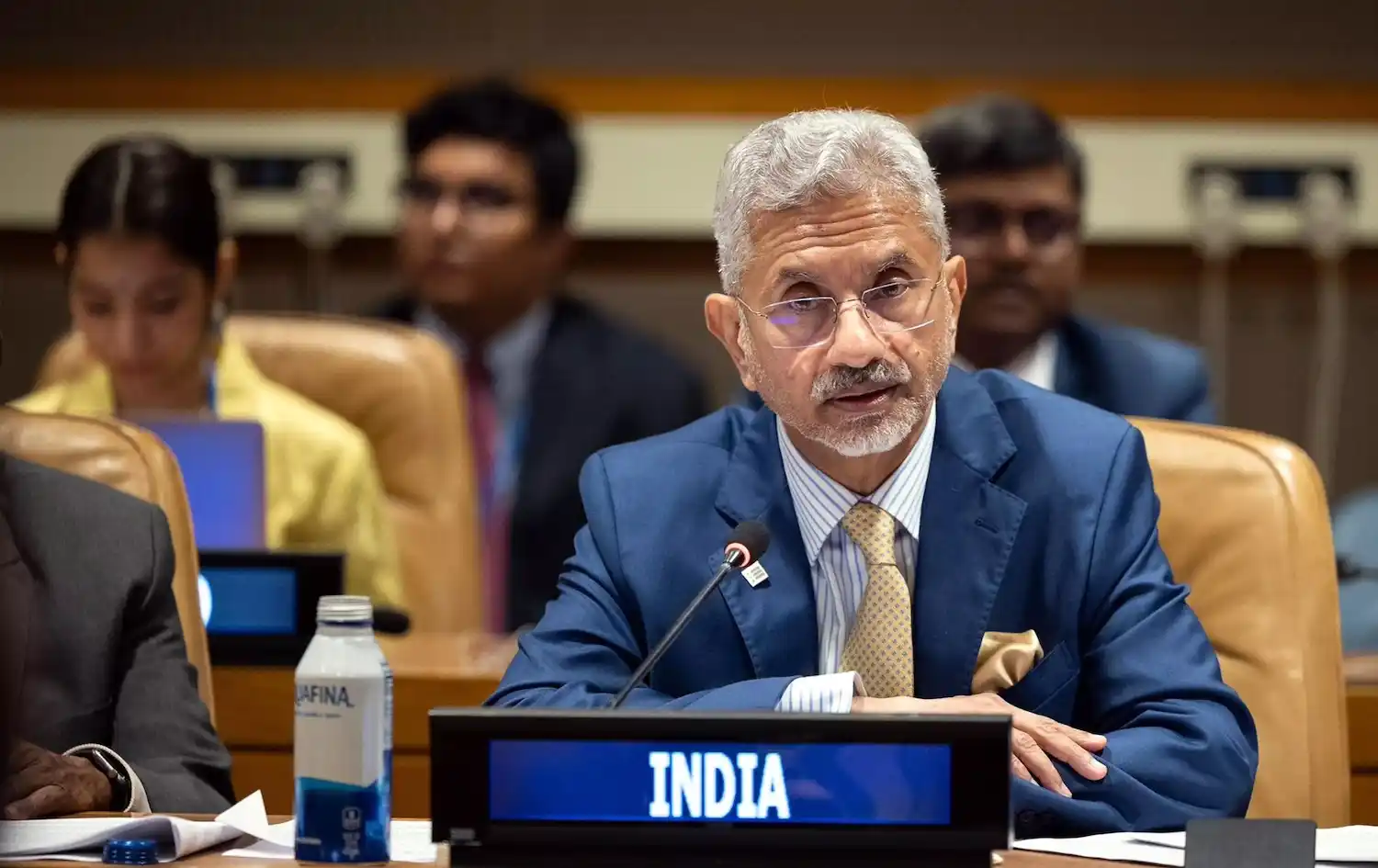
India’s External Affairs Minister (EAM) S. Jaishankar addressed the 80th session of the United Nations General Assembly on September 27, 2025, exemplifying India’s increasingly pragmatic approach to international relations. Rather than any diplomatic grandstanding, his speech reflected what one may call a calculated assessment of India’s strategic interests and the practical realities of contemporary geopolitics. The deliberate use of ‘Bharat’ in his opening, where he stated, “Namaskar from the people of Bharat”, could be looked at as less about cultural assertion and more about signalling New Delhi’s comfort with its own identity in international forums. The EAM’s speech was characterised by three broad elements: the terrorism paradigm as an aspect of offensive diplomacy, the practical philosophy of the three As framework and emphasis on the UN reforms.
First, the most striking element of Jaishankar’s address was his unflinching denunciation of Pakistan as the ‘epicentre of global terrorism’. By pointing out the UN’s own designated lists of terrorists and tracing major international terrorist attacks to “that one country”, India’s stance highlighted a tilt towards offensive accountability, rather than any defensive explanations. Such a frontal assault on Pakistan’s international standing points towards a recalibrated approach of India’s counter-terrorism diplomacy. The reference to Operation Sindoor, India’s retaliatory strikes against terror infrastructure in Pakistan following the Pahalgam attack, demonstrates New Delhi’s willingness to act unilaterally and then justify the rationale of those actions at the global stage, rather than relying solely on diplomatic protests or even international pressure to dissuade Pakistan. The revelation that Islamabad “pleaded directly for cessation” after India’s strikes on multiple Pakistani bases further transforms the narrative from that of a regional skirmish to one of strategic dominance, reassuring Indian citizens as well as demonstrating capability to its international partners.
Second, Jaishankar outlined three guiding principles, the three As: Atmanirbharta or self-reliance, Atmaraksha or securing oneself and Atmavishwas or self-confidence. These concepts reflect practical policy imperatives for New Delhi, rather than mere ideological positions. They acknowledge India’s position as a developing economy that must secure its own interests while simultaneously engaging with the world. Atmanirbharta responds to supply chain vulnerabilities that are exposed by the recent global crisis. Atmaraksha attempts to address immediate security threats that international mechanisms have failed to resolve effectively. Atmavishwas reflects India’s augmenting economic and strategic weight that naturally translates into a more assertive international presence. These should not be considered as mere philosophical terminologies, but as operational guidelines that are derived from India’s experience of the past decade. Moreover, Jaishankar’s emphasis on “freedom of choice” and being the “voice of the Global South” attempts to position India as an active shaper of international order, beyond the status of a neutral observer.
Third, Jaishankar’s focus on the UN reforms was evident in his address to the UNGA. He stated, “Central to the erosion of UN’s credibility has been resistance to reform”. This direct critique reflects India’s concerns regarding institutional paralysis, especially about the Security Council expansion. It is to be noted that New Delhi’s longstanding bid for permanent membership is not merely about prestige, but about ensuring that global governance structures reflect contemporary geopolitical realities, rather than the post-World War II global order. The EAM’s remarks acknowledge a practical truth that multilateral institutions that fail to adapt lose relevance and effectiveness. This further positions India as speaking for broader institutional effectiveness, rather than narrow national ambition. Thus, it becomes evident that India’s approach to multilateralism reflects pragmatic assessment rather than principled positioning.
The timing of this assessment during the UN’s 80th anniversary remains significant, as this year’s theme was ‘Better Together: 80 Years and More for Peace, Development and Human Rights’. Through his speech, Jaishankar subtly exposed the gap between multilateral aspirations and achievements. His call, “When nations openly declare terrorism as state policy, when terror hubs operate on an industrial scale, when terrorists are publicly glorified, then such actions must be unequivocally condemned”, indicts the UN system’s inability to act decisively against state sponsors of terrorism. Therefore, the diplomatic messaging indicated New Delhi’s embrace of multilateralism’s potential, while exposing multilateralism’s current limitations. This, thereby, helped India position itself as both a committed stakeholder as well as a necessary reformer of multilateralism, particularly in the context of the UN.
To conclude, Jaishankar’s address at the UNGA attempted to crystalise three pillars characterising India’s contemporary diplomacy- offensive accountability on terrorism backed by demonstrated military capability, operational guidelines rooted in self-reliance and self-defence instead of ideological abstractions and persistent advocacy for institutional reforms in order to restore credibility in multilateralism. These elements together represent a pragmatic adaptation in India’s strategic thinking. As global uncertainties deepen and geopolitical faultlines sharpen, India’s path ahead lies in sustaining this pragmatic approach. Thus, rather than being trapped by binary alignments or in instances of institutional paralysis, New Delhi must continue calibrating its responses pragmatically and building flexible coalitions that serve specific interests. A balance between principled consistency and tactical flexibility, that Jasishankar’s address underlined, must guide India’s strategic thinking in times to come.