Health is a very important element of human existence. Health is not just the absence of disease; it also shapes individual well-being and ultimately the development of societies and nations. Health cannot be defined as the absence of disease; the World Health Organization defines it as “Health is a state of complete physical, mental, and social well-being” (WHO, 1948). This definition reminds us that health is holistic, encompassing the strength of the body, the stability of the mind, and the ability of individuals to live with dignity and contribute meaningfully to their communities. In a country like India, with a large and youthful population, health is not just an individual personal need but also a national imperative.
India’s Achievement
India has made remarkable progress in public health: life expectancy has risen to around 65 years, and the Infant Mortality Rate (IMR), Maternal Mortality Rate (MMR), and overall death rate have all decreased significantly. Most diseases, such as polio, smallpox, guinea worm, and leprosy, have been virtually eradicated, and the birth rate is declining. The number of physicians, medical clinics, and nurses has also increased, resulting in better access to healthcare even in remote areas. Overall, these achievements have been made possible due to more extensive penetration of healthcare services, sustained improvements in immunization rates, increments in literacy levels, and many efforts from both the government and private sectors.
The economic survey of 2024-25 suggests that India’s Total Health Expenditure was roughly ₹9 lakh crore in 2021-22, amounting to 3.8 percent of GDP. This translates to approximately ₹6,600 per person. More importantly, this is an upward trend since 2019, meaning that the health sector is slowly developing.
In addition, government health insurance schemes are increasing in prominence. Health insurance schemes cover nearly 6% of health financing. Specifically, Ayushman Bharat – PM-JAY is transforming; this government health insurance scheme covers over 12 crore families (about 55 crore individuals) with in-hospital benefits up to ₹5 lakh. This has reduced the financial strain on health care: the share of out-of-pocket expenditure – or cash money a household pays out of its own funds at the point of care – has fallen from 63% of the total in 2015, to below 40% in 2021-22. This means families are less likely to be pushed into poverty due to out-of-pocket costs for illness. The scheme has expanded too. By September 2024, it will be available to all seniors over 70 years, regardless of income. With an additional ₹5 lakh annual allowance (paid for by the government scheme) to meet their health needs, 40 lakh seniors are currently enrolled in the scheme. This demonstrates policy making, understanding, and responding to new demographic challenges.
Limitations
Despite Ayushman Bharat–PMJAY covering over 12 crore families (~55 crore individuals) with up to ₹5 lakh benefits, there are still some issues that persist with this program. The share of Out-of-Pocket (OOP) expenditure decreased, but it made up 46.6 percent of total health expenditure in 2021–22, with various health costs, mostly medicines, diagnostics, and transport, excluded or under-reimbursed, thus putting households at risk.
Utilization is also uneven: across all groups, there is an uneven awareness, and relatively few households from remote areas may make it to the empanelled list, facing administrative barriers that impact access to the scheme. Even the eligibility extension for all seniors (>70) has led to lower-than-expected enrolment numbers, compared to the overall potential eligible.
Therefore, while the scheme has introduced significant innovation and progress for financial protection, the provided impact is limited by the gaps in coverage, awareness, and the infrastructure for broader overall incentivization of the program.
- The healthcare system in India has progressed; however, some issues remain and ultimately limit effectiveness. For example, awareness remains a significant gap. Earlier research found that only one-third of antenatal mothers, and only 11.3% of adolescent girls, in Haryana were aware of essential antenatal practices. While reviews have confirmed a persistent, inadequate state of literacy regarding reproductive, nutritional, and geriatric health contexts, much of this inadequacy persists, particularly in rural areas.
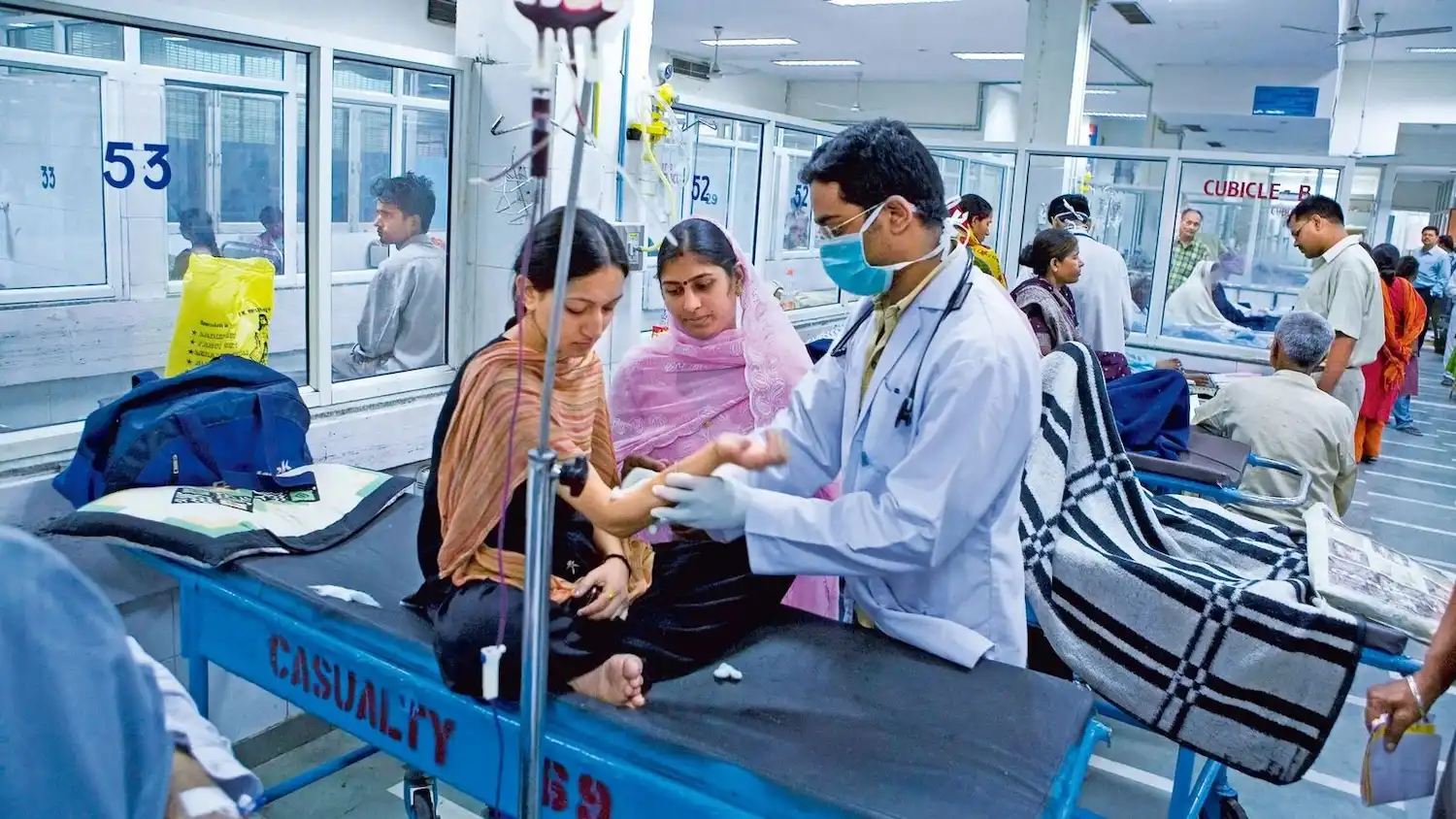
- Access to quality care is also limited. The most recent data shows that, as of 2023, only 13% of Primary Healthcare Centres (PHCs) and only 8.4% of Community Health Centres (CHCs) had basic facilities such as clean delivery rooms, beds, and reliable electricity. It is indicative of the weaknesses of health infrastructure in rural communities.
- Workforce shortages remain significant; even though medical college seats have doubled over the past 10 years, India still falls short of the WHO target of 44.5 health workers per 10,000 population. Ongoing inequities in access to healthcare persist in rural and poorer states (ResearchGate, 2024).
- Affordability is slightly better; out-of-pocket expenditure has decreased from 64.2% in 2014-15 to 39.4% in 2021-22, and government health expenditure has increased to 48% (PIB 2024). However, rural households are still paying the majority of hospital costs, upwards of 92% (The Print, 2024). Weak accountability and disparity in quality of care have led to a loss of faith in the system.
India has improved significantly in public health, with increased life expectancy, the elimination of major diseases like polio and smallpox, and successful programs such as Ayushman Bharat-PMJAY helping millions escape the financial burden of health care. However, challenges persist. General understanding of health practices remains low; there are insufficient quality services in rural areas, the necessary resources and workforce for those services are inequitable, and out-of-pocket costs cause distress for families.
India has strengths in disease management, immunization, and expanding insurance policies, but needs to act quickly to improve awareness of health care, access to care in rural areas, capacity in the health workforce, affordability, and accountability. Improvement will be required to build a fair and sustainable health system.