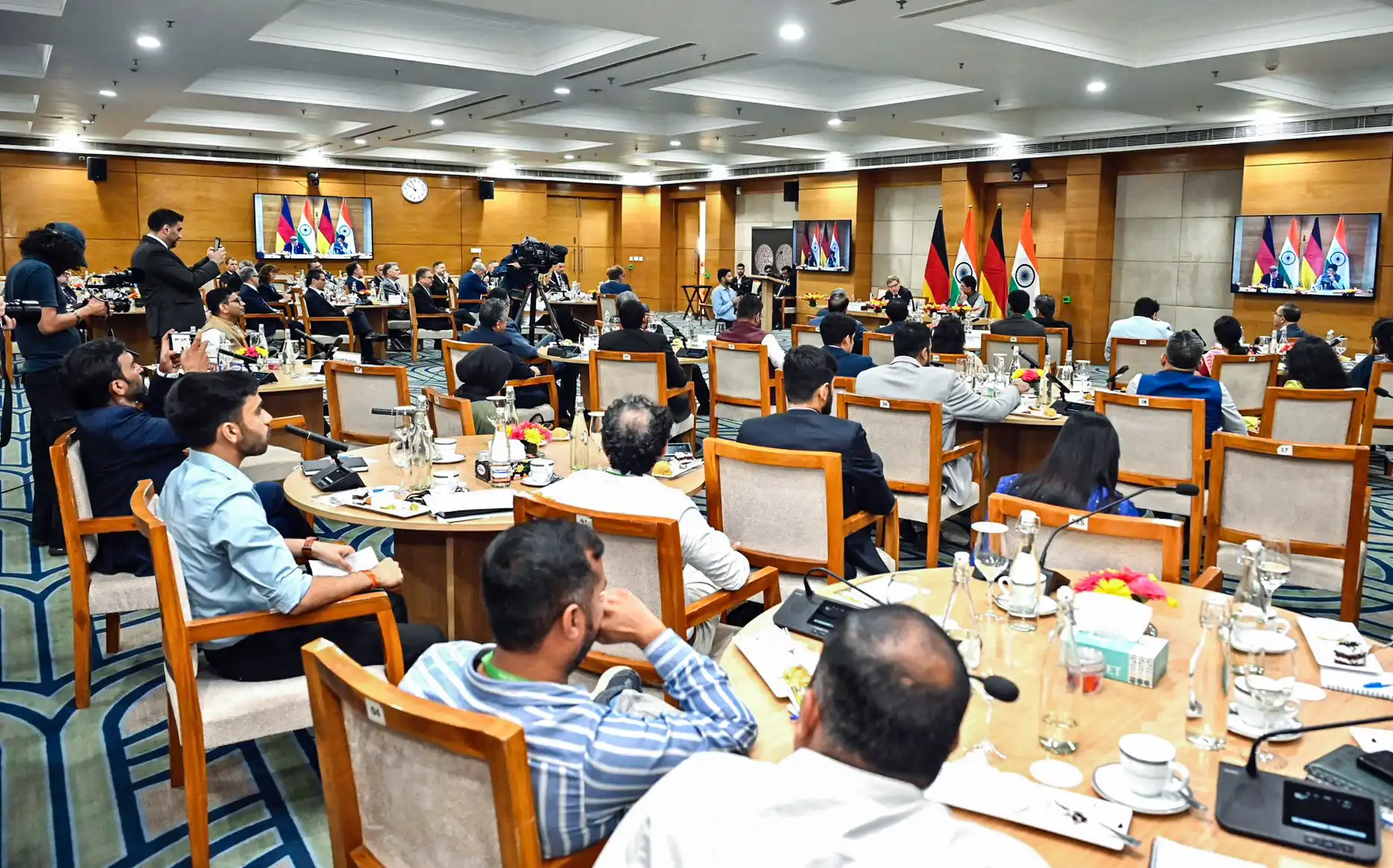
During the German Foreign Minister Johann Wadephul’s visit to India from 1-3 September 2025, the minister declared that “India equals Asia for us and Germany and the European Union, in a way, are equivalent for India”. Here, he was not indulging in mere diplomacy by equating India with the whole of Asia. His words underlined a strategic assertion that signals towards a fundamental recalibration in Berlin’s strategic thinking and its outlook towards the India-Germany ties. What exemplifies this shift is the recently cleared INR 70,000 crore submarine project under Project 75(I) that involves Germany’s ThyssenKrupp Marine Systems and India’s Mazagon Dock Shipbuilders. Taken together, these developments highlight Germany’s recognition of India as a trusted partner in its pursuit of technological sovereignty, economic diversification, and Indo-Pacific engagement.
Berlin’s interest in collaborative technology with New Delhi was explicitly signalled in the recent press interaction of German Foreign Minister Johann Wadephul and External Affairs Minister S. Jaishankar held on September 03, 2025. Wadephul expressed his admiration for India’s innovation hubs, for instance, his visit to Bengaluru and ISRO, and highlighted further cooperation in sectors like AI, space, and other technology-related fronts.
For Germany, this reflects a concern about over-dependence in technological supply chains and regulatory standards. Berlin has commenced to see New Delhi as a necessary partner to ensure access to cutting-edge research, human capital, and infrastructure, where Wadephul termed India as “an innovative powerhouse and technology center”. Similarly, on India’s part, forging partnerships in domains like research, semiconductors, AI, aerospace, and digital infrastructure provides an opportunity to move beyond being a consumer of technology and become a co-creator of such technology that meets global norms.
The clearest example of technology sovereignty playing out in practice remains the submarine deal under Project 75(I). Its emphasis on technology transfer and domestic manufacturing underlines this phenomenon, where Germany and India will be investing in shared capabilities rather than just selling and buying hardware. For Germany, it is beyond a defence export opportunity where it attempts to provide security by being a partner’s innovation backbone.
Furthermore, trade featured as a prominent agenda item of discussion between the two foreign ministers. Germany and India affirmed that their bilateral trade was nearly € 50 billion last year, and both sides expressed confidence in doubling it. German businesses are exploring the Indian market in order to diversify supply chains across sectors such as chemicals, pharmaceuticals, and electronics. Wadephul noted that more than 2,000 German companies have been operating in the Indian subcontinent and underlined the necessity of efforts to reduce market access restrictions on both ends.
The talks on trade and investments should be viewed through the prism of a strategic shift, rather than just investments chasing lower costs. Economic volatility, characterised by the pandemic, geopolitical ruptures, and trade disruption, has shown that relying on a small set of partners for sourcing everything from semiconductors to pharmaceuticals can be fatal for the domestic economy. In this regard, Berlin seems to view New Delhi as a reliable partner for its diversification agenda, offering scale, human resources, and growing domestic markets.
In addition to this, Germany’s support for India-EU Free Trade Agreement talks and discussion on easing regulatory bottlenecks and export-clearance mechanisms signals a maturity in their economic relations. India has asserted that it will address concerns regarding ease of doing business, mobility of talent, and regulatory predictability. Likewise, Germany recognises the opportunity in aligning with India’s growing capabilities.
Lastly, Germany’s Indo-Pacific interests stand prominently in its attempt to engage further with India. In the joint press interaction, freedom of maritime trade routes in the region, freedom of navigation, and regional security were expressly discussed. In a tense, volatile, and uncertain regional environment, Germany expressed its concerns and wished to cooperate with India, a prominent Indo-Pacific actor.
The submarine deal should be looked at through this dimension. By enhancing Indian underwater capabilities, Germany contributes to regional balance and deterrence, even while refraining from stationing its own forces in these distant waters. The European actor’s port call, participation in joint exercise Tarang Shakti, and calls for smoother export clearances in the defence domain together indicate that Germany is seeking a more concrete presence and footing in the Indo-Pacific than in the past years.
In conclusion, Germany’s “awakening” to India remains anchored in three concrete strategic priorities: technological sovereignty, economic diversification, and Indo-Pacific engagement. Wadephul’s September 2025 visit, clearance for the submarine deal, and statements from both ministers underline that Germany views India as a key strategic partner in multiple domains. Therefore, apart from just naval platforms, the partnership signifies deterrence, trust and the recognition that India is becoming Germany’s central partner in Asia. The submarine deal remains a proof of intent for larger collaboration; nevertheless, the deeper test lies in whether both partners can sustain this elevation in the long term.