The Politics of History
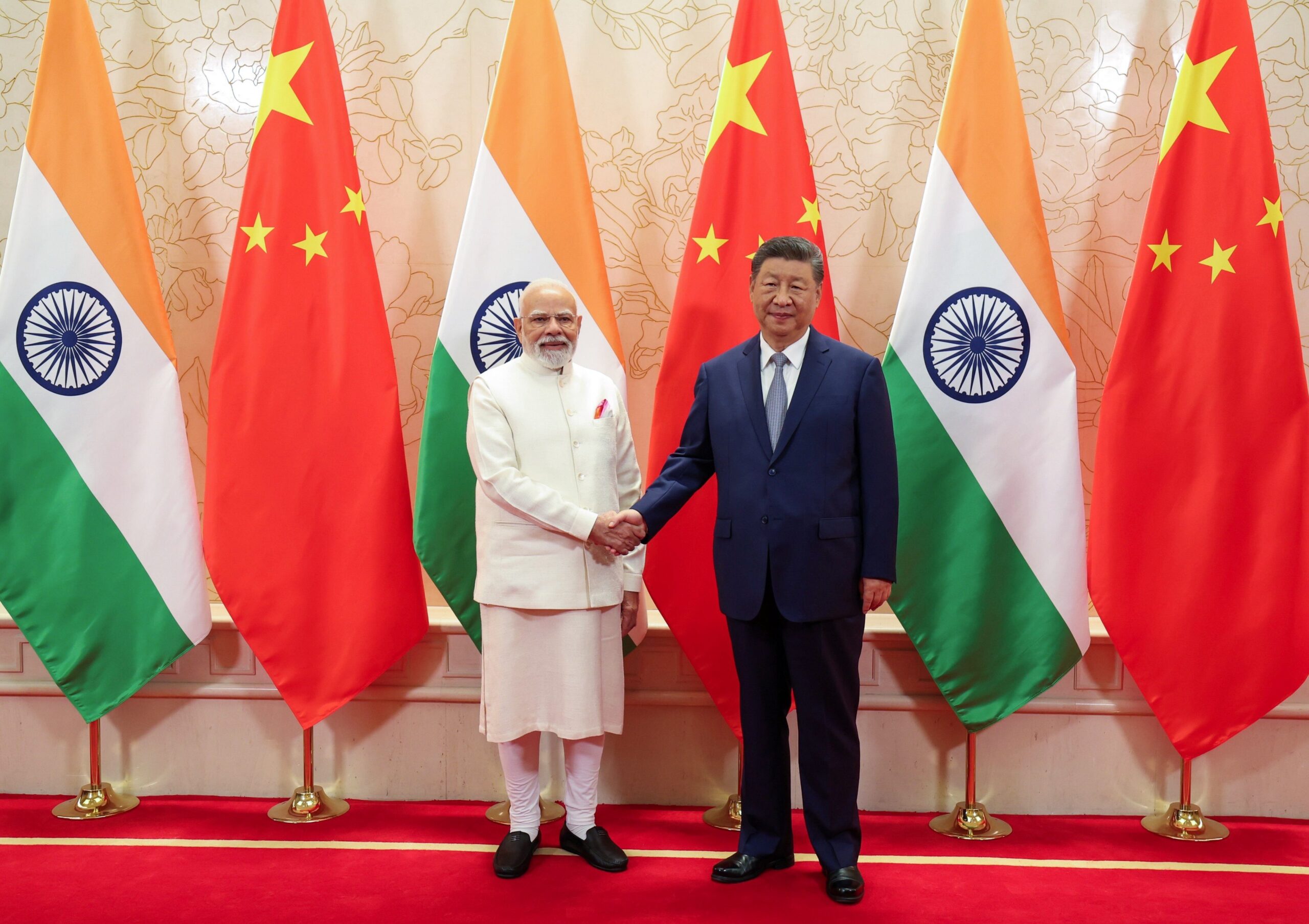
This year marks seventy-five years since India and China established diplomatic relations. A few years later, the two civilizational states, newly sovereign, pledged coexistence in the so-called Panchsheel Agreement of 1954. The Himalayan border—unsettled and disputed—has continued to cast its long shadow on this relationship of 2.8 billion people: the bitter conflict of 1962, the clashes of 1967, Tulung-La in 1975, Sumdorong Chu in 1986, Doklam in 2017, Galwan in 2020, and again in the subliminal distrust that still lingers under what is being sold as the new thaw in relations since October 2024. Thus, Prime Minister Modi’s visit to Tianjin does not carry the euphoria of late summer but the chill of memory, where every gesture must be tempered by restraint.
The Tightrope Today
The Prime Minister spoke of peace and stability along the border with China during his meeting with President Xi in Tianjin. But sixty thousand soldiers remain, disengaged, yet maintaining readiness, their presence an enduring reminder of the absence of mutual trust. Pilgrimages to Kailash-Manasarovar have resumed after a five-year hiatus. Direct flights are set to resume, and visa facilitation will be more streamlined. Meanwhile, India runs a deficit of $100 billion in imports of Chinese goods, exposing, inter alia, the harsh reality of our manufacturing (and pharmaceutical) industry’s dependence on Chinese inputs—thus defining the paradoxes of détente and dependency held in uneasy balance.
Trump’s Return, Pax Americana’s decline
Above all, this cautious pas de deux with China unfolds under the shadow of a resurgent second Trump presidency. “America First” is real: fracturing alliances, imposing protectionism. India’s relationship with the U.S. is encountering severe turbulence. It cannot rely on Pax Americana to undergird its regional vision. If there is one inference to be drawn from this, Asia must author its own architecture, rooted in autonomy rather than being dictated by the Atlantic world.
The Tokyo Interlude
Before he stepped into Tianjin, the Prime Minister was in Tokyo. It was no mere stopover, but a deliberate prelude. In Japan, he and his counterpart, Prime Minister Ishiba, affirmed the vision of a free, open, rules-based Indo-Pacific. Tens of billions in investment were pledged—semiconductors, green energy, digital infrastructure, defence cooperation—underscoring that India’s eastward arc is anchored in democratic partnerships as much as in dialogues with Beijing. The symbolism of the two prime ministers traveling on the iconic Shinkansen spoke not only of speed but also of constancy. This was India’s reassurance that engagement with China does not signal estrangement from Japan or the Quad.
The Shadow Triangle
The complexities faced by India are deepened by the China–Pakistan alliance of iron brotherhood. The Prime Minister of Pakistan was in Tianjin too for the S.C.O. Summit. The old South Asian hyphen has become a distorted triangle, with China elevating Pakistan beyond strategic relevance. That asymmetry is the new normal. For India, of course, Pakistan is not a peer, but a tactical irritant. China is the system peer.
Tibet: The Twilight Zone
There is an even subtler pressure, a metaphysical one, in the impending succession of the Dalai Lama. A reincarnation chosen in exile, beyond Beijing’s imprimatur, would challenge the India–China relationship. India may speak little. But sanctuary to the new incarnation by India could itself speak volumes and cast long shadows.
The Aftermath of Wang Yi’s Visit
Before the Prime Minister went north to Tianjin, China’s Foreign Minister Wang Yi came south to India from August 18 to 19. Over a series of meetings—starting with NSA Ajit Doval and leading to PM Modi himself—China and India renewed the rituals of diplomacy, speaking of the “strategic guidance” being provided by the leadership on both sides and announcing some tangible outcomes:
- Border Confidence Moves: India and China set up an Expert Group under the Working Mechanism for Consultation and Coordination on India-China Border Affairs (WMCC) to explore what was termed “Early Harvest” in boundary delimitation in the border areas (there is a lot to read between the lines here). Boundary talks will continue, with the next round to take place in China.
- Pilgrimage and Connectivity: Direct flights will resume. Pilgrimages to Kailash Manasarovar will expand in 2026. Border Trade will be reopened through three designated passes along the border.
- Both sides agreed to facilitate trade and investment flows between the two countries through concrete measures. Rare earth magnets, special fertilizers, and tunnel-boring equipment, for instance, are areas of particular concern for India.
- River and Trade Links: A trans-border rivers expert-level mechanism was reaffirmed, with China agreeing to share hydrological data in essentially humanitarian emergencies. EAM Jaishankar also emphasised the necessity of “utmost transparency” from Beijing on trans-border river projects (with reference to the risks associated with China’s mega hydropower project on the Yarlung Tsangpo (Brahmaputra) river).
- Counterterrorism: The Ministry of External Affairs also highlighted that terrorism in all its forms was raised as a critical issue during EAM Jaishankar’s talks with Wang. This is especially in the context of cross-border terrorism fuelled from Pakistan, on which China has been unprincipled and refused to take a condemnatory stand.
Conclusion: Not breakthroughs, but ballast—steadying the deck beneath our feet.
Trilateral Stagecraft: Modi, Xi, and Putin
And then, Tianjin. Vladimir Putin was also in the frame. The summit projected a troika of proximity: India, China, and Russia together in one tableau. Cameras captured the symbolism—handshakes, shared laughter, gestures of ease. Putin denounced Western “bullying,” Xi pressed multipolarity, Modi reaffirmed strategic autonomy, terrorism concerns, and a multipolar Asia.
This stagecraft was not an accident. It reminded the world that Asia is no longer scripted by one superpower, that India will neither vanish into China’s embrace nor become a pawn of Washington, that Russia still breathes relevance even under sanctions. The imagery was powerful: Modi, Xi, Putin—three leaders, three trajectories, converging briefly in one frame.
The Archer on the Iceberg
Yet, India walks the tightrope on China. In Tianjin, China and India have pledged to be partners and not rivals in carefully couched diplomatese. Warm words emanated from Tianjin, but sweet words butter no parsnips. Pious statements alone will not suffice. The bow is drawn, the aim uncertain. More than being the elephant, as some refer to it, India is the archer standing on a thin iceberg. The slightest tremor can shift the balance. India must be prepared.
It must navigate with careful intent, not illusions of friendship. Asia’s future depends on whether its giants—India and China—can transcend old disputes to build a multipolar tomorrow. Prudence, patience, and purpose must guide us.
Reimagining the Indo-Pacific
We stand at a crossroads. Trust and empathy between nations have entered a season of drought. Asia cannot wait for a stable or principled America to re-emerge. It must craft a regional architecture from its own agency. As I have said elsewhere, we need six guardrails: strategic restraint, maritime rules, interoperable economies, continental-maritime balance, a China that does not play disruptor, and technological sovereignty. These are not lofty ideals—they are necessities. India and China are together the spine of Asia. If we fail to use our strengths wisely, no one else will build a stable future for us. In that sense, the fact that India and China are once more in touch, in dialogue with each other, and their leaderships are attempting to rebuild a damaged relationship, is a positive development.