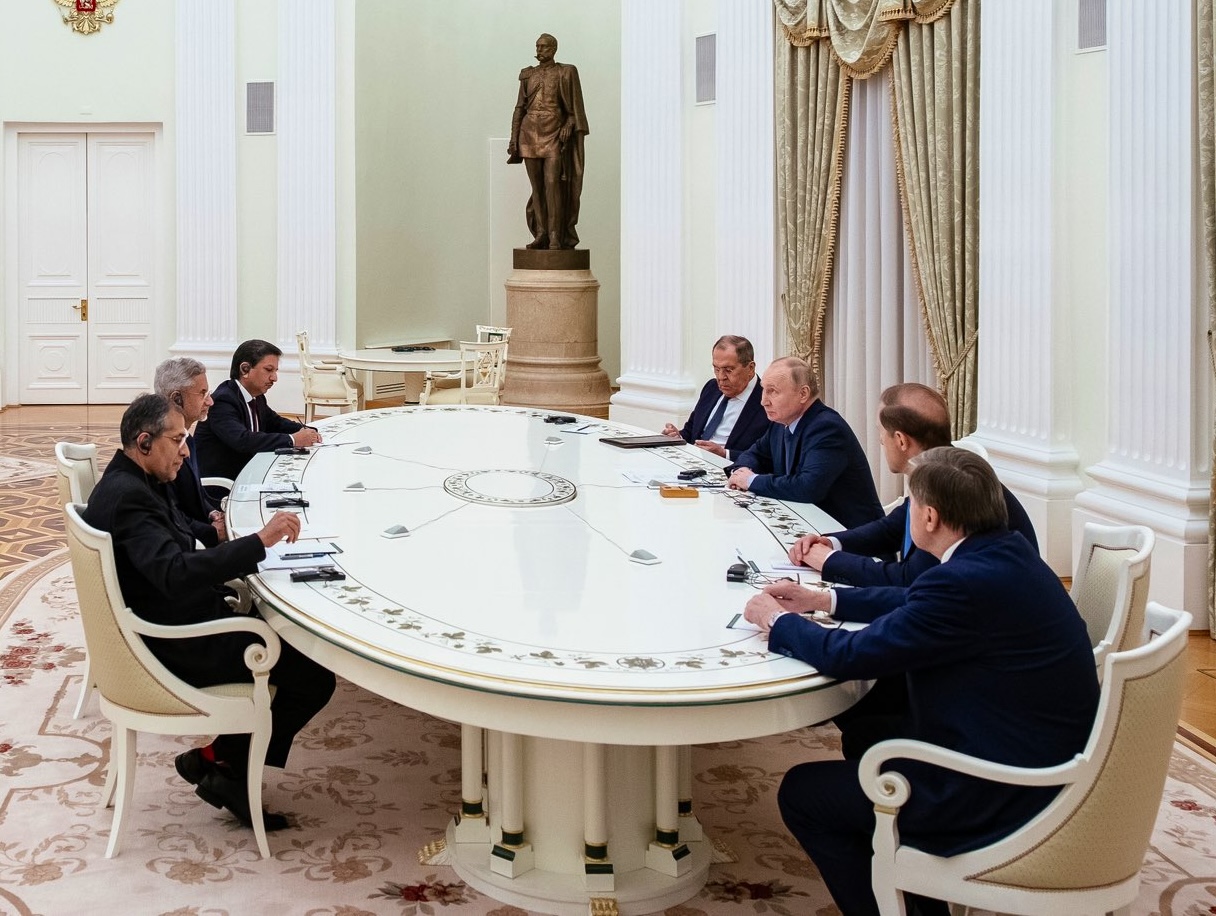
The Indian External Affairs Minister Dr. S Jaishankar concluded his three-day visit to Russia from 19-21 August 2025 on the invitation extended by the First Deputy Prime Minister of the Russian Federation, Mr. Denis Manturov. Dr. Jaishankar officially visited Russia to co-chair the 26th session of the India-Russia Inter-Governmental Commission on Trade, Economic, Scientific, Technological, and Cultural Cooperation (IRIGC-TEC) on 20 August 2025 and also addressed the India-Russia Business Forum meeting in Moscow. Dr. Jaishankar also met his Russian counterpart Sergey Lavrov on 21 August 2025, and the significant encounter with President Vladimir Putin gained further impetus to his official visit. The meetings and interactions between the counterparts of India and Russia were a prelude to the upcoming annual bilateral summit by the end of this year.
Key Takeaways from the Moscow Meet
Amidst the growing anxiety between India and the United States and the recently concluded Alaska talks 2025, the official visit of EAM Jaishankar to Russia comes at a critical juncture. Highlighting some of the major takeaways from the official visit of Dr. Jaishankar are: at the IRIGC-TEC interaction, he opined that despite the growing economic ties comprising around $58.9 billion, there exists the issue of the significant trade imbalance between India and Russia. In this context, he called for diversification of trade items that go beyond energy and raw materials. He further stated that exploring the relevance of ‘Make in India’, investment, and alluring foreign business will be the key to advancing economic cooperation. Additionally, attention was brought to resume the Eurasian Economic Union (EAEU) trade talks, which were halted in 2022 following the deterioration in Russia-Ukraine relations. First Deputy PM Manturov also stated that Russian oil and other energy supplies will continue to reach India, adding that Moscow was eyeing new opportunities for LNG exports.
In his remarks at the India-Russia Business Forum in Moscow, Dr. Jaishankar surmised that geopolitical challenges such as the COVID pandemic, unresolved conflicts, economic volatility, and many such developments have posed a significant challenge for India-Russia bilateral engagements. These untoward developments though have assisted in assimilation of ‘common lessons’, it has also given scope for identifying the importance of dependable and steady partners which in this case is India-Russia bilateral relations.
The meeting between EAM Jaishankar and his counterpart FM Lavrov signalled a positive interaction that called for a more robust engagement in global and multilateral fora, including BRICS, G20, and SCO, alongside a committed and prominent role in the UN. In a broader spectrum, Dr. Jaishankar also highlighted India’s pledge towards dialogue and diplomacy on regional issues surrounding Afghanistan, Ukraine, and West Asia in resolving the crisis. The ‘zero tolerance policy’ towards terrorism has been a key feature in terms of ‘common concerns’ in India-Russia, as both countries have been casualties of terrorist attacks. EAM Jaishankar’s meeting with President Putin discussed key issues of the bilateral agenda and contemporary global issues of mutual interest, including the developments related to Ukraine.
Regions of Russia, such as Kazan and Yekaterinburg, are host to a significant number of Indian medical students. Listing out the backlogs and pending commitments, Dr. Jaishankar prompted for the opening of two new Indian Consulates at full tilt in Kazan and Yekaterinburg, as it is set to deepen people-to-people ties, including regional outreach further, and enhance trade. Dr. Jaishankar also showed concern about over-dependence on limited market options, including reliance on narrow connectivity and limited logistics.
Providing a summation of the visit by Dr. Jaishankar, the perusal of the interactions was more pragmatic in approach and critical in evaluating the progress the bilateral engagement has made in the recent past. This also conveys that the partnership has reached a ‘comfortable’ zone where a realistic introspection by the leaders has signaled the aim for a result-oriented bilateral relation.
Expanding Connectivity and Trade Corridors
India-Russia relations have explored trade corridors and mechanisms through which the bilateral relations continue to see an upward trend. In this regard, the Eastern Economic Forum, International North‑South Transport Corridor, the Chennai–Vladivostok eastern maritime corridor, and cooperation are a case in point. As a prerequisite to a new era of cooperation, these corridors promise to deepen economic linkages, reduce transit times, and expand trade access across Eurasia and beyond, however, more initiatives at the bilateral level especially exploiting national policies such as Samudhra Manthan which is a deep Ocean Mission that aims to not only unlocking vast reserves of minerals and biodiversity but also explore oil and gas reserves in the sea. With the center of global economic gravity seemingly shifting toward the Indo-Pacific, India-Russia may also move beyond the Delhi-Moscow-centric approach and explore the regional connectivity offered by regions such as Astrakhan, Rostov-on-Don, Cochin, Port Blair, and the North East, among others, to enhance regional connectivity.
As India becomes the fourth-largest economy with a GDP surpassing $4 trillion, its economic growth is valuable for the bilateral cooperation and its active participation in BRICS and SCO. For instance, exploring the potential of BRICS under the National Administration and Mobilization of Entrepreneurialism (NAME), which aims to bring together the largest pools of skilled citizens and SMEs, is crucial, given India’s success in hosting startups and young entrepreneurs. As Dr. Jaishankar displayed apathy towards the limited market options, India may also reinvigorate those export items that had once captured the Soviet market, such as tea, handicrafts, spices, etc.
Looking Ahead: Building a Resilient Partnership
As part of the ministerial level interaction, the conclusion of EAM Jaishankar’s visit to Russia and also the interaction with Chinese counterpart Wang Yi on 19 August 2025, has caused a possible thaw in the relations. These events have given scope to explore the prospects of stronger cooperation and overcome impediments, thus providing further scope for the three Eurasian giants to establish the vision carried forward by RIC.
While focusing on strengthening an enduring partnership, the two countries aim to build bridges that overcome impediments such as addressing the backlogs and insulating the bilateral partnership from geopolitical tensions and sanctions. Nevertheless, the visit of EAM Jaishankar has set the stage for President Putin’s visit to India for the 23rd annual bilateral summit scheduled to take place in the year end.