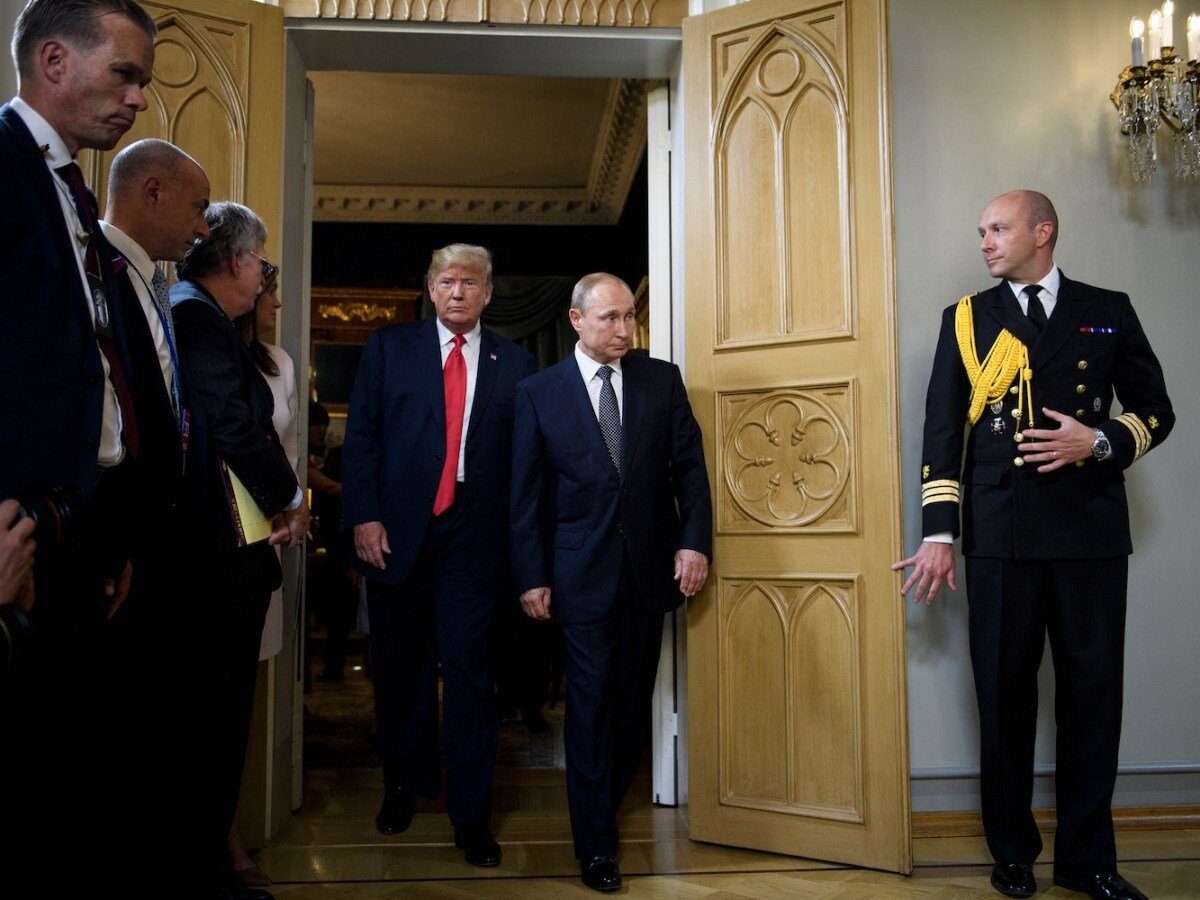
The world will be watching with great interest the outcome of the Trump-Putin meeting in Alaska. Normally, such meetings at the summit level are carefully prepared to ensure positive outcomes. Trump’s envoy Steve Witkoff has had more than one meeting in Moscow with Putin, with the most recent one achieving some breakthrough. The Russian side made it known that the latest US proposal was acceptable. This has paved the way for the Alaska summit.
While the Russian side has refrained from publicly talking about the US proposals, Trump himself, as is his wont, has been talkative about aspects of what to expect at Alaska. He has mentioned some exchange of territories between Russia and Ukraine as part of an eventual solution. Russia will withdraw from some Ukrainian territory it has occupied in Sumy, Kharkiv, and the Dnipropetrovsk region in exchange for Ukraine withdrawing from Donbass, while the battle lines in Zaporizhzhia and Kherson will be frozen. Whether this is kite-flying or deliberate leaks to prepare public opinion is unclear.
Nothing has filtered out about the status of the core Russian demands, namely, no NATO membership for Ukraine and the country’s demilitarisation. It is difficult to imagine that. Russia will yield on these fundamental demands, as otherwise the three years of war would seem a costly error. It is also difficult to imagine that Trump can commit himself formally to meeting these demands at Alaska. While Trump has already ruled out Ukraine’s NATO membership, the question is how the issue of security guarantees for Ukraine will be addressed.
For Zelensky, security guarantees are a code word for NATO membership or some form of guarantee by NATO countries. Already, individual European countries such as France, Germany, Italy, the UK, Denmark, Poland, and others have signed security agreements with Ukraine. These agreements, some lasting 10 years, outline commitments to provide security and military assistance to Ukraine in the face of potential future Russian aggression. However, without the US backing them, these guarantees are not really meaningful, as these countries are in no position to enter into a direct conflict with Russia on their own.
Zelensky continues to try his best to prevent a US-Russian agreement over Ukraine’s head. He has already stated repeatedly that Ukraine will not agree to any cession of its territory to Russia. He wants to be a party to the talks at Alaska. He is demanding that Russia agree to a ceasefire before the territorial issues are discussed. Trump has promised that he would be the first to be briefed after the summit. Europe is livid at being excluded from the US-Russian peace negotiations on Ukraine. For it, the issue is one of European security and, therefore, Europe must be consulted.
Europe seeks to derail as much as possible the US-Russia negotiations over Ukraine. European leaders such as Macron of France, Merz of Germany, Meloni of Italy,, Starmer of the UK, Tusk of Poland, Stubb of Finland, and the EU’s von der Leyen have issued a strongly worded statement a few days ago reiterating their continued substantive military and financial support to Ukraine as well as more sanctions on Russia.
They have made Ukraine’s security an issue vital to Europe’s own security. Europe has unconditionally adopted the Ukrainian position on Russia as its own. Their rhetoric about not changing international borders by force or Russia’s violation of the UN Charter sounds hollow in the light of their own record. Be that as it may, the short point is the inherent contradiction in their position in that they want to be part of the US-Russia dialogue even while they strongly oppose it.
Many believe that Russia should have no interest in a ceasefire without a clear understanding of the larger issues involved because a ceasefire would give breathing space to a battered Ukraine to reorganise itself, build up defences in critical areas, receive more arms and training missions, and so on. It would seem that the Trump administration is tempering expectations that major progress towards a ceasefire could be made at Alaska. It is calling the summit a “listening exercise”. Secretary of State Rubio has given a similar spin by saying that Trump wants to size up Putin face-to-face.
The anti-Trump Western politicians and foreign relations experts are calling the meeting in Alaska, on US soil, a diplomatic success for Putin. He has, in their view, obtained acceptability and, indeed, an equality of status with the US president. This is a far cry from being declared a war criminal. For both sides, the issues to be discussed go beyond Ukraine. Witkoff has been discussing broader issues of an economic nature. Nuclear disarmament issues are important because of the New Start Treaty expires in February 2026 and both sides would prefer to renew it to avoid a new arms race. US commentators believe Trump wants to wean Russia away from China so that America can focus primarily on the threat from China. These are issues that go beyond US-Europe ties.
India has welcomed the projected Trump-Putin dialogue at Alaska, which it believes holds the promise of bringing to an end the ongoing conflict in Ukraine and opening up the prospects for peace. India is ready to support these efforts. We have reiterated Prime Minister Modi’s dictum that this is not an era of war.
Trump’s egoism and erratic nature, his lack of attention to detail, his impatience, his view of diplomacy as mere deal making, his blowing hot and cold on talks with Russia, optimistic and pessimistic at different moments, recognising that Russia cannot be defeated and yet threatening even to bomb Moscow, raises the question why Russia thinks he can be taken at his word and whether any understanding with him can be durable, especially as anti-Russian sentiment in the US is very deep. But maybe Putin judges that keeping Trump engaged is helpful in many ways. At least the two leaders are talking, some diplomatic dialogue has been restored, these direct Russia-US contacts are causing cracks in transatlantic unity, Europe is being put in its place and is being burden with costs, and so on.
If some understanding is reached in Alaska and there is some unfreezing of US-Russia ties, then Trump’s decision to impose an additional penalty of 25% tariffs on India for its energy and defence ties with Russia would lose its rationale. Let us see.