
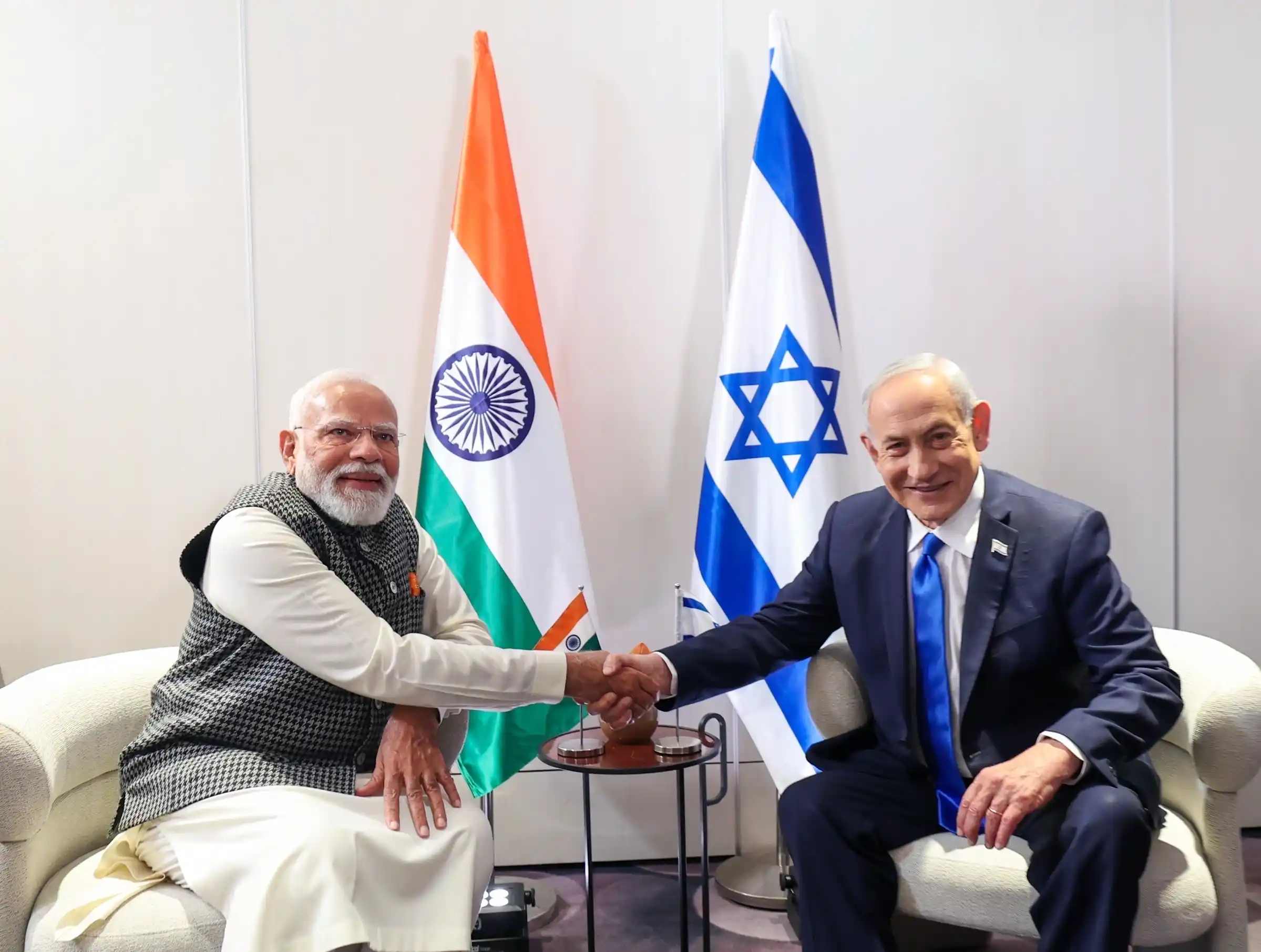
Indian Prime Minister Narendra Modi’s ongoing two-day state visit to Israel marks a pivotal moment in the evolving strategic partnership between the two nations. Hosted by Benjamin Netanyahu, the trip, PM Modi’s second since his landmark 2017 journey, centers on defense collaboration, a nascent free-trade agreement, and innovation-driven ties, all set against the backdrop of a fragile post-Gaza ceasefire and shifting West Asian geopolitics. With bilateral trade already surpassing $10 billion annually, the leaders aim to unlock a new era of economic and technological interdependence, signaling India’s assertive pivot westward.
PM Modi touched down at Ben Gurion Airport on February 25, greeted by Netanyahu and his wife Sara in a ceremonial embrace that underscored their personal chemistry. The Israeli prime minister, facing domestic scrutiny post-Gaza war, used the occasion to project strength through high-profile alliances. PM Modi’s itinerary is packed: bilateral summit talks in Tel Aviv, a historic address to the Knesset, India’s first by a sitting prime minister, and a community event highlighting the safety of Jewish life in India.
Today, February 27th, PM Modi is scheduled to visit Yad Vashem, the Holocaust memorial, meet President Isaac Herzog, and preside over the signing of memorandums of understanding. Netanyahu hosted a private dinner the previous evening, where sources indicate discussions touched on immediate deliverables like defense tech transfers and trade roadmap acceleration. This red-carpet treatment is no mere protocol; it’s a deliberate optic of two leaders betting on mutual resilience amid global flux.
Free Trade Momentum Builds in Tandem
Parallel to PM Modi’s visit, the first round of India-Israel Free Trade Agreement (FTA) negotiations kicked off in New Delhi on February 23, extending through February 26. Building on a 2025 Bilateral Investment Treaty (BIT) and pre-negotiated terms of reference, the talks cover goods, services, customs facilitation, intellectual property, and rules of origin. Commerce officials from both sides, led by India’s Rajesh Agrawal, described the timing as “opportune,” targeting an ambitious conclusion within 18 months to boost trade toward $20 billion by 2030.
The FTA push reflects pragmatic economics: Israel seeks Indian markets for its cybersecurity and agritech exports, while India eyes high-end defense systems, semiconductors, and desalination tech. PM Modi’s political endorsement from Tel Aviv injects urgency, with expectations of interim pacts on digital trade and investment protections. This economic architecture insulates ties from regional volatility, complementing the BIT’s investor safeguards.
Defense Ties: From Arms to Interoperability
Defense remains the bedrock, with talks expanding beyond procurements to joint production and intelligence sharing. India, modernizing its forces amid border tensions with China and Pakistan, values Israel’s drones, missile defenses, and counter-terror tech, evident in recent deals like the “Sudarshan Chakra” air-defense system. PM Modi’s Knesset speech drove home ideological alignment: “Jews in India live without fear,” he declared, framing terrorism as a shared scourge.
New MoUs are anticipated on cybersecurity, quantum computing, and maritime security, building on 2025’s “Operation Sindoor” drills that demonstrated interoperability. Israel, diversifying arms clients post-Ukraine war, sees India as a stable, high-volume partner. This pillar extends to countering Iran-backed proxies, aligning with Netanyahu’s “hexagon” security framework involving Greece, Cyprus, and now India.
Innovation and Beyond-Defense Horizons
The visit reorients ties toward “innovation-led” domains: AI, agritech, water management, and semiconductors. Israel’s drip-irrigation and desalination expertise addresses India’s climate challenges, while joint ventures in quantum and cyber bolster both nations’ tech sovereignty. PM Modi positioned this as symbiotic: India’s scale meets Israel’s ingenuity, fueling Atmanirbhar Bharat (self-reliant India) goals.
Connectivity emerges as a wildcard. Discussions revive Haifa port as a Mediterranean gateway for Indian goods to Europe, bypassing chokepoints like the Red Sea. This “maritime-plus-land corridor” integrates with India’s IMEC vision, enhancing energy security and logistics amid Houthi disruptions.
| Bilateral Trade Snapshot (2025) | India Exports to Israel | Israel Exports to India | Growth YoY |
|---|---|---|---|
| Total Volume | $6.5B | $4.2B | +15% |
| Key Sectors | Gems, pharma | Defense, diamonds | – |
| FTA Target (2030) | $12B | $8B | +25% CAGR |
Navigating Gaza’s Shadow and Regional Flux
In his historic address to the Knesset, the first by an Indian prime minister, he extended India’s deepest condolences for the lives lost in Hamas’s “barbaric terrorist attack” on October 7, 2023, stating: “We feel your pain. We share your grief. India stands with Israel, firmly, with full conviction, in this moment, and beyond.” He emphasized that “no cause can justify the murder of civilians” and that countering terrorism demands “sustained and coordinated global action,” framing India and Israel as partners in resilience against shared threats.
Geopolitically, PM Modi’s presence burnishes Netanyahu amid Western isolation, while advancing India’s multipolar strategy. With U.S. strikes on Iran proxies escalating, India positions as a security provider linking South Asia to the Levant. For Israel, India offers a democratic counterweight in Asia, hedging against China’s regional inroads.
Long-Term Stakes for Two Democracies
The award of the first-ever ‘Speaker of the Knesset Medal’ upon Prime Minister Shri @narendramodi is truly a special gesture.
— Dr. S. Jaishankar (@DrSJaishankar) February 25, 2026
It is a fitting recognition of PM Modi’s unique role in crafting the India – Israel partnership and his steadfast commitment to taking it forward.
🇮🇳 🇮🇱 pic.twitter.com/BRGGNMFok0
This visit cements India-Israel ties as a strategic countercurrent to traditional alignments. Economically, the FTA and BIT promise resilience; technologically, they fuel dual-use innovation; security-wise, they enhance deterrence. As PM Modi departs on Thursday, expect joint statements framing a “robust partnership between two resilient democracies.”
For India, it’s about securing tech edges in a China-shadowed world. For Israel, it’s diversification amid isolation risks. The Modi-Netanyahu chemistry charts a pragmatic path forward, one that could reshape West Asian connectivity for decades.

