
When US President Donald Trump described India’s economy as “dead,” his words weren’t just diplomatically jarring — they were flatly disconnected from economic reality. Trump’s post, seemingly aimed at criticizing India’s growing ties with Russia, dismissed the world’s fourth-largest economy as lifeless. That’s not just wrong; it’s absurd.
India is not a dead economy. It’s a dynamic, evolving, and increasingly critical engine of global growth. The numbers speak louder than any tweet.
A Three-Decade Surge
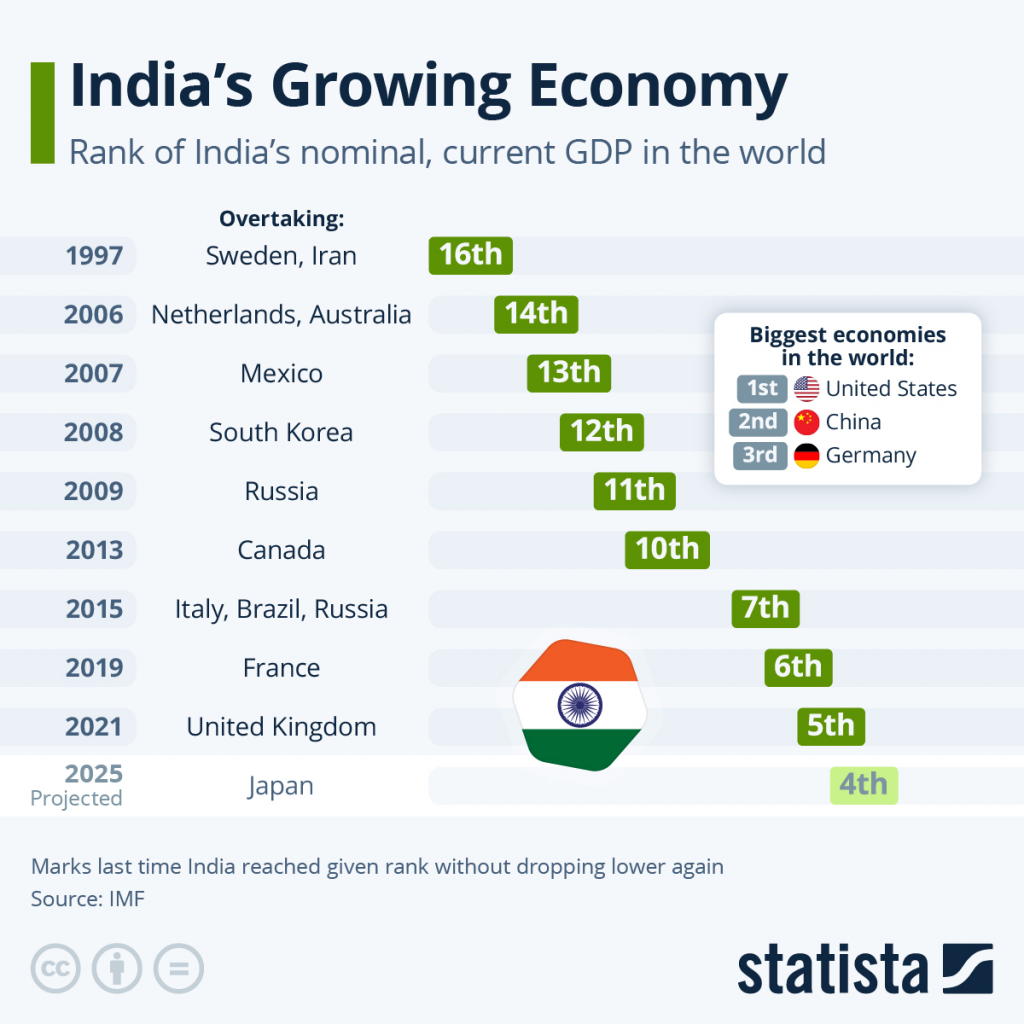
Let’s rewind to 1995. India’s GDP was barely 5% the size of the U.S. economy. Fast forward to 2025, and that figure has nearly tripled to 14%. Over the past 30 years, India’s economy has expanded nearly twelvefold — outpacing the likes of Germany, the United Kingdom, and even Japan, whose economy is now smaller than it was in 1995. If economic growth is the litmus test for vitality, then India is very much alive — and thriving.
According to IMF data, only three major economies have grown in size relative to the U.S. over the past three decades: China, Russia, and India. These are the very economies Trump derided. Meanwhile, the GDPs of America’s closest allies — the UK, Germany, and Japan — have either stagnated or shrunk in comparison.
India has also undergone a remarkable transformation, shedding its “fragile five” status of the early 2010s to emerge as the fastest-growing major economy in the world. Union Minister Piyush Goyal recently underscored this transformation in Parliament, noting that India is now poised to become the third-largest economy globally within a few years.
Growth Amidst Complexity
Is India’s economy without flaws? Of course not. It faces challenges — persistent inequality, rural distress, and slow manufacturing growth are real concerns. Female labor participation remains low, and youth unemployment is aggravated by a stark mismatch between skills and opportunities.
Yet to use these issues to label the entire economy as “dead” is akin to calling a thriving forest dead because some trees are diseased. India’s GDP has surpassed $4 trillion mark this financial year, nearly double its size in 2014. Its exports, while still a small share of global trade, have steadily grown over the past decade. And India’s young, skilled, and entrepreneurial workforce is positioning the country as a global innovation hub.
The country’s structural challenges should not be ignored, but they should be understood in the context of its scale. India is home to over 1.4 billion people, and reforming such a vast and complex economy is a long-term project. The good news is: the direction is right.
Global Perceptions vs Political Rhetoric
International institutions and economists are not buying into the doom narrative. On the contrary, they increasingly view India as a “bright spot” in the global economy, contributing nearly 16% of global growth. That’s hardly the mark of a comatose economy.
Trump’s comments may reflect frustration over stalled trade negotiations or India’s independent geopolitical stance. But that’s politics, not economics.
The Road Ahead
India still has work to do. The country must boost manufacturing, overhaul its education and skilling systems, and make growth more inclusive. But these are the challenges of a developing, not declining nation. The pulse of India’s economy is strong — and beating faster.
As the world reconfigures its supply chains and economic alliances in the post-pandemic era, India stands not at the margins but at the center of emerging possibilities. Those who write off India as “dead” are not just misinformed — they’re missing out on one of the most significant economic transformations of the 21st century.
India is not a fading force. It is a rising one.

