
India’s economic story is often told through exports, startups, or manufacturing ambitions. Yet one of the most significant and underappreciated drivers of the country’s transformation is the rapid rise of Global Capability Centres (GCCs). Once viewed primarily as offshore support hubs, these centers have quietly evolved into engines of innovation, high-value engineering, and global strategy. Their growth is not accidental; it reflects a deeper shift in how India positions itself within the global knowledge economy.
What are Global Capability Centres?
Global Capability Centres (GCCs) are offshore units established by multinational companies to deliver specialized business functions and strategic capabilities for their global operations. These centres operate as integrated extensions of the parent organization, handling activities such as information technology services, research and development, engineering, data analytics, finance, customer support, and digital innovation.
Unlike traditional outsourcing hubs, modern GCCs are designed to create long-term value. They leverage skilled talent, advanced technology, and cost efficiencies in a host country to drive innovation, improve operational efficiency, and support global decision-making. Over time, many GCCs have evolved from back-office support roles into strategic centres that lead product development, artificial intelligence initiatives, and enterprise transformation.
GCC Outlook in India
Today, GCCs represent far more than outsourced service units. They have become strategic extensions of multinational corporations, handling research and development, advanced analytics, cybersecurity, artificial intelligence, and product design. This evolution signals a structural upgrade in India’s role in global business, from a cost-saving destination to a capability-building powerhouse.
The numbers alone tell a compelling story. In just five years, GCC revenues have expanded dramatically, reflecting steady annual growth and increasing value creation. Millions of professionals are now employed within these centers, many working on cutting-edge technologies rather than routine back-office operations. If current projections hold, the sector could cross the $100-billion mark within this decade, making it one of the most influential components of India’s services economy.
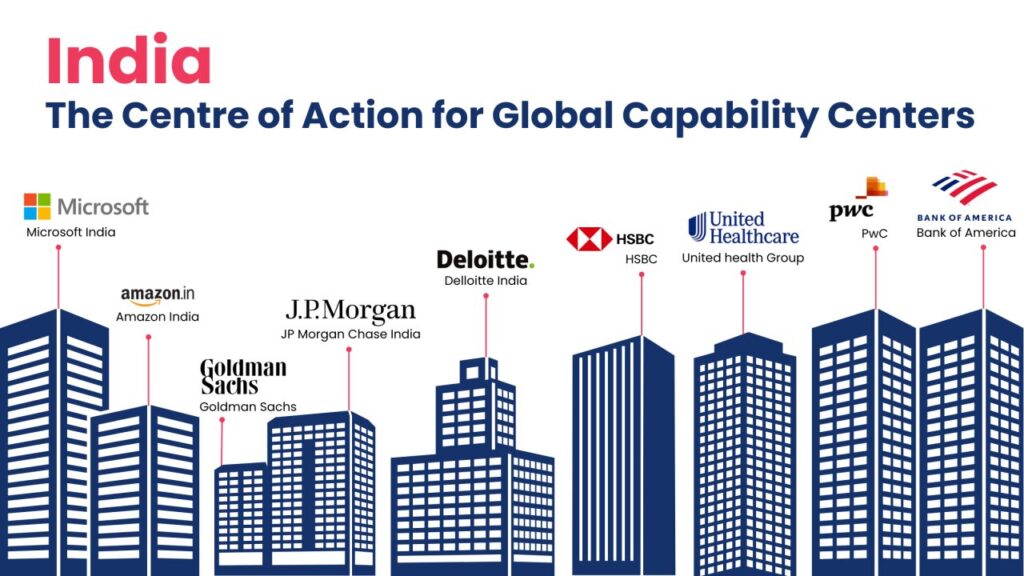
What makes this shift particularly noteworthy is the nature of the work being done. GCCs are no longer limited to transactional tasks; they are central to enterprise transformation. Engineering research in aerospace, semiconductors, advanced manufacturing, and defense technologies is increasingly being led from India. Artificial intelligence and machine learning are no longer experimental buzzwords; they are core operational tools embedded into product development and global decision-making processes. The implication is clear: India is not just executing global strategies; it is helping define them.
This transformation has been powered by a unique convergence of policy vision and market forces. Over the past decade, government initiatives have laid the groundwork for sustained growth. Infrastructure programs offering plug-and-play facilities and ready-built industrial clusters have made it easier for companies to set up operations quickly. Liberalized foreign investment policies and streamlined regulatory processes have reduced friction for global firms entering the market. Meanwhile, the country’s push to improve ease of doing business has created an environment where expansion is not only feasible but strategically attractive.
Equally important is India’s thriving startup ecosystem. The country now hosts one of the largest startup landscapes in the world, creating a pipeline of innovation that feeds directly into GCC operations. Rather than operating in isolation, many multinational centers collaborate with local startups to develop new solutions in AI, cloud computing, fintech, and digital services. This symbiotic relationship strengthens both sides: startups gain access to global networks and resources, while corporations benefit from entrepreneurial agility and local insight.
However, perhaps the most decisive factor behind the GCC boom is India’s talent advantage. With a vast share of the world’s STEM graduates and software engineers, the country offers a scale of skilled professionals that few others can match. Government-led digital skilling initiatives have further expanded this talent pool, preparing workers for roles in cybersecurity, data science, and emerging technologies. The result is a workforce capable not only of executing global mandates but also of leading innovation initiatives.
Yet this success story raises an important question: can India sustain its momentum as the GCC ecosystem expands? Rapid growth brings its own challenges. Infrastructure in major tech hubs is already under strain, and competition from emerging destinations in Southeast Asia and Eastern Europe is intensifying. Companies will increasingly look beyond traditional metros, expanding into Tier-II and Tier-III cities where costs are lower and talent is emerging. This decentralization could reshape India’s urban economic landscape, spreading opportunity more evenly across regions.
Moreover, as GCCs transition into leadership hubs, the expectations placed on India’s workforce will evolve. The next phase of growth will demand not only technical expertise but also strategic thinking, cross-cultural management, and global leadership capabilities. Projections suggest that the number of senior leadership roles based in India could rise sharply in the coming years, a sign that multinational corporations are placing greater trust in local decision-making.
Critics may argue that GCCs remain dependent on global corporate strategies and external demand cycles. That concern is valid, but it overlooks the deeper transformation underway. By anchoring high-value engineering and innovation work within India, GCCs contribute to domestic capability-building. They strengthen local supply chains, encourage knowledge transfer, and create spillover benefits for academia and startups. In effect, they are becoming catalysts for broader economic modernization.
There is also a geopolitical dimension to consider. As global supply chains diversify and companies seek resilient operating models, India’s GCC ecosystem offers stability combined with scale. The country’s policy continuity, English-speaking workforce, and digital infrastructure make it an appealing alternative in an era of economic uncertainty. For India, this represents an opportunity to move up the global value chain, not by competing solely on cost, but by offering intellectual capital and innovation leadership.
The future of India’s GCC story will depend on how effectively policymakers and industry leaders address emerging risks. Continued investment in infrastructure, education, and research will be essential. Equally important will be ensuring that growth remains inclusive, extending opportunities beyond major urban centers and fostering collaboration between corporations, startups, and universities.
The rise of Global Capability Centres reflects a broader truth about India’s economic trajectory. The country is no longer just the world’s back office; it is becoming a global brain trust. By aligning policy reforms with technological ambition and human capital, India has built an ecosystem where multinational corporations can innovate, not merely operate. If this momentum continues, GCCs may well become one of the defining pillars of India’s journey from service economy to innovation powerhouse, a transformation that could reshape not only corporate strategy but the very narrative of India’s place in the world economy.