

India and Oman are set to ink a Comprehensive Economic Partnership Agreement (CEPA)—a modern form of free trade agreement covering goods, services, investments, and labor mobility. Negotiations began in November 2023 and have moved swiftly, with a formal announcement expected in August 2025 after cabinet clearances in both countries and final translation work in Oman.
This deal reflects more than tariff adjustments—it is part of India’s broader push to secure high-value market access, investment flows, and strategic footholds in key regions.
Highlights of the CEPA
- Tariff Reductions
The FTA will slash or remove customs duties on a wide range of products traded between India and Oman. For many goods, especially Indian exports currently facing around a 5% duty in Oman, the agreement will mean direct price competitiveness and better margins. - Services and Investment Facilitation
Beyond goods, the CEPA addresses service trade liberalization and investment-friendly regulations. This includes sectors like infrastructure, manufacturing, IT, and logistics. - Labour Protections
A sensitive point in talks was Oman’s “Omanisation” policy, which mandates private companies to hire a minimum quota of Omani nationals. India pushed for explicit carve-outs to safeguard its large expatriate workforce—over 480,000 Indians—ensuring they are not disproportionately affected by future policy shifts. - Trade Composition
- India’s exports to Oman: engineering goods, pharmaceuticals, machinery, textiles, food products, and chemicals.
- India’s imports from Oman: petroleum, LNG, urea, petrochemicals, minerals, metals.
- Strategic Investment Linkages
The CEPA is expected to encourage Omani and broader Gulf capital inflows into Indian strategic infrastructure projects—ports, industrial corridors, and logistics hubs. India, in turn, can participate in Omani ventures such as the Duqm Port, enhancing maritime connectivity.
Why This Matters for India
1. Export Boost and Industry Competitiveness
Eliminating Oman’s 5% import duties will directly enhance the competitiveness of Indian goods, particularly in iron and steel, electronics, textiles, plastics, automotive components, and machinery. These sectors align closely with Make in India goals, offering scale expansion opportunities and job creation at home. For small and medium enterprises (SMEs), tariff-free access can open lucrative Gulf markets without the pricing disadvantage they previously faced.
2. Catalyzing Investment and Infrastructure
By reducing regulatory friction and creating predictable investment conditions, the CEPA will encourage Omani funds into India’s infrastructure, logistics, and manufacturing sectors. India’s existing private sector presence in Oman—through joint ventures and service contracts—can expand into higher-value domains like renewable energy, port operations, and digital infrastructure.
3. Enhancing Energy Security
Oman is a reliable Gulf supplier of crude oil, LNG, and fertilizers. Tariff reductions on these imports will lower input costs for Indian refiners, power producers, and farmers. This adds stability to India’s energy security strategy, reducing exposure to price shocks and supply disruptions.
4. Safeguarding Indian Workers Abroad
Labor mobility is not just a human issue—it’s an economic one. Indian expatriates in Oman send significant remittances home, supporting millions of families. By negotiating protections against restrictive hiring quotas, India ensures that its skilled and semi-skilled workers retain opportunities, while companies employing them avoid disruptive workforce changes.
5. Strategic and Geopolitical Gains
Oman’s location near the Strait of Hormuz, a chokepoint for 20% of global oil shipments, gives it outsized strategic importance. Stronger trade and investment ties deepen trust and open doors for defense cooperation, maritime security initiatives, and coordinated infrastructure projects. In a Gulf region where China is expanding its economic influence, India’s CEPA with Oman strengthens its position as a preferred partner.
6. Regional Connectivity and Supply Chain Resilience
The Duqm Port—strategically located outside the Strait of Hormuz—offers India a maritime link to Africa, Europe, and the Middle East. Using Oman as a re-export and logistics hub could diversify India’s trade routes, reduce dependence on congested channels, and increase resilience against geopolitical disruptions.
7. Managing Risks and Trade Balance
While the FTA brings opportunities, India must manage its trade deficit with Oman. Without safeguards, increased imports of petroleum and petrochemicals could widen the gap. The government’s strategy will need to focus on boosting high-value exports—electronics, precision instruments, specialized machinery—and ensuring that rules of origin prevent third-country dumping through Oman.
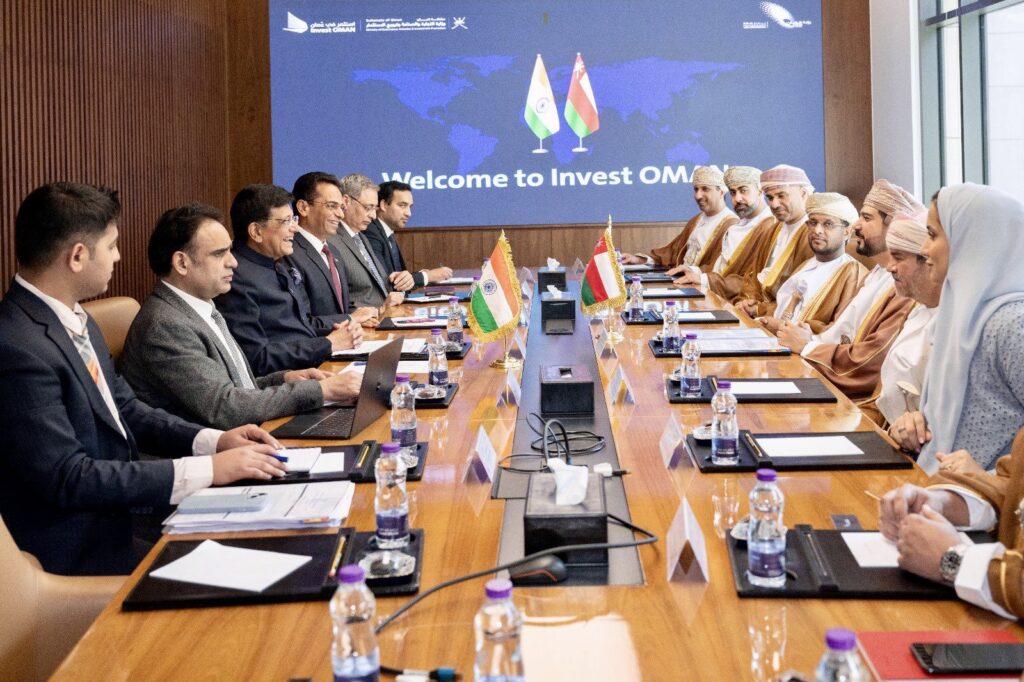
How It Fits in India’s Broader Trade Strategy
This CEPA aligns with India’s ongoing shift towards targeted, region-specific trade agreements. Rather than universal tariff cuts, the emphasis is on agreements that combine market access with strategic positioning—a model seen in the India–UAE CEPA and India–Australia ECTA. With Oman, the partnership integrates trade, investment, labor mobility, and geopolitical calculus into a single framework.
It also builds India’s role in the Gulf Cooperation Council (GCC) network. Though the GCC’s collective FTA with India remains on hold, bilateral deals like this can serve as building blocks for a future region-wide arrangement.
The Road Ahead: Implementation Will Be Key
Signing the CEPA is only step one. The real benefits will depend on:
- Speedy customs and regulatory harmonization to avoid bottlenecks.
- Alignment of standards in pharmaceuticals, engineering products, and food safety to enable seamless trade.
- Efficient dispute resolution mechanisms to ensure investor confidence.
- Active monitoring of labor provisions to ensure protections for Indian workers are honored.
Indian businesses will need to move quickly to leverage the new market access—identifying product niches, building Omani partnerships, and exploring re-export opportunities to Africa and Europe.
Bottom Line
The India–Oman CEPA is more than a tariff deal—it’s a strategic economic bridge between South Asia and the Gulf. It offers India tariff-free access to a receptive market, secures energy and labor interests, attracts Gulf investment, and deepens geopolitical engagement in a region critical to global trade and security.
If implemented effectively, this agreement could become a cornerstone of India’s Gulf diplomacy and a template for future FTAs—blending economic pragmatism with strategic foresight. For India’s exporters, investors, and workers, Oman may soon be more than a trading partner—it could be a gateway.

