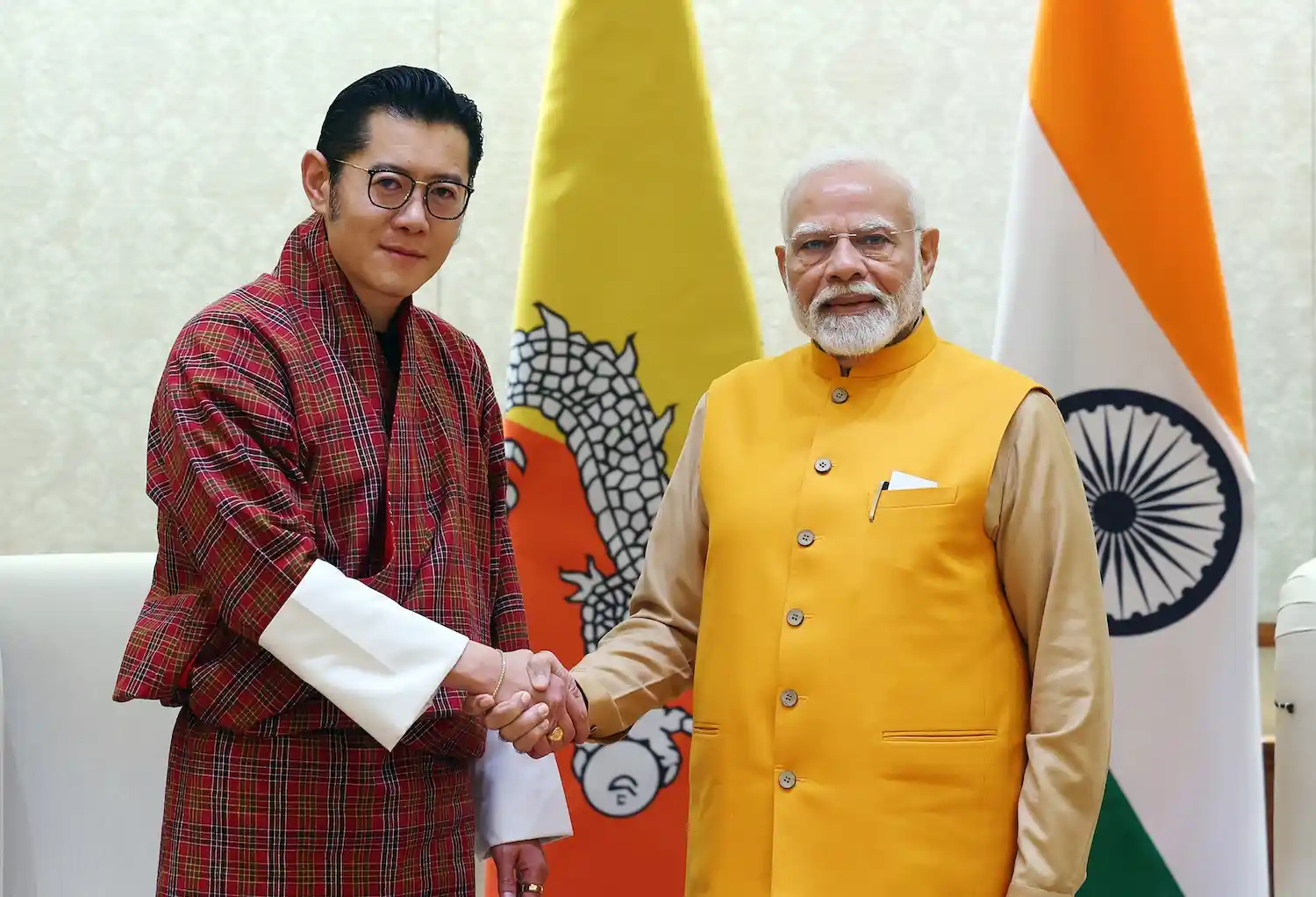
Prime Minister Narendra Modi’s upcoming visit to Bhutan on November 11–12 is poised to be a landmark moment in the bilateral relationship, underscoring the deepening ties between India and Bhutan. The occasion gains added significance as Bhutan not only celebrates the 70th birthday of its revered Fourth King, Jigme Singye Wangchuck, but also inaugurates the fully commissioned 1,020 MW Punatsangchhu-II Hydropower Project. This dual milestone reflects the evolving nature of India-Bhutan cooperation, where strategic development projects and shared cultural respect converge to strengthen regional stability and mutual prosperity.
This fourth trip to the Himalayan kingdom deepens spiritual symbolism as India has dispatched the sacred Piprahwa relics of Lord Buddha to Bhutan for the ongoing Global Peace Prayer Festival, intertwining spiritual heritage with modern statecraft while also harnessing the unique strength of its closest partner that projects shared values on a global stage.
With profound devotion, #Bhutan welcomes the Holy #Piprahwa Relics of Lord Buddha. The Holy Relics were ceremoniously received with Sedrang led by the Tshogki Lopen of the Central Monastic Body, Lyonpo Tshering, the Home Minister, Shri Sandeep Arya, the Indian Ambassador to… pic.twitter.com/d37oe3TbqF
— International Buddhist Confederation (IBC) (@IbcWorldOrg) November 8, 2025
While India is actively focused on Connectivity, Cooperation, and Cross-border initiatives with Bhutan, it must actively recalibrate its regional strategy in an increasingly complex geopolitical landscape of South Asia.
Infrastructure as Statecraft: GMC, Hydropower, and Railway Corridors
The inauguration of the fully commissioned 1,020 MW Punatsangchhu-II Hydropower Project, financed through a 30% Indian grant and 70% loan arrangement, will nearly double Bhutan’s electricity generation capacity.
The two railway projects —The Kokrajhar-Gelephu corridor (69 km) and the Banarhat-Samtse link (20 km) promise to integrate Assam and West Bengal directly with Bhutan’s southern regions, representing India’s commitment to developing its northeastern frontier as a zone of common prosperity rather than insecurity. In this process, Assam is being offered with economic potentialities- pathways for trade, tourism, and people-to-people exchange. These projects, while reshaping India-Bhutan-Northeast India connectivity, also mark Bhutan’s entry into the railway age.
While Gelephu, as the anchor of the Gelephu Mindfulness City (GMC) aims to synergise Assam’s infrastructure development and Bhutan’s mindful urban planning, it will further enhance connectivity through the planned railway links and an international airport, harnessing broader South Asian economic corridors. India’s support for this project demonstrates strategic foresight: helping Bhutan realize its ambitions while securing India’s economic integration through regional corridors.
Purpose-driven Development
India’s assistance to Bhutan has transcended traditional donor-recipient dynamics. Beyond infrastructure-led developments, India provides over 950 scholarships annually in Indian universities and contributes significantly to healthcare, digital connectivity, education, and agricultural development. Unlike extractive partnerships, India’s approach respects Bhutan’s development philosophy centered on Gross National Happiness (GNH); a holistic framework balancing economic growth with environmental sustainability, cultural preservation, and governance quality.
The 283 High Impact Community Development Projects worth Rs 417 crore, focused on drinking water, rural roads, irrigation, and agricultural infrastructure, further demonstrate visions for a village-level transformation. Therefore, rather than imposing a GDP-obsessed development paradigm, India has implicitly acknowledged that genuine partnership means honouring your partner’s values. This, in particular, is a lesson India urgently needs to internalize across its broader South Asian engagements.
While Bhutan welcomes the developmental impetus and infrastructural connectivity offered by India, it remains acutely aware of the risks of over-dependence. While practicing strategic pragmatism, Thimphu welcomes progress and cooperation while also guarding its sovereignty, culture, and environment against erosion in the face of India’s growing influence. This nuanced balancing act underscores Bhutan’s aspiration to chart an independent yet interconnected future in South Asia.
What Lies Beyond Bhutan? Reimagining South Asian Partnership
Modi’s visit’s significance lies not only in its bilateral dimensions but also in what it should precipitate eventually: a fundamental reorientation of India’s approach to broader South Asian engagement. India must now think boldly about differentiated engagement with South Asian nations. While Bhutan’s success is not replicable elsewhere, given its unique historical, geographic, and political conditions, combining development assistance with respect for partner autonomy, infrastructure with cultural exchange, strategic interest with genuine concern for human welfare should guide India’s approach to the domestically troubled South Asian nations-Nepal, Bangladesh, Sri Lanka, and even Myanmar.
It is time for India to architect a coherent South Asian strategy in which successful partnerships like Bhutan serve as demonstration models of what genuine regional cooperation can achieve. Specifically, New Delhi may explore trilateral initiatives with Bhutan and Nepal (on cultural preservation and Buddhist tourism), Bangladesh (on hydropower cooperation and sustainable development), and Sri Lanka (on maritime connectivity and Indian Ocean security).
As the global order shifts to the east, international competition for influence in South Asia is intensifying. The region itself yearns for genuine development partnerships rather than great-power manipulation. India, as the voice of the Global South, must demonstrate that it can be a different kind of significant power within its own region.