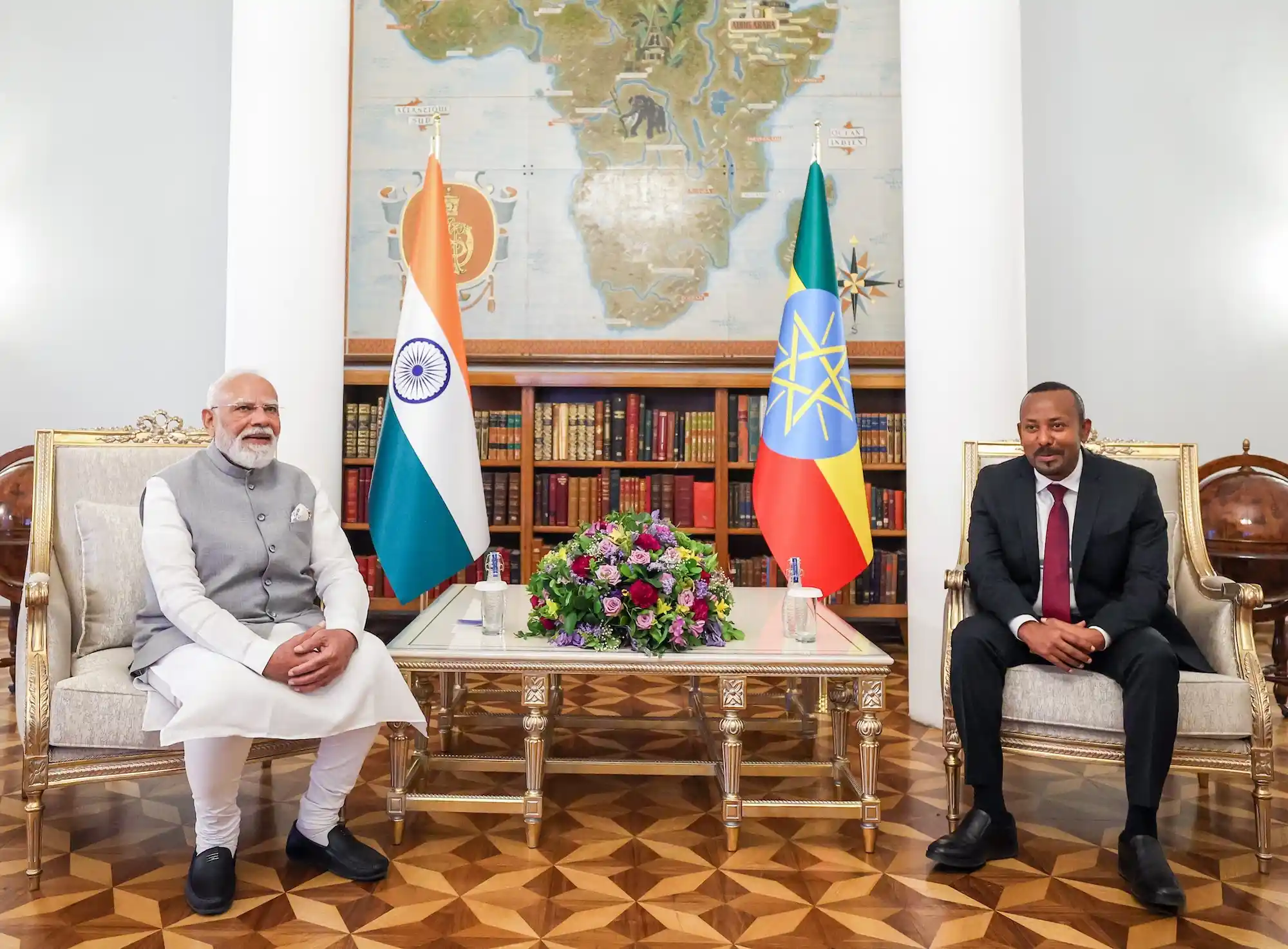
Indian Prime Minister Narendra Modi’s visit to Ethiopia marked a qualitative jump in the relationship, upgrading it to a “Strategic Partnership” and tying together trade, security, technology, and people-centric development. The outcomes listed by both governments underline how New Delhi and Addis Ababa are trying to translate decades of political goodwill into hard economic and developmental gains.
India and Ethiopia already shared dense historical and political ties, from anti-colonial solidarity to India’s longstanding role in Ethiopian education and capacity-building. The formal elevation of ties to a Strategic Partnership gives that legacy a contemporary anchor, signalling regular leader-level engagement, closer coordination on regional security in the Red Sea–Horn of Africa arc, and a stronger diplomatic bridge between India and the African Union, headquartered in Addis Ababa. For Ethiopia, it is also a way of diversifying external partnerships at a time of economic stress and complex regional security challenges.
List of Outcomes: Bilateral Visit of PM @narendramodi to the Federal Democratic Republic of Ethiopia pic.twitter.com/2PUpkGC6N5
— Randhir Jaiswal (@MEAIndia) December 16, 2025
Hard security and multilateral cooperation
One key strand of the visit is security cooperation, especially on United Nations peacekeeping. An Implementing Arrangement on cooperation in UN Peacekeeping Operations Training builds on India’s experience as one of the largest troop contributors and Ethiopia’s record of deploying contingents in Africa-based missions. By institutionalising joint training, both sides gain interoperability and political capital in UN forums where peacekeeping reform and mandates are hotly debated.
Counter-terrorism and maritime security also formed part of the strategic conversation, given Ethiopia’s proximity to the Red Sea choke points and India’s expanding naval footprint in the Western Indian Ocean. Though not framed as an alliance, the partnership subtly pushes back against extremist spillovers and great‑power competition in the Horn of Africa.
Trade facilitation, data and customs cooperation
Economically, the visit tries to remove some of the friction that has limited a relatively modest bilateral trade figure of around USD 550 million, despite India being one of Ethiopia’s top trading partners. The Agreement on Co‑operation and Mutual Administrative Assistance in Customs Matters is aimed at easing documentation, improving information‑sharing, and tackling smuggling or mis‑invoicing that can hurt revenue on both sides.
Equally significant is the MoU to establish a Data Centre at Ethiopia’s Ministry of Foreign Affairs. This plugs directly into India’s pitch on exporting Digital Public Infrastructure—secure, low‑cost platforms for identity, payments and governance—which many African states see as a pathway to leapfrog legacy systems. For Ethiopia, which is liberalising sectors like telecom and finance, Indian support on secure data architectures offers both technology and political reassurance.
Debt relief and economic stabilisation
One of the more politically resonant outcomes is the MoU on debt restructuring for Ethiopia under the G20 Common Framework. Ethiopia has been battling high external debt and foreign-exchange shortages; India’s support within the multilateral process adds both flexibility and credibility to Addis Ababa’s restructuring talks with major creditors. For New Delhi, it showcases a Global South‑friendly approach to sovereign debt crises that contrasts with perceptions of opaque or security‑linked lending by some other major powers.
People-centric development: health, skills and education
Where the visit stands out is its focus on visibly “people-centric” deliverables—a phrase Modi himself emphasised in his public remarks. India’s commitment to help augment the capacity of the Mahatma Gandhi Hospital in Addis Ababa, particularly in maternal and neonatal care, responds directly to Ethiopia’s public‑health priorities and gives a high‑visibility flagship to the partnership. Building specialised units, training staff, and supplying critical equipment can have outsized impact on women and infants in urban and peri‑urban catchment areas.
On the human-capital side, the doubling of scholarships for Ethiopian students under the ICCR programme and specialised short-term courses on Artificial Intelligence under the ITEC framework extend a long tradition of Ethiopian elites studying in Indian universities. The AI courses, in particular, align with Addis Ababa’s ambition to build a tech startup ecosystem while ensuring its bureaucracy is not left behind in understanding emerging technologies. These initiatives cultivate a generation of Ethiopian professionals with lived experience of India, deepening soft power that no single trade deal can replicate.
Why this visit matters for the Global South
Stepping back, the outcomes of the visit illustrate how India is trying to frame its Africa engagement as a partnership of equals focused on capacity, resilience and autonomy rather than extractive deals. Ethiopia, as a populous African state hosting the AU headquarters and sitting at the crossroads of the Red Sea, the Nile Basin, and the wider Horn, is a strategic test‑case for that model.
By combining debt relief, digital infrastructure, health cooperation, education, and security training into a single package, the Modi–Abiy roadmap presents an alternative narrative of South‑South cooperation at a moment when both the Horn of Africa and the multilateral system are under stress. If these outcomes translate into visible change on the ground—faster customs clearance, a functioning data centre, a better-equipped public hospital, and more Ethiopian students and peacekeepers trained with Indian support—the India‑Ethiopia “Strategic Partnership” could become a template New Delhi seeks to replicate elsewhere on the continent.