
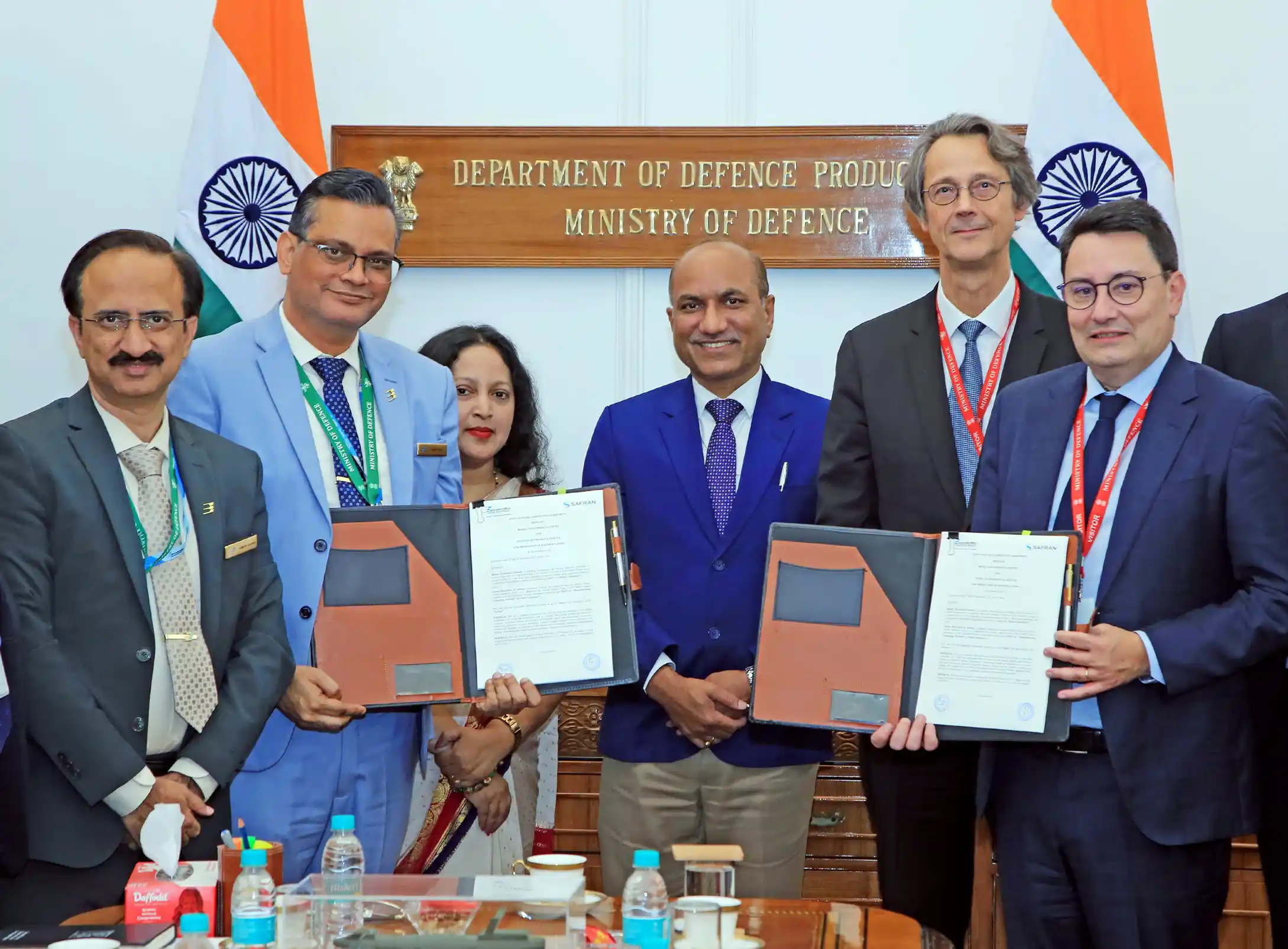
India’s decision to jointly manufacture HAMMER precision-guided air‑to‑ground weapons with France is both a hard power upgrade and a strategic validation of New Delhi’s defence industrial turn under ‘Make in India’ and ‘Aatmanirbhar Bharat’. By pulling a combat‑proven Western weapon into an Indian production ecosystem, New Delhi is signalling it no longer wants to be just an arms buyer, but a serious manufacturing hub in its own right.
The HAMMER (Highly Agile Modular Munition Extended Range) is a French precision‑guided air‑to‑ground weapon that turns standard unguided bombs into stand‑off “smart” munitions with a range of around 70 km, using add‑on guidance kits and a rocket booster. Its modular architecture allows multiple guidance options—INS/GPS, INS/GPS with infrared, or INS/GPS with laser—making it effective even against jamming and in difficult weather or terrain.
Originally developed by Safran Electronics & Defence, HAMMER is designed for tasks such as close air support, suppression of enemy air defences and deep precision strikes against hardened targets like bunkers, radar sites and logistics hubs. The system gained Indian visibility when it was used from Rafale jets during high‑profile missions, including operations linked to Pakistan‑focused counter‑terror strikes, where its accuracy and low collateral damage profile were seen as key advantages.
The new India–France joint venture
The agreement pairs India’s state‑owned Bharat Electronics Limited (BEL) with France’s Safran Electronics and Defence in a 50:50 joint venture company that will manufacture, supply and maintain HAMMER systems in India for the Indian Air Force and Indian Navy. The joint venture formalises intent first signalled at Aero India 2025 and is structured as a private limited company, giving it greater flexibility in operations and partnerships within the wider Indian ecosystem.
Under the deal, indigenisation is expected to progressively rise to about 60 per cent, covering key sub‑assemblies, electronics and mechanical components manufactured within India. BEL will lead final assembly, testing and quality assurance, while Safran brings the core design, critical technologies and integration know‑how, aligning with India’s offset and technology‑transfer preferences in recent defence contracts.
Operational gains for the IAF and Navy
For the Indian Air Force, local production of HAMMER directly supports Rafale squadrons and the integration of the weapon on the indigenous Tejas Mk1 and Mk1A fleet, which has already undergone trials with the system. Stand‑off precision capability from both imported Rafales and home‑grown Tejas jets strengthens deterrence vis‑à‑vis China and Pakistan by allowing high‑value strikes without entering dense enemy air defence zones.
The Indian Navy is set to benefit as well, with the joint venture expected to supply HAMMER for Rafale‑M carrier‑borne fighters and potentially other future platforms. Local maintenance and through‑life support will reduce turnaround time during crises, ensuring sustained sortie generation and ammunition availability in a prolonged conflict scenario—something pure import models struggle to guarantee.
Why this is a ‘Make in India’ win
First, shifting HAMMER production to Indian soil directly reduces long‑term import dependence and foreign exchange outgo on a weapon that will be central to air operations for decades. Instead of buying fully built units from France, India will build most of the system at home, retaining value, building supply chains and creating high‑skill jobs in electronics, precision engineering and testing.
Second, the joint venture structure fits neatly into New Delhi’s defence offset and co‑production model, which uses big imports like Rafale jets to pull OEMs into India‑based manufacturing and technology partnerships. By committing to a 50:50 JV with a rising indigenisation ceiling, France is effectively betting on India as a production base, mirroring similar moves in aero‑engine cooperation and other aerospace projects.
Technology transfer and ecosystem effects
Although the most sensitive intellectual property will likely remain with Safran, the localisation of sub‑assemblies, electronics and mechanical modules creates a new layer of Indian competence in precision‑guided munitions. Indian suppliers drawn into the HAMMER chain can later feed into other missile, glide bomb and UAV projects, multiplying the technology‑spillover effect of a single JV.
Over time, Indian engineers co‑working on integration, testing and potential custom variants can adapt HAMMER for local requirements, including different warhead types or platform‑specific tweaks for Tejas, future AMCA fighters or even unmanned combat systems. This moves India away from “plug‑and‑play” imports towards genuine design participation, which is central to the long‑term vision of Aatmanirbhar Bharat in defence.
Strategic and diplomatic signalling
On the diplomatic plane, the deal deepens the India–France strategic partnership, which already spans Rafale fighters, submarine cooperation and negotiations on a jointly developed fighter jet engine with Indian intellectual property. Paris has consistently positioned itself as a technology partner willing to localise production, and the HAMMER JV reinforces France’s niche as India’s go‑to defence collaborator beyond the US–Russia binary.
For New Delhi, showcasing a cutting‑edge European weapon line built in India is also about narrative: it underlines that ‘Make in India’ is evolving from licence‑assembly of basic platforms to co‑manufacture of sophisticated precision systems with export potential. If the JV scales successfully, India could eventually pitch itself as a regional hub for HAMMER support and components, linking economic ambition with strategic leverage in the wider Indo‑Pacific.

