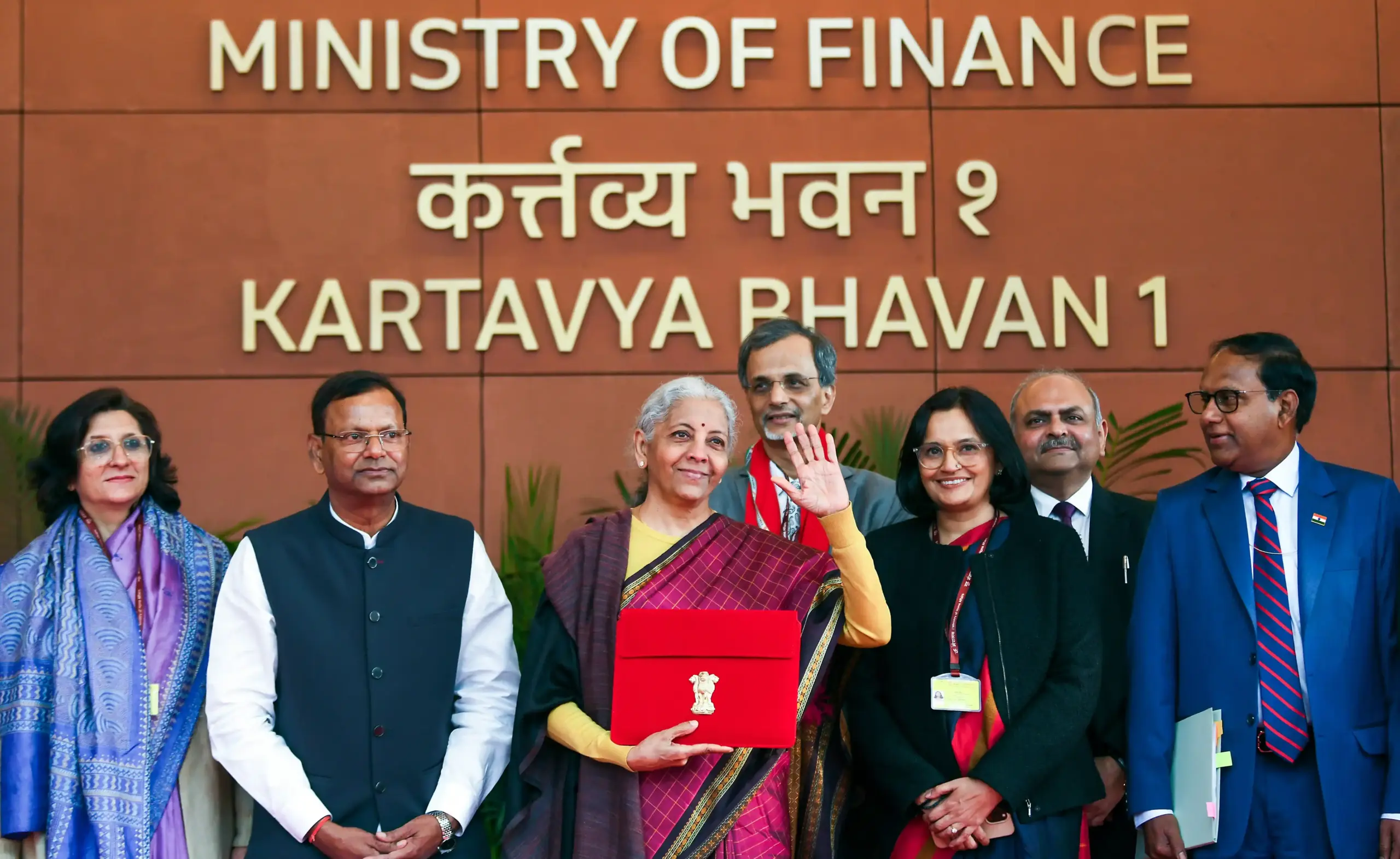
The Union Budget 2026–27 marks a decisive shift from incremental reform to strategic nation-building. Anchored around three guiding kartavyas—accelerating growth, building people’s capacities, and ensuring inclusive development—the Budget seeks to place India firmly on a long-term trajectory toward becoming a Viksit Bharat (developed India).
Rather than focusing only on short-term stimulus, the Budget emphasizes structural transformation, manufacturing depth, skilled human capital, infrastructure resilience, and ease of living. Below is an explainer of its most positive and transformative aspects.
1. A Manufacturing-Led Growth Engine
The Budget places manufacturing at the heart of India’s growth strategy by scaling up seven strategic and frontier sectors. This signals a strong commitment to making India a global production hub, not just a consumption market.
Key initiatives include:
- Biopharma SHAKTI with an outlay of ₹10,000 crore over five years to position India as a global biopharmaceutical manufacturing leader. New NIPER institutes and a nationwide clinical trials network will strengthen both innovation and regulatory capacity.
- India Semiconductor Mission 2.0, aimed at developing full-stack Indian intellectual property, equipment manufacturing, and skilled manpower.
- A major boost to electronics through a ₹40,000 crore outlay for the Electronics Components Manufacturing Scheme.
- Dedicated Rare Earth Corridors and new Chemical Parks, reducing import dependence in critical materials.
- Schemes for capital goods, construction equipment, and container manufacturing to build domestic industrial depth.
Why this matters:
These measures reduce strategic vulnerabilities, strengthen supply chains, and create high-quality jobs—crucial for India’s ambition to compete with global manufacturing powerhouses.
2. Reviving Old Industrial Clusters and Creating Champion SMEs
Beyond new-age sectors, the Budget focuses on rejuvenating traditional strengths:
- Revival of 200 legacy industrial clusters through infrastructure and technology upgrades.
- A ₹10,000 crore SME Growth Fund to nurture future “Champion SMEs.”
- Additional ₹2,000 crore to the Self-Reliant India Fund to support micro enterprises.
- Creation of “Corporate Mitras” to help small businesses navigate compliance and growth.
Why this matters:
India’s employment backbone lies in MSMEs. Supporting their modernization ensures broad-based growth rather than growth concentrated in a few large corporations.
3. Infrastructure as an Economic Multiplier
Public capital expenditure will rise to ₹12.2 lakh crore, reinforcing infrastructure as a key growth driver.
Highlights include:
- Infrastructure Risk Guarantee Fund to crowd in private investment.
- New Dedicated Freight Corridors, 20 new National Waterways, and coastal shipping incentives.
- Seaplane connectivity for remote regions.
- Seven high-speed rail corridors linking major growth centers.
- Development of City Economic Regions (CERs) with ₹5,000 crore over five years per region.
Why this matters:
Efficient logistics lower costs, attract investment, and integrate regional economies—turning cities into engines of productivity.
4. Long-Term Energy Security and Climate Responsibility
The Budget allocates ₹20,000 crore for Carbon Capture, Utilization and Storage (CCUS) technologies and extends customs exemptions for nuclear power, lithium-ion battery manufacturing, solar glass inputs, and critical minerals.
Why this matters:
India is positioning itself as a leader in clean growth, balancing development with environmental responsibility.
5. People-Centric Development: From Education to Employment
The second kartavya focuses squarely on building human capital.
Major initiatives:
- High-powered Education to Employment and Enterprise Committee.
- Addition of 100,000 Allied Health Professionals over five years.
- Five Regional Medical Hubs to boost medical tourism.
- New All India Institutes of Ayurveda.
- AVGC (Animation, VFX, Gaming, Comics) labs in 15,000 schools and 500 colleges.
- Five University Townships near industrial corridors.
- One girls’ hostel in every district via VGF/capital support.
- Khelo India Mission to transform the sports ecosystem.
Why this matters:
The Budget recognizes that growth is sustainable only when citizens are skilled, healthy, and employable.
6. Strong Push to Tourism, Culture, and Creative Economy
Tourism receives a strategic upgrade:
- National Institute of Hospitality replacing the hotel management council.
- Upskilling of 10,000 tourist guides.
- Digital knowledge grid documenting cultural and heritage sites.
- Development of 15 major archaeological sites as experiential destinations.
Why this matters:
Tourism is labour-intensive and regionally inclusive—ideal for generating widespread employment.
7. Farmers, Divyangjan, Mental Health and Regional Balance
Targeted inclusion measures include:
- Integrated development of 500 reservoirs and Amrit Sarovars.
- Support for high-value crops and a Coconut Promotion Scheme.
- Bharat-VISTAAR, an AI-enabled multilingual agriculture platform.
- Divyangjan Kaushal Yojana for task-oriented employment.
- Establishment of NIMHANS-2 and upgrading mental health institutes.
- Special focus on Purvodaya and North-East states with industrial corridors, tourism projects, and e-buses.
Why this matters:
Growth is meaningful only when it lifts farmers, persons with disabilities, and underserved regions.
8. A Friendlier, Simpler Tax System
The new Income Tax Act (effective April 2026) and simplified forms aim to improve compliance and trust.
Positive steps include:
- Reduced TCS rates for education, medical remittances, and overseas tours.
- Automated lower/nil TDS certificates for small taxpayers.
- Extended timelines for revising returns.
- Decriminalization of minor technical offences.
- Safe harbour expansions and faster APAs for IT services.
Why this matters:
Lower friction in taxation improves India’s attractiveness for investment and reduces taxpayer stress.
9. Boosting India as a Global Business Hub
Key incentives:
- Tax holiday till 2047 for foreign cloud companies using Indian data centres.
- Safe harbour for bonded warehouse component storage.
- Exemptions for non-resident experts and capital goods suppliers.
Why this matters:
India is positioning itself as a preferred global base for digital infrastructure and high-value manufacturing.
10. Easier Trade and Customs
- Tariff simplification and customs duty exemptions for key sectors.
- Trust-based clearance systems.
- AI-enabled container scanning.
- Removal of courier export value caps for small exporters.
Why this matters:
Faster, cheaper trade processes directly enhance export competitiveness.
The Big Picture
Union Budget 2026–27 is not merely an accounting exercise—it is a strategic blueprint. It blends industrial ambition with social inclusion, climate consciousness with economic pragmatism, and fiscal discipline with growth orientation.
If effectively implemented, the Budget lays strong foundations for a confident, competitive, and compassionate India over the coming decade.