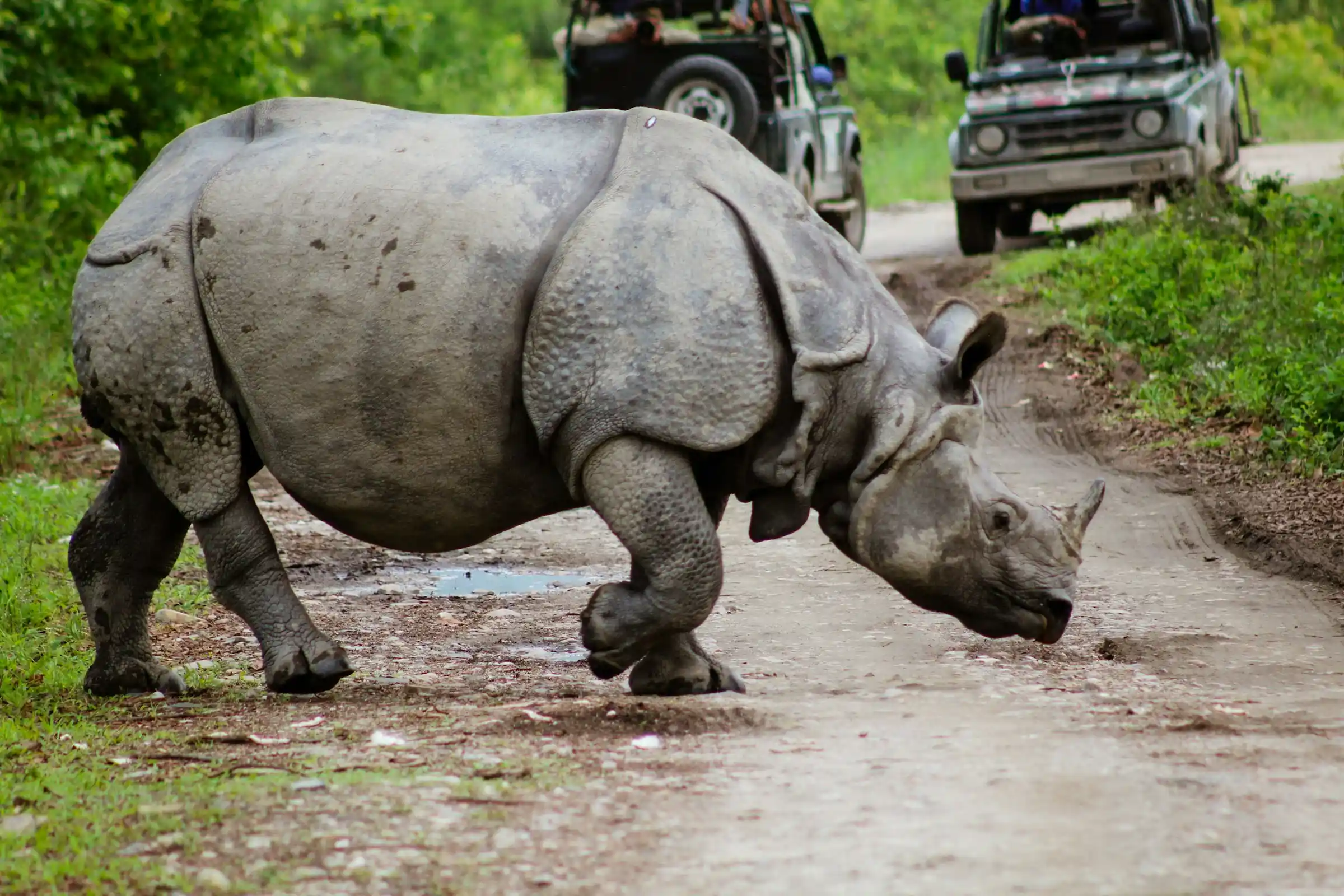
Nestled in northeast India, Kaziranga National Park is world-renowned for hosting the world’s largest population of the greater one-horned rhinoceros with an estimated 2,613 individuals as per the 2022 census, accounting for about two-thirds of the global population of this endangered species, along with rich assemblages of tigers, elephants, swamp deer, and multiple bird species. Established in 1905 and designated a UNESCO World Heritage Site in 1985, the park spans over 1,302 square kilometers across the districts of Golaghat, Nagaon, Sonitpur, Biswanath, and Karbi Anglong. Initially a reserve forest under British rule, it became a national park in 1974 and a tiger reserve in 2006. The park’s unique riverine ecosystem, comprising grasslands, wetlands, and forests, supports unparalleled biodiversity but also exposes it to natural calamities. Annual floods from the Brahmaputra and its tributaries rejuvenate the soil but cause massive animal displacements and deaths. In 2019 alone, floods killed more than 200 animals, including endangered rhinos, while in 2020, 19 rhinos perished.
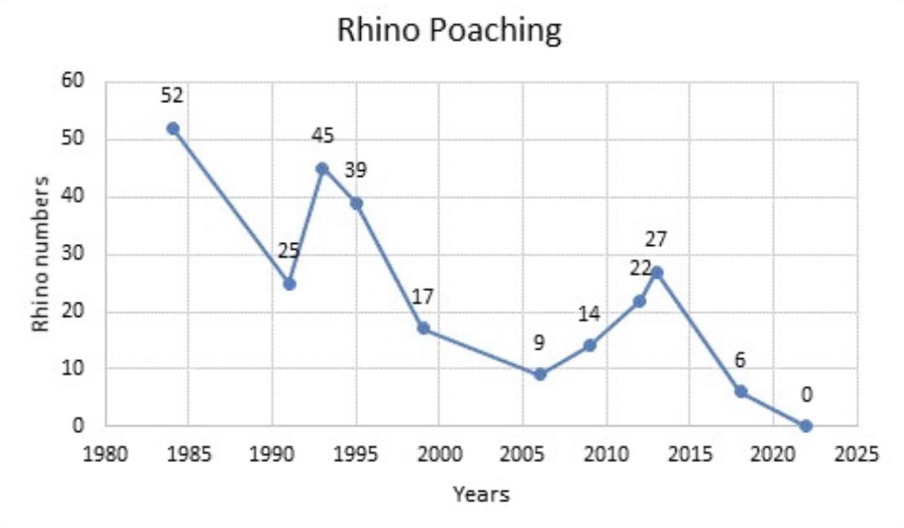
Beyond natural floods, Kaziranga has also battled with the issue of illegal rhino poaching. In the late nineteenth and twentieth centuries, overhunting and poaching nearly wiped out the rhino population, putting a question mark on the survival and existence of the one-horned rhinos. Although conservation measures reversed that decline, rhino poaching still remained a substantive threat well into the twenty-first century as well. In Kaziranga National Park alone, poaching claimed at least 191 rhinos between 2000 and 2021. The crisis intensified in the early 2010s, with 27 rhinos being killed in 2013 and 2014 as well, marking the peak years of this illicit activity. By 2016, the number of poachings in Kaziranga had dropped to 18, signaling the beginning of a downward trend. This momentum continued, with 6-7 rhinos poached in 2017 and 2018, and 3 in 2019. The figures further improved to 2 in 2020 and 1 in 2021 for Kaziranga, representing the lowest poaching record in the last many years for the state. The pinnacle of success came in 2022, when no rhinos were poached across Assam, a milestone not achieved in the past 45 years.
These statistics illustrate a consistent reduction, from double-digit losses in the mid-2010s to near-elimination by the early 2020s. While comprehensive year-by-year poaching data beyond the periods mentioned is limited, the available figures show an over 90% drop from the 2013-2014 highs to the 2020s lows. In 2022, for the first time since 1977, the state of Assam ensured that not even a single rhino was poached, but one rhino death in 2023 and two rhinos killed in 2024 jolted the state’s success story to some extent. However, the state was again successful in ensuring zero rhino poaching in 2025, as the state’s Chief Minister stated in January 2026 that the state had not encountered a single case for 730 consecutive days.
This record doesn’t just stand as a success for the concerned citizens but also narrates the story of the proactive strategies undertaken by the Assam Government to achieve the same. As such it is crucial to analyse the model undertaken by the Assam Government to curb the menace of rhino poaching in Assam, thereby setting a benchmark not only for India, but also for international countries at large, where poaching is still a major issue.
The Assam Government’s approach, often termed as the “Kaziranga Model,” integrates proactive governance with sustainable development, aligning with India’s constitutional mandates for environmental protection. This model emphasizes stringent law enforcement, habitat expansion, community engagement, technological integration, and flood mitigation. It not only safeguards Kaziranga’s iconic rhinos but also sets a precedent for holistic wildlife conservation. By addressing root causes like poverty in fringe communities through eco-tourism and livelihoods, the model fosters harmony between humans and nature. As global biodiversity faces unprecedented decline due to climate change and habitat loss, the Kaziranga Model offers valuable lessons for countries worldwide, demonstrating how political will, innovation, and legal frameworks can reverse environmental degradation.
Central to this success is the robust anti-poaching framework. The government deployed the Special Rhino Protection Force (SRPF), comprising 82 trained personnel across park ranges, equipped with sophisticated rifles, satellite phones, and drones for surveillance. Anti-poaching camps have been stationed every 5.82 sq km, with 233 such units enabling rapid response. In 2023, 3 poachers were arrested, and intelligence-led operations foiled multiple attempts. Technological aids like electronic sensors on highways and Belgian shepherd dogs for tracking have enhanced efficacy. This resulted in a drastic drop in the number of poaching cases from an average of 18 cases pre 2016 to an average of 4 cases post 2016.
To counter habitat loss, the Assam Cabinet approved a massive 47,306.33-hectare expansion in June 2025 as the park’s sixth addition, excluding 10 villages to minimize conflicts. This connects Kaziranga to adjoining areas like Karbi Anglong hills, facilitating animal migration during floods. Expansions in Orang National Park and reclamation in Laokhowa-Burachapori further bolstered the rhino population. The most talked of Anti-encroachment drives have reclaimed lands, such as in Bura Chapori, where evictions of illegal encroachment allowed wildlife to return. The Chief Minister of Assam, Dr. Himanta Biswa Sarma, has linked these to conservation, as such actions are critical for Assam’s wildlife.
The Assam Government’s model is a blueprint of integrated conservation, blending enforcement, infrastructure, and inclusivity. To mitigate the burning issue of floods, three new commando battalions and a 600-personnel forest battalion were deployed in 2024 for flood-season patrols, aided by 20 marine engine boats. A joint task force studies erosion, recommending remedies within 45 days. Over 40 artificial highlands, planted with fruit trees, provide refuge, while the Kaziranga Elevated Corridor, the foundation stone of which has been laid recently, might aid safe crossings, thereby preventing human-wildlife conflicts. Enforcement of speed limits on NH-37, enforced with sensors and fines, has further intensified the process of wildlife conservation.
In the broader perspective of preserving wildlife, the Assam Government has also focused on human capacity building. In 2024, 700 safari drivers and mahouts received refresher training on visitor safety, wildlife interpretation, and conflict mitigation, funded by the Assam Skill Development Mission. Forest personnel were trained at commando centers, making them skilled to use weapons whenever necessary to prevent the dilemma of poaching. Focus was also laid upon public-private partnership as the government collaborated with the Anil Agarwal Foundation for “Mission Van Raksha” and Axis Bank for health insurance for frontline workers, support staff welfare, resulting in many villagers assisting the government in patrols and awareness. In its mission to protect wildlife, the government also enhanced the importance of community engagement. In fact, tourism surged to 3,27,493 visitors in the FY 2023-24, becoming one of the highest visited National Parks in the country, with new attractions like tea tasting and boat rides in Kaziranga.
The Kaziranga Model also exemplifies adherence to India’s environmental legal framework. The Wildlife (Protection) Act, 1972 (WPA), under which Kaziranga is a national park and tiger reserve, mandates the protection of Schedule I species like rhinos, prohibiting hunting and trade. The government’s SRPF and anti-poaching measures directly enforce Sections 9-12 and 51 of the Act, with amendments in 2009 allowing increased imprisonment for habitual offenders. Habitat expansions align with the Forest (Conservation) Act, 1980, requiring central approval for diversions, and the Environment (Protection) Act, 1986, for eco-sensitive zones (ESZ). In TN Godavarman Thirumulpad vs Union of India (1997 onwards), the Court emphasized forest protection and anti-encroachment, mirroring the Assam Government’s model. These alignments ensure the model’s legality while advancing constitutional duties under Articles 48A and 51A(g) of the Indian Constitution.
Assam’s blueprint for Kaziranga offers several transferable lessons. Integrated enforcement mechanisms that synchronise wildlife protection with emergency response (e.g., flood seasons) can drastically minimise poaching opportunities. Habitat continuity and protected area expansion are essential complements to anti-poaching efforts. The expansion of Kaziranga reflects the understanding that living spaces for animals must adapt as populations grow. Laws without enforcement structures cannot protect biodiversity, and the Kaziranga Model also holds this crucial jurisprudence. Further community involvement and capacity building transform conservation from a government mandate into a collective mission.
The model reinforces that conservation is a strategic governance policy rooted in scientific understanding and legal frameworks. The success of Kaziranga can be an example for rhino poaching hotspots in countries like South Africa or flood-prone habitats in Indonesia. The blend of enforcement, community involvement, and use of technology like drones and AI patrol addresses major global challenges in terms of wildlife conservation. Habitat corridors and flood adaptations also offer blueprints for climate-resilient parks worldwide.
The Kaziranga Model of the Assam Government has transformed grim poaching statistics into a conservation resurgence story. By declaring rhinos as the “pride and crown jewel” of the state, the Chief Minister has honoured India’s legal heritage while inspiring global action. In a world where wildlife faces pressures ranging from poaching syndicates to habitat fragmentation and climate change, stories like Kaziranga shine as beacons of possibility. Across continents, conservationists, policymakers, and communities have witnessed the success of Kaziranga as the symbol of preservation of one-horned rhinos, which was once a hotspot for poachers, leading to a drastic reduction in the rhino population. This success story of Kaziranga thereby proves that with vision, commitment, and legal-institutional alignment, the future of iconic species like the rhinoceros need not be tragic, but triumphant.