
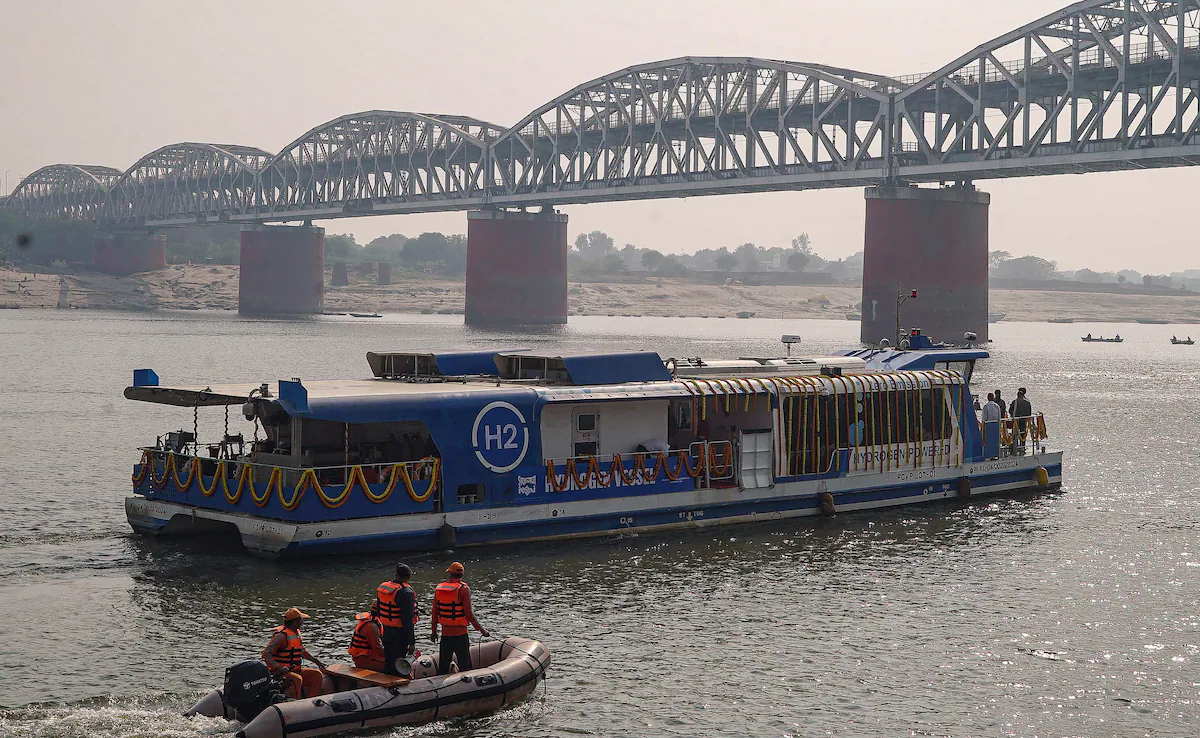
India’s first hydrogen-powered water taxi glides silently across the Ganga in Varanasi, a revolutionary fusion of ancient spirituality and futuristic green technology. Launched on December 11, 2025, by Union Minister Sarbananda Sonowal at Namo Ghat, this 24-meter air-conditioned catamaran carries 50 passengers on emission-free journeys between Namo Ghat and Ravidas Ghat, with plans to extend to Asi Ghat and Markandeya Dham. At ₹500 per one-way ticket, it promises cleaner tourism, reduced road congestion, and a blueprint for decarbonizing India’s sacred rivers.
For millennia, the Ganga has sustained Varanasi’s soul, drawing 50 million pilgrims annually for rituals amid swirling pollution from diesel boats and untreated sewage. This hydrogen vessel, powered by a low-temperature proton exchange membrane fuel cell, emits only water vapor—no smoke, no noise, just pure propulsion at 6.5 knots for eight hours on a single fill. Equipped with bio-toilets, CCTV, solar panels, and vegetarian refreshments, it directly counters the diesel ferries that choke the river, aligning with the Modi government’s Namami Gange mission to revive the waterway.
Traditional boats spew carbon and particulates, exacerbating the Ganga’s toxic load, where dissolved oxygen levels often dip below survival thresholds for aquatic life. By contrast, this zero-emission hybrid—integrating fuel cells, batteries, and solar—slashes urban air pollution while easing Varanasi’s narrow streets from tourist traffic. Officials hail it as a game-changer for public health, positioning the world’s holiest river as a model for sustainable urban mobility in dense heritage cities.
Indigenous Innovation Triumph
Developed entirely by Cochin Shipyard Ltd. (CSL) under a tripartite pact with the Inland Waterways Authority of India (IWAI) and Inland and Coastal Shipping Ltd., the taxi embodies “Make in India” at its finest—certified by the Indian Register of Shipping with hydrogen sourced from Bengaluru. Unlike imported electric ferries, its fully indigenous design proves India can lead in hydrogen tech, a sector where global giants like Japan and Europe still dominate prototypes.
The vessel’s fuel cell system converts hydrogen and oxygen into electricity, powering electric motors with water as the sole byproduct—a scalable leap from battery-limited EVs. Sonowal emphasized this as Prime Minister Modi’s vision for self-reliant green tech, dovetailing with the National Green Hydrogen Mission targeting 5 million tonnes annual production by 2030. Early refueling stations at key ghats pave the way for fleet expansion, potentially transforming 111 national waterways into hydrogen corridors.
Economic and Tourism Catalyst
Varanasi’s tourism economy, worth billions, thrives on Ganga darshan, yet outdated boats deter eco-conscious visitors. This sleek catamaran offers booked rides via WhatsApp or portals like Jalsa Cruise Line, running seven to eight daily round trips at 1.5-2 hour intervals—affordable at ₹500, though concessions for seniors or students remain pending. It boosts local jobs in operations, maintenance, and hydrogen supply chains, while hybrid electric catamarans already tested under IWAI signal a full green fleet.
Environmentally, it cuts reliance on fossil fuels amid climate crises flooding Himalayan glaciers that feed the Ganga. Economically, cleaner rides enhance Varanasi’s global brand, rivaling Amsterdam’s electric canals or Sydney’s hybrid ferries, and could replicate in Ayodhya or Kolkata. By reducing road vehicles, it eases congestion, lowers accident risks, and spurs ancillary businesses like green souvenir stalls along ghats.
Global Leadership, Local Legacy
India’s hydrogen taxi vaults ahead of global peers: while the UK trials small ferries and California eyes pilots, Varanasi delivers commercial operations on a sacred artery. This aligns with Maritime India Vision 2030 and Amrit Kaal 2047, aiming for net-zero shipping by mid-century, and counters China’s hydrogen dominance in Asia. For a nation importing 85% of its energy, domestic hydrogen cuts costs and emissions, fostering energy security.
Critics may note high upfront costs or infrastructure gaps, but the pilot’s success—flagged off amid dignitaries from Namo to Lalita Ghat—proves viability. Expanding to 50 such vessels could save millions in diesel subsidies while creating 10,000 green jobs. Varanasi, cradle of eternal cycles, now births a virtuous one: heritage preserved, planet healed. India’s Ganga taxi isn’t just transport; it’s a manifesto for green sovereignty, whispering progress where pilgrims pray.

