
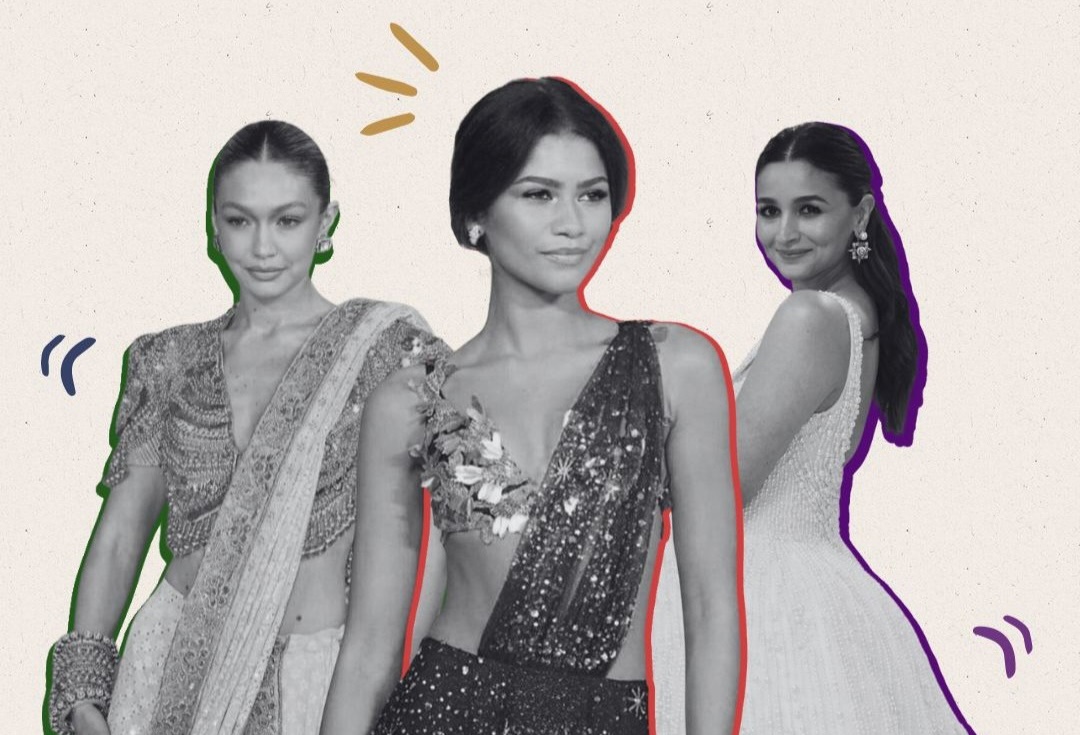
In 2025, the year global fashion capitals finally began to call Delhi and Mumbai their equals, India stands not as an emerging player but as an eternal one. The triumphs of Rahul Mishra, whose nature‑infused couture has graced Paris runways; Gaurav Gupta, who dressed international icons in sculptural gowns that bend the fabric of physics; and Sabyasachi Mukherjee, whose maximalist, jewel‑box world has come to define contemporary luxury, are not sudden miracles. They are part of a continuum. For centuries, India has been the designer behind the world’s wardrobes—sometimes acknowledged, often not.
Now, as we mark the 79th year of Indian independence, it is a fitting moment to trace how this nation’s fabrics, motifs, and sartorial imagination have not only clothed its own people but also rewoven global style itself.
A Loom Older Than History
Long before India was a nation, it was a tapestry. Archaeological finds from the Indus Valley Civilization (circa 2500 BCE) reveal impressions of woven cotton, the first evidence of cotton’s domestication anywhere in the world. Textiles didn’t just cover the body here; they structured society through practices like block printing in Gujarat, tie‑dye in Rajasthan, and double ikat in Patan. Through trade routes, Indian cloth traveled farther than its people ever could. Roman senators draped themselves in Indian muslins, medieval Arabs prized Gujarati block prints, and Indonesian batik makers borrowed dyeing techniques first perfected on Indian soil.
The paisley motif, now an eternal fashion print in London boutiques and Paris ateliers, was born as the boteh or kairi in Kashmir. These teardrop designs, woven painstakingly on shawls, traveled to Persia, then to Scotland, where the town of Paisley borrowed both name and pattern. What feels ‘European classic’ today is, in truth, an Indian inheritance.
Colonial Threads and Broken Chains
The global love for Indian cloth shaped the course of history. In the 17th and 18th centuries, British and Dutch trading companies shipped Indian chintz and calico in such volumes that European textile guilds launched full‑scale campaigns to ban them. The fear was simple: Indian fabrics were lighter, brighter, more affordable, and infinitely more desirable than anything local mills could produce. So popular were these fabrics that French women smuggled saris under their garments and English aristocrats imported them despite prohibitions.
Colonial rule, of course, changed the story. Britain dismantled thriving artisanal economies by turning Indian weavers into suppliers of raw cotton for Manchester’s mills while flooding Indian markets with machine‑made cloth. Yet resistance was woven into the very fabric. Gandhi’s call for khadi—handspun and handwoven cotton—transformed fabric into politics, stitching freedom directly into the act of wearing. The spinning wheel wasn’t merely a tool; it was a rebellion.
From Tradition to Runway
Post‑independence, as India rebuilt itself, fashion remained a site where history breathed. The sari, a six‑yard canvas adaptable in hundreds of regional drapes, continued its fluid life. From the Kasavu of Kerala to the Kanjeevaram of Tamil Nadu, each iteration spoke of a geography and its poetry. The salwar‑kameez, Mughal in ancestry, became everyday wear for millions of women. The sherwani, bandhgala, kurta, and Nehru jacket made their way from courtly inheritance to democratic uniform. Jawaharlal Nehru’s tailored jackets became icons of political chic, later embraced by The Beatles and diplomatic wardrobes worldwide.
Meanwhile, Indian craftsmanship, zari embroidery, phulkari, kantha stitching, mirror work, continued to allure global houses. French couture ateliers famously borrowed zardozi embroiderers from Lucknow and Surat to embellish their gowns. By the late 20th century, even when a garment displayed on Fifth Avenue bore an Italian or French label, its dazzling sequins often came from Mumbai’s by‑lanes.
The New Guard Raises the Flag
Fast forward to 2025. Indian designers no longer work only as whispering hands behind Western glory. They are protagonists.
- Rahul Mishra brings the delicacy of Indian embroidery into contemporary silhouettes, weaving narratives of flora and fauna into gowns that feel as light as air but as disciplined as miniature art. In doing so, he has placed the handloom and the hand‑embroidered craft on equal footing with Paris couture.
- Gaurav Gupta, India’s own sculptor of fabric, speaks in futuristic tongues: metallic ripples, architectural folds, and gowns that look carved rather than sewn. His work resonates with international stars from Beyoncé to Cardi B yet remains steeped in the fluidity of Indian drape.
- Sabyasachi Mukherjee has created a global empire based on nostalgia, excess, and unapologetic Indian grandeur. Brides in New York now dream not of Vera Wang but of Banarasi brocades laced with Sabyasachi magic. His collaborations, such as with H&M and Bergdorf Goodman, have democratized Indian luxury while carrying Calcutta’s stories worldwide.
Together, they have shown that Indian fashion doesn’t have to dilute itself to go global; it needs only to be truer, more intensely Indian.
A Global Industry with Local Souls
Estimates suggest that in 2025, India’s fashion and textiles industry will grow at a rate of more than 10% per year, according to the India Brand Equity Foundation (IBEF). It is expected to reach a market value of around Rs 45.3 lakh crore by 2032, at a projected 12.6% growth rate. Parallel to high fashion, India also fuels the world’s appetite for fast fashion outputs. Cities like Tirupur and Surat produce for global chains, ensuring Indian fabric continues its legacy as the world’s wardrobe factory.
At the same time, new movements in conscious fashion have found resonance in India’s ancient concepts of sustainability. When the West struggles with the environmental crisis of disposable clothing, India’s centuries‑old traditions – natural dyes, plant‑based fabrics, community handlooms – provide a blueprint for more mindful making. Designers from Stella McCartney to Dior have tapped into Indian sustainable weaving practices, from khadi cotton to peace silk. What is marketed abroad as “green luxury” has been a lived tradition here for generations.
The Cultural Pulse of Clothing
Fashion in India has always been more than attire – it is ritual, identity, memory. A sari isn’t just a garment; it is an heirloom, a wedding rite, an unspoken dialogue between grandmother, mother, and daughter. Turbans change color and style to signify different regions, castes, or celebrations. Handloom weaving centers often sustain entire villages, anchoring not just livelihoods but cultural storytelling.
This is why India’s entry into fashion’s global A‑list is not merely commercial success. It is cultural recognition. To see an Indian designer headline Paris haute couture week or dominate the red carpets of Hollywood is to witness centuries of suppressed credit finally being acknowledged.
Looking Ahead: The 2025 Moment
As India celebrates its 79th year of independence, a new independence has arrived for its fashion: liberation from the need to borrow validation. India does not need to prove itself as exotic, nor does it have to mimic Western minimalism. Its maximalist embroideries, riot of colors, versatility of drape, and complexity of handwork are its strengths. From Jaipur jewel tones to Kerala whites, from Banarasi gold to Nagaland weaves, the spectrum is so wide that no singular “Indian look” exists—only infinite variations.
In 2025, “India” is no longer a geographical reference on a care label. It is aesthetic leadership. Whether it is Dior staging a runway show at Mumbai’s Gateway of India or Gucci collaborating with Indian artisans, the tide has turned. The West now comes East not to pilfer but to partner.
The Eternal Designer
If fashion is the art of clothing identity, India has played designer for the world since time immemorial. From paisley prints worn in London’s Carnaby Street in the 1960s, to khadi jackets embraced by world leaders, to couture gowns that now glide across global red carpets, the Indian hand, eye, and heart are everywhere.
In 2025, we recognize that Indian fashion is not arriving; it has always been here. It stood silently in muslin traded across oceans, in saris smuggled into Europe, in embellishments on Paris gowns, in the spinning wheels of freedom. Today, thanks to designers like Rahul Mishra, Gaurav Gupta, and Sabyasachi, it finally wears its own label.
As we mark another Independence Day, perhaps the more fitting phrase is: from threads of the past to runways of the future, India remains what it has always been, the world’s most eternal fashion designer.

