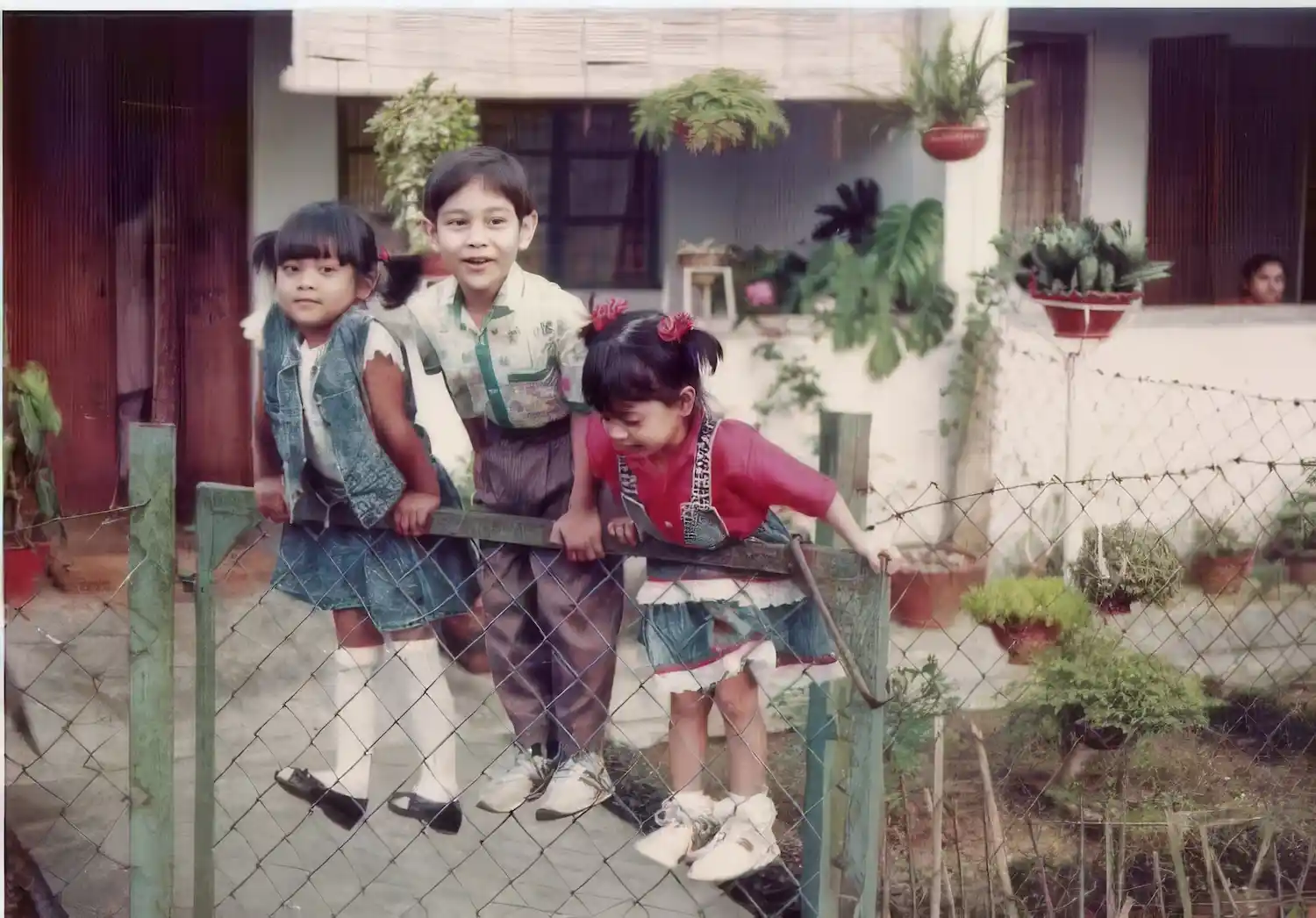
Three of us standing on a narrow lane: my sister in a frilled dress, me in a sleeveless denim frock with embroidered strawberries, and my Ma behind us in a neatly pleated sari that somehow never wrinkled. The photo smells of parachute oil, Johnson’s baby powder, and the faint rustle of pristine white socks with frills. The photograph is slightly tilted, the background blurred with hibiscus shrubs and a stray bicycle. I think that was a birthday, or just another evening to go out and play. Back then, every photo felt like an event.
My Ma had style. Not the kind that came from glossy magazines, those were few and far between, but the kind built out of instinct. She knew exactly how a dupatta should fall, how a salwar needed that extra inch at the ankle, and how two sisters four years apart could wear matching frocks without looking identical. I suspect she dressed us alike so we wouldn’t get lost in the crowd, or maybe because she liked the neatness of symmetry.
Clothes were stories then. And if you grew up in 90s India, you probably lived a similar one, somewhere between Bata shoes and Benetton dreams, between “foreign return” cousins and the first time your local tailor tried a “designer blouse.”
We weren’t consuming fashion, we were becoming it, in real time, through our families, television, and every small-town trend that trickled in via Doordarshan.
The slow fashion of a slower world
There was no Zara, no sheen of fast fashion. Instead, there were neighbourhood boutiques with names like Shalu’s Creations or Style Point, where the tailor’s son took your measurements in a notebook while master dada dictated them. Catalogues came via visiting relatives from Dubai, or even the master dada’s shop, creased pages with models wearing puff sleeves and shiny Lycra leggings. I vividly recall the arrival of the Otto Burlington catalogue, a tangible portal to a world of fashion. The glossy pages, thick with possibilities, were an endless source of fascination. I would meticulously flip through each section, my imagination alight with the outfits displayed, much in the same way I now mindlessly scroll through endless online websites. It wasn’t just a catalogue; it was a window into trends, a source of aspirational dreaming, and a beloved ritual of discovery that predated the digital age.
Every Diwali or wedding season meant a visit to the cloth market, rows of polyester bolts in peacock blues, mango yellows, and what my Ma called “wine colour.” The ritual was slow but full of intention. We’d run our fingers through fabrics, match laces, and hold them up against the light. Ma would say, “This one will fall better after the first wash.” She was always right.
Looking back, that slowness feels luxurious. The idea that a garment was made for you, stitched, altered, refitted, was a quiet kind of privilege. Even the act of picking buttons felt creative.
Uniforms, icons, and the first hint of rebellion
Our first uniform was probably school itself. Navy pinafores, white socks that never stayed white, ribbons that went missing in tiffin breaks. But inside that sameness were small rebellions, a friendship band on the wrist, a neon hair clip, rolling up sleeves one fold higher than allowed.
By middle school, fashion meant idols, Urmila Matondkar’s crop tops, Karisma Kapoor’s sheer shirts, and the global echo of the Spice Girls. The “cool” girls wore Lisa Shoes, and every birthday gift included a butterfly clip or a roll-on lip gloss which tasted of green apple or watermelon.
We learned about self-expression through imitation. The MTV years taught us layering, oversized shirts, and the idea that street style could come from the street itself, Indianized through the new rising Indian hip hop trend or the rise of the Indian pop music scene.
Ma’s closet, our runway
My mother’s closet was a museum of the ‘90s Indian woman, starched cottons for day, embroidered georgettes and silks for evenings, gold chains tucked carefully under blouses or matching beads with the colour of the motif in the saree. She was modern in a way that didn’t need English validation.
On some afternoons, when she wasn’t home, I’d open that steel Godrej almirah just to look. The smell was comforting: mothballs, Pond’s powder, the fading Elle perfume, and the faint memory of special occasions. Her sarees told time better than calendars: wedding gifts, puja wear, and the chiffon she wore to the first PTA meeting.
When I think of my own sense of style now, it’s impossible to separate it from hers. Her silhouettes, her sense of occasion, even her practicality, those are the roots of everything I do as a designer today.
The India that was changing
We didn’t realise it then, but we were growing up in a moment of transition. Liberalisation wasn’t just economic, it was cultural. The 90s were India’s adolescence, where cable TV, Archie and Tinkle comics, and “foreign” chocolates collided with Sunday Mahabharat reruns and Nirma ads.
Our wardrobes became symbols of aspiration. Denim jackets, dungarees, printed skirts, they all whispered the same thing: “We’re moving forward.” Yet even as MTV played Backstreet Boys, our fashion DNA remained local, stitched together by master dada, exported by cousins, worn by kids running to burst Frooti packets under tyres.
The ‘90s that never left
Today, when I walk into a store and see cropped vests, straight jeans, or floral coord sets, it feels like déjà vu. The ’90s never really left us; they just evolved with better fits.
There’s something about that decade that refuses to fade. Maybe it’s because it wasn’t curated, it was lived. We weren’t dressing for Instagram; we were dressing for birthdays, family functions, or a trip to have an evening Gold Spot with the nuclear family.
Fashion then was memory, not marketing. It wasn’t about trends, it was about time. About the way cotton softened after ten washes, or how your hand-me-down became your sister’s “vintage” without her knowing it.
Maybe that’s why we keep going back
Every time I see a ’90s trend return, mom jeans, chokers, scrunchies, I don’t see a fashion revival. I see a portal. A flash of what it meant to grow up in a country finding its modern identity.
For some, nostalgia is aesthetic. But for those of us who lived it, it’s a language of care, chaos, and character. A time when style was stitched at home, shared with siblings, and worn without irony.
The ’90s closet isn’t a memory we revisit; it’s one we carry inside us.
And sometimes, on quiet mornings, when I pick an old cotton shirt or a pair of vintage denims, I can still hear Ma say:
“Try this one. It’ll fall better after the first wash.”