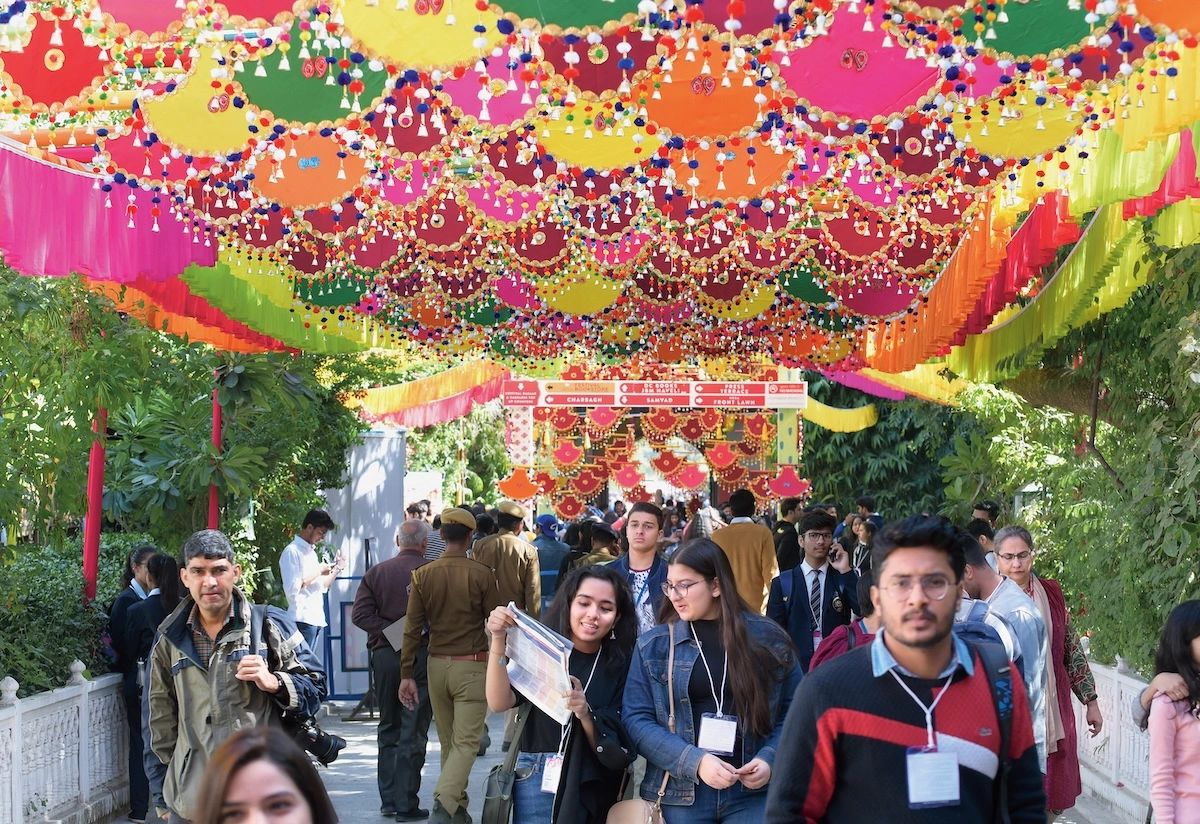
When we first gathered in Jaipur in 2006, under the mellow winter sun, the Jaipur Literature Festival was little more than an experiment. A handful of writers, a few curious listeners, and a dream that perhaps India could host a festival devoted solely to books and ideas. We could not have imagined that, less than two decades later, Jaipur would stand as one of the world’s most celebrated literary gatherings in the world, inspiring a reading culture in India that is vibrant, visible, and deeply aspirational.
What began as a modest literary segment supported by the Jaipur Virasat Foundation – soon took root at the historic Diggi Palace and evolved into what’s referred to as the “greatest literary show on Earth,” drawing more than 6000 speakers and hundreds of thousands of attendees from across the globe each year. For over fifteen years, Diggi Palace remained its cherished home until 2022, when the festival shifted to Hotel Clarks Amer to accommodate its expanding scale, continuing to welcome a worldwide community of readers, writers, and thinkers while retaining the openness and spirit that defined its beginnings. From its roots in Jaipur, JLF has travelled across continents, building bridges through books and ideas. The festival now has editions in London at the British Library, Valladolid in Spain, and across the United States, spread to Boulder, Houston, Seattle, New York & North Carolina, creating vibrant literary platforms that echo the ethos of Jaipur while celebrating local voices and contexts. The 2025 JLF USA series will begin from September 5-28, 2025, marking yet another chapter in its global story of cultural dialogue and exchange.
Reimagining the Place of Literature
From its earliest days, the Festival was open to all. Students, homemakers, shopkeepers, CEOs, diplomats, poets, scientists—everyone had equal access to world-class authors. That principle of democratic access was revolutionary, and it changed how Indians thought about literature. Writers who had often lived in the margins of public attention suddenly found themselves greeted with the energy of celebrities. Book launches were no longer quiet affairs but events that drew thousands. Young readers saw writers as role models, not distant intellectuals, and literature itself became “cool.” In doing so, the Jaipur Literature Festival pulled books out of private study rooms and into the public square. This, perhaps, is its greatest impact: it made reading into a groundswell! For young people, discovering writers at the Festival was like meeting heroes. For older readers, it was the rediscovery of a lost joy. Conversations spilled out of sessions and into cafés, hotels, and the streets of Jaipur. Everywhere you turned, people were debating history, mythology, climate change, cinema, gender, or philosophy. Reading had once been seen as solitary; at Jaipur, it became a celebration for communities to come together. The Festival redefined what it meant to be a reader in India. Many Languages, One Stage.
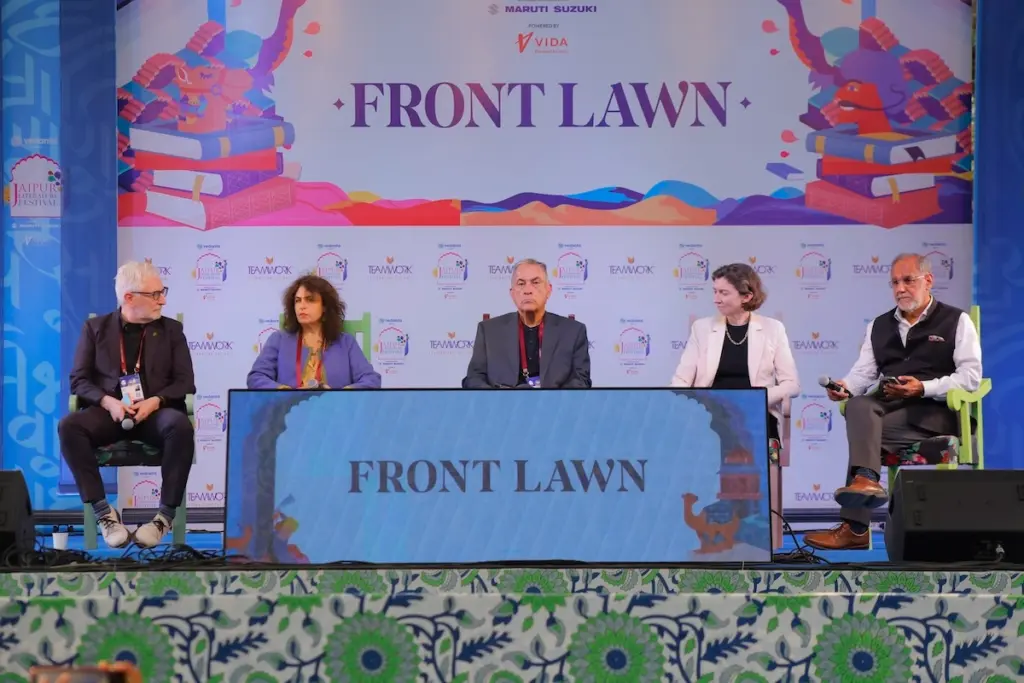
But the impact was not only in scale. The Festival has consistently celebrated India’s many voices. Tamil, Hindi, Malayalam, Bengali, Marathi, Gujarati, Kashmiri —our stages have heard them all. This multilingual spirit gave writers from regional traditions a platform alongside global repute. It reminded us that the strength of Indian literature lies in its diversity, and that every tongue carries its own world of imagination. In doing so, the Festival reshaped not only how Indian audiences value their own languages, but also how the world encounters them.
A Seedbed for the Future
One of my most cherished memories is watching children in our school outreach programmes encounter books for the first time. Their eyes lit up as they listened to authors tell stories. Some of those children are now grown, and a few have returned to the Festival as writers themselves. That, to me, is proof of impact more powerful than any statistic: a cycle of inspiration that keeps renewing itself. The publishing industry, too, has felt this energy. Through Jaipur BookMark, rights are exchanged, translations find homes, and new projects are born. The ‘greatest literary show on earth’, as Jaipur has been called, does not just inspire readers; it strengthens the entire ecosystem of storytelling in India.
The Dialogue That Matters
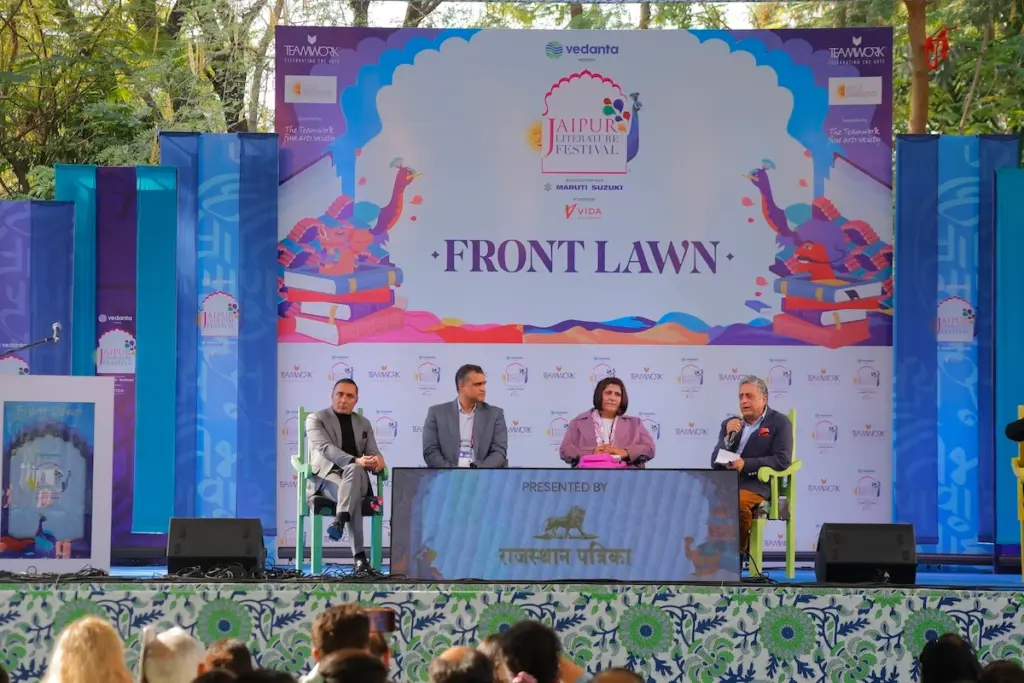
In today’s fractured world, the Jaipur Literature Festival has also become a rare space for dialogue. Our stages host voices from every perspective—sometimes in harmony, often in disagreement. There is debate, dissent, and the occasional discomfort. But that, too, is the work of literature: to provoke thought, to create empathy, to open doors to conversations we might otherwise avoid, and in moments of silence—when thousands lean in to listen to a poet’s voice—you feel the extraordinary truth that words still matter. Over the years, JLF has travelled beyond Jaipur, but wherever it goes, it carries the same spirit: a belief in accessibility, diversity, and joy. Looking back, what astonishes me most is not the scale of the Festival, though that is extraordinary. It is the way it has changed the cultural fabric of India. It made literature aspirational again. It showed that writers could be heroes, and the ideas—presented with passion—can bring people together on a massive scale.
The Road Ahead
As we approach the twentieth year of JLF in 2027, I often think back to that first winter morning in 2006. I remember the uncertainty in our hearts. I also remember the sparkle in the eyes of those who came to listen. That sparkle is still there, in every edition, in every audience. If the Festival has had an impact, it is not only in numbers or headlines but in the way it has revived reading in India. It has given us back the simple, profound joy of stories. It has shown that literature is not a luxury but a necessity—for connection, for empathy, for resilience. In the end, the Jaipur Literature Festival is not ours alone. It belongs to every reader who has walked through its gates, every writer who has shared their voice, and every young person who has discovered a love of books beneath its tents. It is, at its heart, a festival of humanity told through stories. And that, I believe, is its greatest gift.