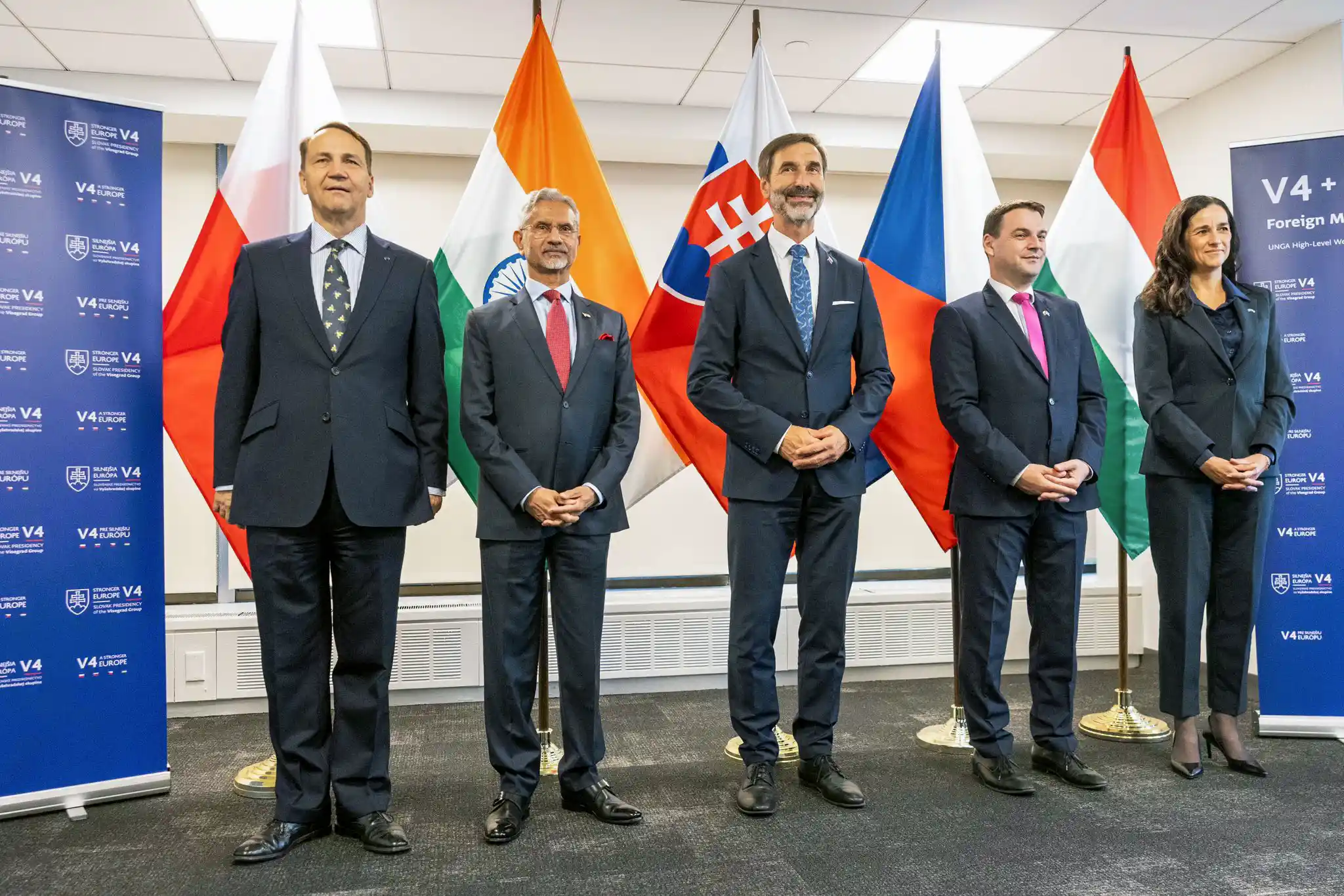
The first Visegrád Group–India foreign ministers’ meeting, held in New York on 21 September 2026 on the margins of the 81st United Nations General Assembly, produced a sentence that European diplomacy has been circling for years. Speaking for Poland, Hungary, Slovakia and the Czech Republic, Slovak Foreign Minister Juraj Blanár said the four agreed that India, “as a part of the Global South” and an “upcoming superpower in the Indo-Pacific,” “must be at the table as the permanent member of the UN Security Council.”
That formulation is useful because it is precise. It does not treat India as an honorary Western power. It locates Indian weight where it actually sits — in the Indo-Pacific and among developing countries — and it treats permanent membership as a requirement of an effective Council, not a decoration.
The case is not new. What has changed is Europe’s own map of risk. After the shock of economic over-dependence on China, the war in Ukraine and the exposure of distant sea lanes as domestic politics, a growing number of EU member states have concluded that a Security Council frozen in 1945 is a liability. India is the most credible Asian democracy available to correct that freeze.
An institution built for another century
The Council was designed for a United Nations of 51 members. Today there are 193. The five permanent members — the United States, Russia, China, France and the United Kingdom — still monopolise permanence and the veto. The only structural reform, in 1965, added four elected seats and left the permanent category untouched. The ratio of veto-holders to elected members therefore worsened from 5:6 to 5:10.
India’s claim begins with scale that the 1945 settlement simply did not contain. It is the world’s most populous country, with some 1.48 billion people. On a purchasing-power basis the IMF places its economy near $18.9 trillion in 2026, third globally and about 8.5 percent of world output. Nominal GDP is in the region of $4.15 trillion, among the six largest. Among major economies it remains one of the fastest growing.
A body charged with international peace and security that permanently excludes the largest population and one of the three largest economies is asking to be judged as a historical arrangement rather than a working institution. That is the substance of India’s long argument: an architecture designed for the 1940s is ill-equipped for contemporary crises. Several European governments now say the same thing in private. The V4 said it in public.
Contribution, not only weight
Size without contribution is a weak brief. India has sat as an elected member eight times, most recently in 2021–22, and has opened a campaign for the 2028–29 term. Historically it has been among the largest troop contributors to UN peacekeeping. Cumulative deployments approach 300,000 personnel across more than 50 missions. More than 180 Indian peacekeepers have died under the UN flag. As of late 2025 it remained in the first rank of current contributors, with more than 5,000 personnel still deployed.
That record matters inside the Union for a practical reason. The Council writes mandates; the Global South largely supplies the troops. A permanent member that both shapes mandates and sends soldiers changes the quality of the debate about what those mandates can actually achieve.
India is also a nuclear-armed state that has not used nuclear weapons, a regular presence in Indian Ocean maritime security, and a first responder in regional disasters. Its vaccine diplomacy, digital public infrastructure and development partnerships give it working relationships across Africa, West Asia and Southeast Asia that few European capitals can match on their own. When Blanár invoked the Global South, he was describing a diplomatic asset, not offering a slogan.
France has long supported Indian permanence and has used its veto to keep bilateral India–Pakistan questions from becoming a formal Council file when others tried to put them there. The United Kingdom has backed expansion that includes India. Germany sits with India in the G4, alongside Japan and Brazil. The United States and Russia have expressed support in principle. China remains the holdout among the P5. Four Central European members adding a collective line does not amend the Charter. It does thicken a European majority that already includes the Union’s two permanent members and its largest economy.
Why the Union’s interest now runs through India
For much of the post-Cold War period, China was Europe’s Asia file. That hierarchy did not survive economic coercion, supply-chain rupture, the dual-use technology problem and the recognition that a single authoritarian manufacturing giant is a strategic vulnerability. Official language in Brussels now treats India as a diversification partner and as a necessary pole if the Union wants a multipolar order that is not reduced to a United States–China contest.
The V4 have particular reasons. Poland and the Czech Republic live with Russian revisionism as a neighbour, not a theory. All four sit inside a Union trying to de-risk from China without becoming a strategic appendage of Washington. India offers scale, a market, a defence-industrial conversation and a habit of strategic autonomy that is not anti-European.
The New York meeting was not confined to the Council. The ministers agreed to annual foreign-minister meetings, an annual business forum, and deeper work on technology, defence, space and connectivity. Jaishankar tied the V4 track to the fact that India’s relationship with the European Union itself is deepening. That sequence is the correct one. Political recognition follows entanglement. It does not precede it.
The FTA as the economic constitution of the political case
Negotiations on an India–EU free trade agreement began in 2007, stalled in 2013 and were relaunched in 2022. They were concluded on 27 January 2026 in New Delhi. The Commission president called the result the “mother of all deals”: a preferential zone covering about two billion people, roughly a quarter of world GDP and a third of world trade. Two-way goods and services trade already exceeded €180 billion a year and supported close to 800,000 jobs in the Union.
The commercial core is tariff liberalisation on the overwhelming share of trade. The Union committed to eliminating or reducing duties on the great majority of Indian exports by value, with immediate zero duty on a large slice of labour-intensive goods — textiles, apparel, leather, footwear, gems and jewellery, marine products, tea, coffee and spices. India committed to calibrated opening covering about 96 to 97 percent of EU goods by value, with sensitive farm sectors carved out on both sides and staged reductions on automobiles and wines. Brussels estimates annual duty savings for European exporters near €4 billion and a path to doubling EU goods exports to India over time.
The pact reaches beyond tariffs into services, professional mobility, digital trade, intellectual property and SME facilitation, with investment protection on a parallel track. Formal signature and ratification were still moving through the Council and the European Parliament in September 2026. The political meaning does not wait on the last parliamentary vote. After two decades the two sides chose binding market integration rather than another strategic-partnership communiqué.
For the Security Council debate the agreement does three jobs. It makes India a stakeholder in European prosperity, not a distant emerging market. It is an instrument of economic security: diversification written into tariff schedules. And it answers the older European complaint that India talks multipolarity while remaining too closed to be a rules-based partner. The deal is development-sensitive and leaves some carbon-border and agricultural fights for later politics. It remains the deepest market-opening India has offered a developed bloc.
A partner wired into European industry is a partner Europe needs inside the institution that authorises sanctions, arms embargoes and operations affecting the Indian Ocean and West Asia.
Geography that Europe can no longer treat as optional
Blanár did not say South Asia. He said Indo-Pacific. European energy, data cables and container traffic run through waters India actually patrols. France is a resident Indo-Pacific power through its overseas territories; the rest of the Union is a trading power that discovered, after the pandemic and the war in Ukraine, that distant chokepoints are domestic politics.
India is not a European ally in the Atlantic sense. It buys Russian energy and equipment, sits in BRICS and the Shanghai Cooperation Organisation, and refuses bloc discipline. That is why it is useful. A partner that can speak to the Global South, keep channels with Moscow and still conclude a mega-agreement with Brussels is a shock absorber, not a satellite. The V4 meeting itself discussed Ukraine and the Gulf. Europe does not need another permanent member that only repeats familiar talking points. It needs one that can help assemble coalitions when the P5 are split.
Obstacles remain. Charter amendment requires the P5. China has no incentive to create a second Asian veto. Africa’s Common Position demands permanent African seats; any package that looks like the G4 alone will fail in the General Assembly. There is no consensus on whether new permanent members receive the veto. None of that is an argument for leaving the 1945 table intact. It is an argument for treating reform as a package — India, Africa, Latin America, a larger elected tier — in which the Indian piece is no longer optional.
The V4 put that judgment on the record. The FTA, concluded eight months earlier, is why the judgment is no longer abstract. Trade made India material to European industry. Geography made India material to European security. Demography and peacekeeping made India material to the United Nations’ own legitimacy. The remaining work is political. The analysis is already clear enough.