Analysts in India are known to keenly watch the destination of the maiden foreign visit by the Head of Government/ Head of State of countries in its immediate neighbourhood. There is considerable speculation/interest in whether this visit will be to India or to China. This is usually seen as an indication of the present regime’s orientation in the relevant country and as a factor affecting the India-China contestation in South Asia.
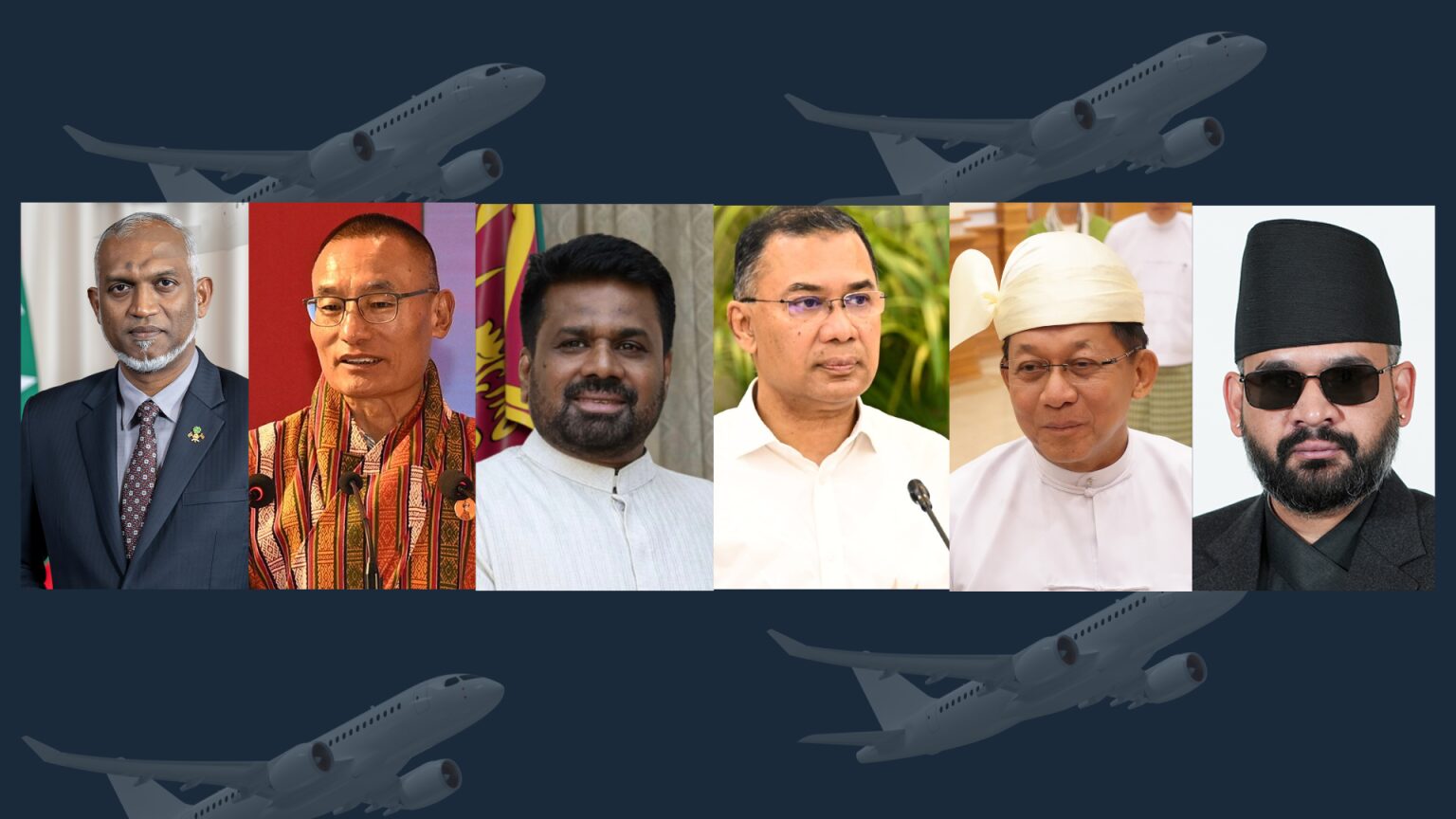
The maiden visits by the Heads of Government/ Heads of State of Maldives, Bhutan, Sri Lanka, Bangladesh, Nepal and Myanmar are discussed in the succeeding paragraphs. The sequence follows the dates of office assumption for the respective leaders. Pakistan and Afghanistan have not been included because there is no contest for influence between India and China in these two countries.
Maldives
President Mohamed Muizzu assumed office on 17 November 2023.1 Interestingly, Muizzu’s first foreign visit was not to India or China, but to Turkiye from 26 to 29 November 2023.2 Muizzu visited China from 08 to 12 January 2024.3 President Muizzu visited India from 09 to 10 June 2024, to attend the oath-taking ceremony of Prime Minister Narendra Modi.4 Incidentally, the visit to China was Muizzu’s third visit abroad. The second visit abroad was to the UAE for the United Nations Climate Change Conference. The visit to India was President Muizzu’s 8th foreign visit.
Bhutan
Tshering Tobgay became Prime Minister of Bhutan for the second time on 28 January 2024.5 His first foreign trip after taking over was to India from 15 to 16 March 2024.6 Prime Minister Tshering Tobgay’s first visit was to India, as expected.
Sri Lanka
Prime Minister Anura Kumara Dissanayake assumed office with effect from 22 September 2024.7 He chose India as the destination for his first overseas trip from 15 to 17 December 2024.8 Incidentally, the new Sri Lankan Prime Minister’s second visit abroad was to China from 14 to 17 January 2025.9 Prime Minister Anura Kumara Dissanayake seems to have followed the expected script of choosing between India/China for his maiden visit abroad.
Bangladesh
Tarique Rahman was sworn in as the Prime Minister of Bangladesh on 17 February 2026.10 His first overseas visit as Prime Minister was to Malaysia from 21 to 22 June 2026.11 His second visit was to China from 24 to 26 June 2026.12 Incidentally, Prime Minister Narendra Modi had extended an invitation to the Bangladesh Prime Minister, Tarique Rahman, to visit India along with his family in February 2026.13
Prime Minister Tarique Rahman also seems to have followed the pattern of Maldives’ President Muizzu by choosing Malaysia for his maiden visit abroad. However, he later followed it up immediately with his second visit to China. The visit to India has not happened to date.
Nepal
Balendra Shah became the Prime Minister of Nepal on 27 March 2026.14 Prime Minister Balendra Shah has not undertaken any foreign visit to date since assuming office on 27 March 2026.
Myanmar
Min Aung Hlaing was elected President of Myanmar on 03 April 2026.15 His first foreign trip as President was to India from 30 May to 03 June 2026.16 He visited China from 15 to 19 June 2026.17 President Min Aung Hlaing also seems to have followed the expected script of choosing between India/China for his maiden visit abroad.
Conclusion
The maiden visits of the respective Heads of Government/State, of the countries mentioned above, are summarised in the table below: –
| Ser | Country | Maiden Visit To | China (Visit No.) | India (Visit No.) |
|---|---|---|---|---|
| (a) | Maldives | Türkiye | 3rd | 8th |
| (b) | Bhutan | India | — | 1st |
| (c) | Sri Lanka | India | 2nd | 1st |
| (d) | Bangladesh | Malaysia | 2nd | — |
| (e) | Nepal | — | — | — |
| (f) | Myanmar | India | 2nd | 1st |
(Table 1- Summary of Maiden Visits)18
The newly elected leaders of three countries, namely, Bhutan, Sri Lanka and Myanmar, chose India for their first trip abroad. While in the case of Bhutan, the reason is obvious, since China and Bhutan do not have formal diplomatic relations. However, in the case of Sri Lanka and Myanmar, it does seem to be a signal, indicative of their current leaning and/or compulsions emanating from their circumstances and/or geographical proximity to India and/or deep-seated cultural linkages.
The significant civilisational, historical and cultural commonalities between India and the countries in its immediate neighbourhood, coupled with the geography of the region, have, by default, resulted in a deep-seated relationship of these countries with India.
Any influence-generating activity by an extra-regional power may result in the temporary realignment of interests and a swing towards, say, a country like China. This swing could be driven by emergent compulsions related to the economy, internal politics, security, or diplomacy. However, these strong linkages with India cannot be overcome or even ignored for an extended period. These countries are then compelled to maintain a certain level of relationship with India. Interestingly, the same applies to India as well, and even India cannot afford to downgrade relations with its neighbours beyond a point, even if the said neighbour is seen to be swinging towards an extra-regional power like China. Compulsion, therefore, is a major factor in the decision to choose a destination for the maiden foreign visit by a leader in this region.
In the case of Nepal, it seems that the leadership is in a dilemma, and it is not yet clear how to progress on this, or it has simply kicked the can down the road. This makes both India and China uneasy and may be detrimental to Nepal in the long run. In the case of Bangladesh, the new Prime Minister’s lack of a visit to India (while having visited China) should be seen as part of a well-thought-out strategy that may eventually prove short-sighted.
It is, however, interesting to note that none of the Heads of Government/State of the six countries chose China as the destination for their maiden visit abroad. This indicates that, as far as India’s neighbouring countries are concerned, China’s influence has an upper limit, and the extent to which these countries can estrange India has a lower limit. The so-called ‘influence game’ has to be played within this box.
The decision regarding the destination for a leader’s maiden visit abroad after assuming office is difficult, especially for smaller countries. It is a decision that should ideally be rooted in strategy. However, the strategy itself may be constrained by compulsions, as seems to be the case in respect of India’s neighbouring countries. In a scenario of contestations between India and China, simple diplomatic decisions tend to have a disproportionate impact and are fraught with risk and uncertainty.
*****
Endnotes
1 The President’s Office, “Former Presidents”, https://presidency.gov.mv/PO/FormerPresidents/10,
2 The President’s Office, Press Release, “The Maldives and Türkiye hold Official Talks”, 27 November 2023, https://presidency.gov.mv/Press/Article/29186
3 The President’s Office, Press Release, “Joint Press Communiqué between the Republic of Maldives and the People’s Republic of China: 11 January 2024, Beijing”, 11 January 2024, https://presidency.gov.mv/Press/Article/29610
4 High Commission of India, Male, https://www.hcimale.gov.in/page/bilateral-visits/
5 Gopal Sharma, “Bhutan’s liberal Tobgay becomes prime minister after fourth free vote”, Reuters, January 28, 2024, https://www.reuters.com/world/asia-pacific/bhutans-liberal-tobgay-becomes-prime-minister-after-fourth-free-vote-2024-01-28/
6 Geeta Mohan, “Bhutan PM to visit India next week in first foreign trip after re-election”, India Today, Mar 8, 2024, https://www.indiatoday.in/india/story/bhutanese-prime-minister-tshering-tobgay-india-visit-china-economic-development-2512058-2024-03-08
7 Parliament of Sri Lanka, “Heads of State”, https://www.parliament.lk/en/learn/handbook-of-parliament/heads-of-state
8 The Hindu, “Sri Lankan President Anura Dissanayake to visit India from December 15-17”, December 10, 2024, https://www.thehindu.com/news/international/sri-lankan-president-anura-dissanayake-to-visit-india-from-december-15-17/article68968358.ece
9 Liu Xin, “Sri Lankan President Dissanayake’s first visit to China since taking office is of great importance to bilateral ties: FM”, Global Times, Jan 10, 2025, https://www.globaltimes.cn/page/202501/1326665.shtml
10 Ruma Paul, “Tarique Rahman sworn in as Bangladesh’s PM after landslide election victory”, Reuters, February 17, 2026, https://www.reuters.com/world/asia-pacific/tarique-rahman-sworn-bangladeshs-pm-after-landslide-election-victory-2026-02-17/
11 Anmol Singla, “Why Bangladesh’s Tarique Rahman chose Malaysia, not India, for his first foreign visit”, First Post, June 5, 2026, https://www.firstpost.com/explainers/why-bangladesh-pm-tarique-rahman-chose-malaysia-over-india-china-for-first-foreign-visit-14019187.html
12 CGTN, “China-Bangladesh economic ties in focus as PM Tarique Rahman visits China”, 25-Jun-2026, https://news.cgtn.com/news/2026-06-25/China-Bangladesh-economic-ties-in-focus-as-PM-Rahman-visits-China-1OgIMKnnrna/p.html
13 Akashvani News (AIR), “PM Modi invites Bangladesh PM Tarique Rahman to visit India”, February 18, 2026, https://newsonair.gov.in/pm-modi-invites-bangladesh-pm-tarique-rahman-to-visit-india/
14 Kul Chandra Neupane & Ganga BC, “Balendra Shah becomes 40th prime minister of Nepal”, The Kathmandu Post, March 28,2026, https://kathmandupost.com/politics/2026/03/28/balendra-shah-becomes-40th-prime-minister-of-nepal
15 Jonathan Head, “Myanmar’s coup leader who set off a brutal civil war becomes president”, BBC, 3 April 2026, https://www.bbc.com/news/articles/c1782nk0018o
16 The Irrawaddy, “Neighbors in Need: Six Key Takeaways from Min Aung Hlaing’s India Trip”, June 5,2026, https://www.irrawaddy.com/news/burma/neighbors-in-need-six-key-takeaways-from-min-aung-hlaings-india-trip.html
17 The Irrawaddy, “Visiting Shanghai, Min Aung Hlaing Steps Up Push for Chinese Investment”, June 18,2026, https://www.irrawaddy.com/business/visiting-shanghai-min-aung-hlaing-steps-up-push-for-chinese-investment.html
18 Author’s compilation from notes 2,3,4,6,8,9,11,12,12,16 and 17
The copyright of this article remains with the Politeia Research Foundation ©️PRF.