
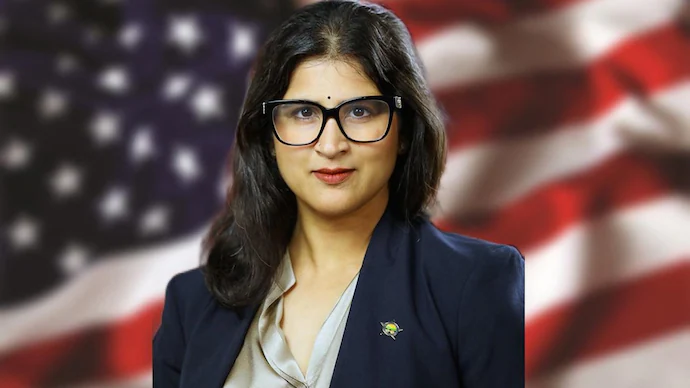
When Indian-origin lawyer Mathura Sridharan was appointed as Ohio’s Solicitor General on July 31, the occasion should have been one of celebration: a meritorious legal mind, a daughter of immigrants, entrusted to represent her state at the highest appellate levels—including the United States Supreme Court. Yet, almost instantly, the digital applause was drowned out by a cacophony of racist and xenophobic backlash, much of it circling around two questions: “Why not an American?” and “Why her bindi?”
This episode is about more than just one woman’s credentials being questioned. It is an indictment of how narrow and divisive some segments of American society remain, especially when faced with visible symbols of difference and an ever-expanding definition of what it means to be “American.”
Merit and Identity: A Collision Course
Mathura Sridharan’s qualifications are unimpeachable: a Juris Doctor from NYU School of Law; master’s and bachelor’s degrees from MIT in engineering, computer science, and economics; and direct Supreme Court experience, having argued Ohio v. EPA in 2023. Her track record led to glowing endorsements from her predecessors and earned her the trust of Ohio Attorney General Dave Yost, who called her “brilliant” and “outspoken”.
Yet, online trolls seized on her Indian heritage, her Hindu religious symbol (the bindi), and even her name as proof that she did not belong. Outright racist rhetoric (“Another American job given away to foreigners”) mixed with religious bigotry (“Is she a Christian? That’s the biggest factor that concerns me. Based on the bindi on her forehead, I worry she is not. That absolutely should matter to us when choosing our leaders”) flooded social media platforms, reducing a career defined by intellect to questions of birth, skin color, and faith.
The Attorney General Fights Back
To his credit, Attorney General Dave Yost did not equivocate. In a pointed public statement, he emphasized that Sridharan is a U.S. citizen, married to one, and the child of naturalized citizens. “If her name or her complexion bother you, the problem is not with her or her appointment,” Yost said.
His defense of Sridharan is not only about her—a recognition that, in this multicultural nation, American identity cannot and should not be policed by anonymous social media users wielding ancestry charts and narrow religious dogma.
Old Bigotry, New Platform
The sight of a bindi, a name that’s not Anglo-Saxon, or a resume that doesn’t fit the stereotype, can still provoke an instinctive “othering”—even (or perhaps especially) when the individual is the very embodiment of American aspiration and achievement. The racism is overt in places: “At this rate, Ohio will soon be exclusively governed by Indians,” one commenter groused.
This is not a problem unique to Ohio or the right, nor is it new. But it’s telling that even now, for many, “American” still means white, nominally Christian, and with family trees rooted in place for generations. This was exemplified by social media users who demanded whether her ancestors had “fought in the Civil War”—as though American belonging is determined by proximity to historical conflicts, rather than by citizenship, principles, or, most importantly, contribution.
A Test for American Ideals
What has happened to Mathura Sridharan is not just a personal attack—it’s a test for the institutions, and for all Americans who claim to value diversity, inclusion, and, above all, the idea that this country is a place where hard work and achievement count for more than accident of birth.
Dave Yost passed that test. So has every Ohioan who recognizes that the strength of American democracy lies not in uniformity but in resilience and renewal, powered by the talents of people from all backgrounds.
But the barrage of racist vitriol should alarm us. It’s a reminder that the American experiment is unfinished, and fragile. There is still work to do to ensure that “American” cannot be hijacked by the small-minded, nor reduced to the color of one’s skin or the presence of a bindi.
Mathura Sridharan deserves her new role not because of her ancestry, nor in spite of it, but because she is—by every measure that should count—eminently qualified. The real question America faces is not whether “people like her” should serve, but whether the nation itself is prepared to accept and champion the fullness and plurality of its own identity—in spite of the anonymous trolls who, threatened by change, would prefer to keep the doors closed.
The answer to that will define what it means to be American in the years to come.

