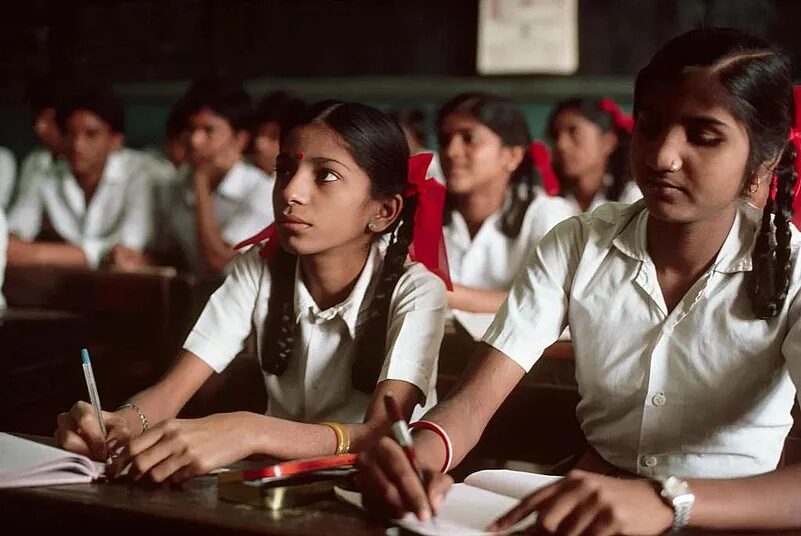
India’s aspiration of becoming a developed nation by 2047, popularly known as Viksit Bharat, cannot rest on economic growth alone. As highlighted in the Economic Survey 2024, the social sector forms the true backbone of this transformation, with education emerging as the most decisive driver. Schools and universities are not just spaces for imparting knowledge; they are engines of empowerment, shaping citizens who fuel the economy, uphold democracy, and strengthen the social fabric. Expanding access is essential, but reach alone is not enough. For education to truly serve as the cornerstone of nation-building, it must ensure quality, equity, and relevance. Numbers by themselves cannot guarantee empowerment (Economic Survey 2024).
In recent years, India has begun treading new pathways in education. The National Education Policy (NEP) 2020 set a bold vision by moving away from rote memorisation towards skill development, critical thinking, and digital readiness. This marked a departure from focusing narrowly on literacy rates to emphasising broader learning outcomes (Economic Survey 2024). The COVID-19 pandemic, while highly disruptive, accelerated the use of digital and hybrid learning models. On one hand, this created opportunities for students to access better resources; on the other, it exposed the stark digital divide, where millions of rural children without devices or internet were left behind. Unless this divide is addressed, technology meant to democratise opportunity may end up deepening inequality.
The link between education and health underscores why empowerment must extend beyond classrooms. A malnourished child cannot learn effectively, while inadequate healthcare and sanitation often disrupt school attendance. Conversely, educated families are more likely to adopt preventive health practices, demand healthcare services, and invest in nutrition. Programs such as the Mid-Day Meal Scheme prove how integrating education and health interventions can break the vicious cycle of poverty and ill-health (Economic Survey 2024). To build a healthy nation, therefore, education cannot be treated in isolation; it must function as part of a larger ecosystem.
This ecosystem becomes even more vital in the rural economy. Rural India continues to be the backbone of the nation’s workforce, yet its education system often fails to align with local needs. Literacy is essential, but insufficient. Rural youth require vocational training, financial literacy, agricultural innovation, and digital skills to thrive in the modern economy (Economic Survey 2024). By integrating local livelihoods with school curricula such as training in agri-tech, entrepreneurship, and cooperative models, villages can be transformed from sites of outmigration into hubs of opportunity. In this sense, education is not merely a ladder out of poverty but a tool to strengthen rural resilience.
Looking ahead, the outlook is both promising and challenging. India’s focus on expanding school infrastructure, improving teacher recruitment, and building digital platforms represents significant progress (Economic Survey 2024). Yet, infrastructure without quality will not deliver results. To achieve the vision of Viksit Bharat 2047, education must go beyond quantitative expansion. It must nurture adaptable, creative, and socially responsible individuals. Learning outcomes, not just enrollment numbers, should become the measure of success. Most importantly, education must remain inclusive, ensuring equal opportunities for women, disadvantaged groups, and rural communities because no nation can rise on uneven ground.
Three Policy Priorities for an Empowered Education System
- Close the Digital Gap with Smarter Classrooms
India cannot afford a future where some students thrive with high-speed internet while others remain offline. Public investment must focus on affordable devices, reliable connectivity, and digital training. Hybrid learning should complement not replace teachers, ensuring that quality education reaches every child, from metropolitan centres to the most remote villages (Economic Survey 2024). - Make Schools the Centres of Health and Nutrition
Education thrives only when children are healthy. Schools must function as centres for holistic growth, combining academics with nutritious mid-day meals, health check-ups, and awareness of hygiene and nutrition. These interventions not only improve attendance and reduce dropouts but also create a virtuous cycle where health and learning reinforce each other. - Link Rural Education with Local Economies
For rural India, education must go beyond rote learning to become relevant to community livelihoods. When school curricula include agri-tech, rural entrepreneurship, crafts, and cooperative models, young people can create opportunities within their villages. This shift can turn migration-prone regions into centres of innovation and resilience.
Why This Matters to Every Citizen
For ordinary Indians, education is more than a personal opportunity; it shapes the nation’s collective future. A poorly skilled workforce cannot compete globally, a generation without health awareness cannot sustain productivity, and communities excluded from education will remain trapped in inequality. This makes education policy not just a government agenda but a citizen’s concern. The kind of India we inherit in 2047 will depend on the kind of education we provide today (Economic Survey 2024).
The Way Forward
India’s march towards Viksit Bharat demands an education system that is ambitious, inclusive, and future-ready. It requires political will to invest in digital infrastructure, creativity to integrate health and livelihoods with schooling, and a commitment to equity that leaves no child behind. Most importantly, it calls for a mindset shift from treating education as a pipeline that produces graduates to recognising it as a movement that builds empowered citizens.
The countdown to 2047 has already begun. To truly realise this vision, education must expand beyond classrooms and embed itself within communities. Only then can it become the true backbone of nation-building and the driving force of India’s transformation.