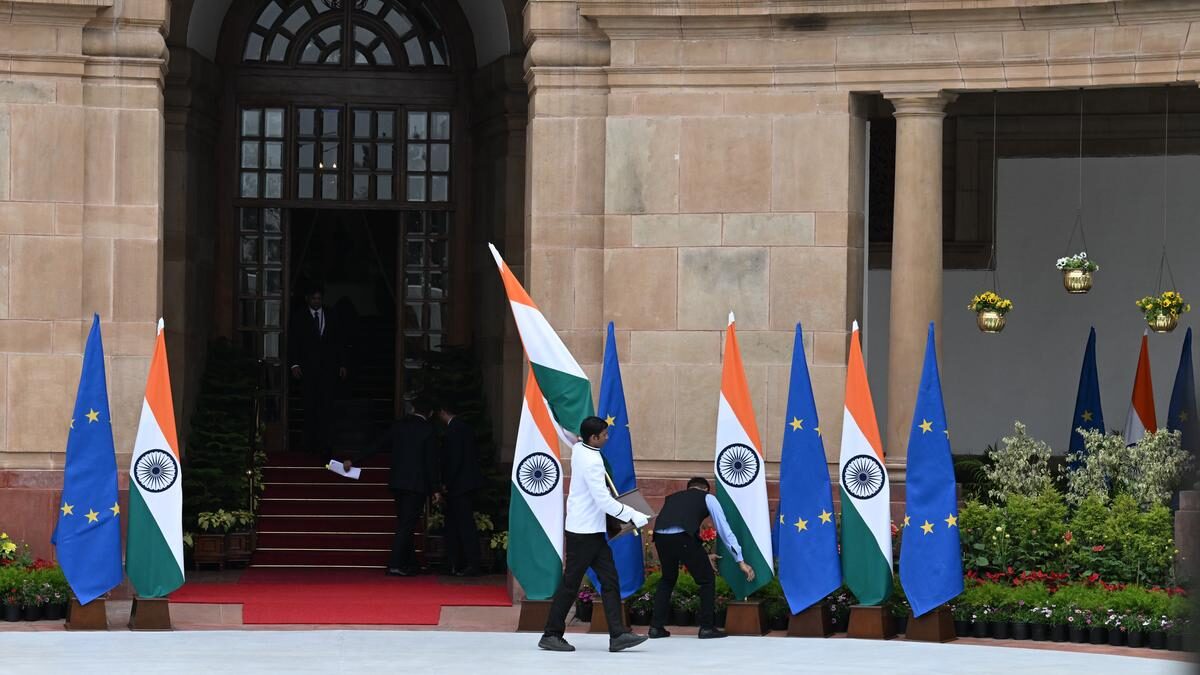
The EU and India have just refined their strategic partnership. On 17th September 2025, the EU launched a New Strategic EU-India Agenda, with greater priorities in trade, investment, technology, defence, and shared norms. While launching the Agenda, European Commission President Ursula von der Leyen stated, “Now is the time to double down on partnerships rooted in shared interests and guided by common values. With our new EU-India strategy, we are taking our relationship to the next level.” To this, Indian Prime Minister Narendra Modi reacted, “Delighted to know about the ‘New Strategic EU-India Agenda. India is ready to take the India-EU relationship to the next level. It is our shared commitment, shared goal, and shared responsibility”.
The EU-India Strategic Partnership: A Roadmap to 2025, adopted in 2020, had laid out broad goals in domains like trade, climate, security, research, health, as well as mobility. This New Strategic Agenda, at first, may appear as another diplomatic framework, but it should be looked at as a decisive step forward. The earlier roadmap built an institutional scaffolding for the EU-India strategic partnership. It led to dialogues in areas such as climate change, disarmament, and maritime security, being comprehensive in its scope. Nonetheless, its vast scope became a limitation as it stretched across too many vast sectors without prioritisation. Moreover, the implementation mechanism lagged significantly due to regulatory differences, export restrictions, and mismatched expectations from both sides. The global environment has also changed drastically since 2020, witnessing supply chain disruptions, the intensification of the great power rivalry, and strategic technology becoming a currency of power. Thus, what was perceived to be sufficient as a framework five years back has become inadequate today.
The new Strategic Agenda portrays a recognition of today’s altered reality and thus, it attempts to concentrate on three core imperatives, namely, technological sovereignty, economic diversification, and Indo-Pacific engagement, where each responds to the lessons of the past and the demands of the present times.
First, the Agenda explicitly puts emphasis on technological sovereignty, a notion that has risen to the forefront of the EU’s strategic thinking. It identifies specific areas such as semiconductors, artificial intelligence, quantum computing, and defence technology as domains where the EU and India must work together. The submarine deal under Project 75(I) already demonstrates what this can look like in practice, as not a one-way arms transaction but a partnership based on technology transfer, coproduction, and capacity building. Germany, a major EU member-state, and its willingness to embed itself in India’s naval modernisation reflects a broader EU-level thinking that partnering with India strengthens the bloc’s quest for technology independence, rather than undermining it. The Strategic Agenda builds on this logic by highlighting innovation ecosystems, talent mobility, and regulatory convergence at the heart of the partnership. For New Delhi, it is equally significant as it shifts the country from being a consumer of Western technology to a co-creator. This, furthermore, enables India to consolidate its own rise as a global innovation hub.
Second, economic diversification as a core aspect remains prominent in the New Strategic Agenda. The pandemic and geopolitical shocks have made the EU realise a painful lesson about over-reliance on narrow supply chains. The earlier Roadmap highlighted the importance of trade and investment cooperation. But it had put emphasis on long-term dialogues rather than urgent restructuring of supply chains. The new strategy acknowledges that India’s scale, depth, and growing manufacturing capacity make it an indispensable partner for the EU’s economic resilience. Furthermore, the commitment to fast-track negotiations on a Free Trade Agreement (FTA) and investment protection shows that the EU-India partnership is prepared to move beyond consultations, towards binding economic frameworks. For the Indian industry, it provides an opportunity to anchor itself more firmly into European value chains. India offers not just low-cost alternatives, but high-quality, rule-based partnerships across sectors from green hydrogen to pharmaceuticals.
Third, and perhaps the most consequential dimension, is the Indo-Pacific engagement. When the EU and India endorsed the Roadmap to 2025, maritime security and ‘freedom, openness and an inclusive approach in the maritime domain’ were already mentioned. But they were framed as one agenda item among many others. In today’s volatile environment, with regional tensions mounting, the Indo-Pacific has moved to the centre of the strategic conversation between Brussels and New Delhi. The New Agenda lays the foundation for an EU-India Security and Defence Partnership that covers maritime security, cyber defence, counterterrorism, and industrial cooperation in defence production. Furthermore, the EU’s support for the India-Middle East-Europe Economic Corridor and its Global Gateway Initiative establishes a link between economic connectivity and geostrategic balance. By signalling its readiness to collaborate with India on regional security, the EU positions itself as a consequential actor in the Indo-Pacific, while India secures valuable partners in shaping the future of the regional order.
In the context of the EU-India strategic partnership, the record of the past years shows that institutional enthusiasm often collides with bureaucratic inertia. Visa and mobility barriers, export-control regulations, and differences over foreign policy choices could slow the current momentum. The ambitious deadline for concluding the FTA by the end of 2025 will test the political will on both sides. Yet the difference today is that the stakes are higher and the priorities sharper for Brussels and New Delhi. Thus, the real test will not be the signing ceremonies in Brussels or New Delhi, but whether the agenda translates into tangible outcomes. These outcomes could be in the form of co-developed technologies, streamlined regulations, resilient supply chains, and visible cooperation in the Indo-Pacific.
For the EU, India offers a partnership that enhances technological independence and economic security. For India, the EU offers capital, advanced know-how, and a voice in shaping global governance structures. The partnership, thus, does not concern abstract alignment of values, but hard strategic interests. Where the Roadmap to 2025 was a beginning in a good direction, the Strategic Agenda of 2025 stands as a response to a new world. If the two partners can overcome the inertia of past dialogues and deliver concrete results, this could mark the moment where the EU-India strategic partnership transforms from mere aspiration to strategy.