
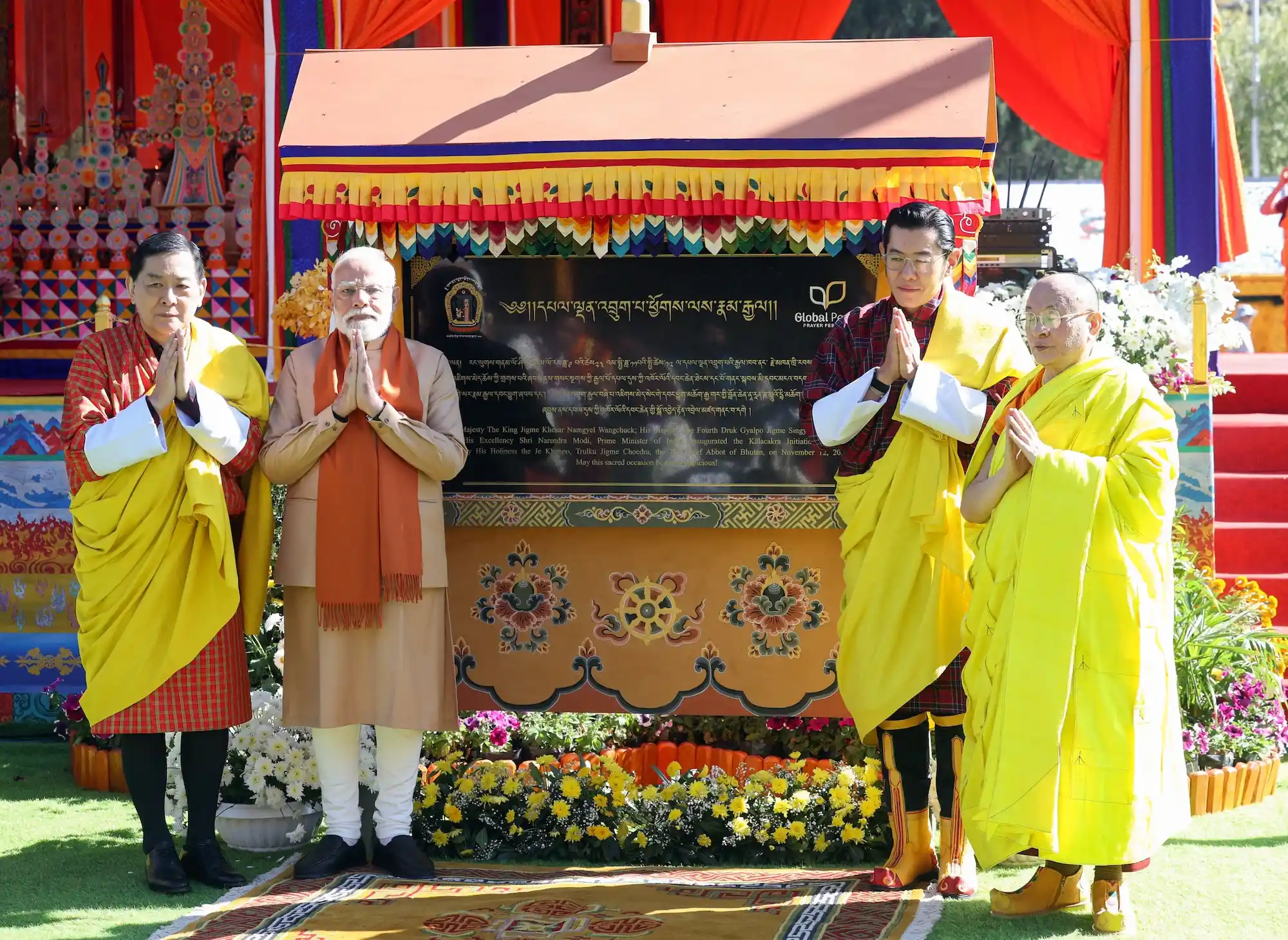
On November 11, Indian Prime Minister Narendra Modi made a two-day visit to Thimphu, the capital city of the Himalayan Kingdom of Bhutan. Prime Minister Modi joined the people of Bhutan in marking the 70th Birth Anniversary of His Majesty the Fourth Druk Gyalpo in Changlimithang as the Guest of Honour—reflecting India’s time-tested partnership with the Himalayan kingdom. While the announcement of the Prime Minister’s visit to Bhutan was seen with great optimism and perfected the momentum through his reiteration of the ‘All-Weather Friendship’, the media frenzy began questioning it, as India’s national capital, Delhi, was hit by a brutal terrorist attack that claimed innocent lives on the evening of November 10. However, those two days, 10 and 11 November, exhibited the complexity of India’s relationship with its neighbourhood. There will be no surprises if the Lal Quila terror attack in Delhi finds its roots in Pakistan, and then there was Bhutan, which condemned the terror attack in the strongest words.
Away from Pakistan, Bhutan offers the strongest partnership that Delhi has cherished for decades. Thimpu has also accommodated India’s security concerns vis-à-vis China and maintains no diplomatic ties with Beijing despite having a long Himalayan border with China. The bonhomie between the two countries has remained constant, and even the introduction of a constitutional monarchy in 2007 has not altered the foundational values of the India-Bhutan partnership, as is often seen in the case of other neighbours, where a political transition is perceived to jeopardise India’s bilateral partnerships. A regime change in Bangladesh has almost put Dhaka-Delhi ties on hold. Similarly, ever since entering office in 2024, Maldives President Mohamed Muizzu has also left no stone unturned in shifting Male-Delhi ties from ‘India first’ to ‘China first’.
At the same time, India’s partnership with Sri Lanka has evolved significantly since the Rajapaksas played the China card, which allowed Beijing to encroach on Sri Lanka’s strategic space through projects like the Belt and Road Initiative (BRI). Delhi’s prompt and speedy response to the 2022 economic crisis in Sri Lanka has helped restore India-Sri Lanka ties.
India’s new outreach with the Taliban regime in Afghanistan provides momentum to the Delhi-Kabul relationship. It has made substantial progress in redefining Afghanistan as the so-called ‘strategic depth’ that Pakistan used in plotting terror attacks against India for several decades. Today in Afghanistan, India has come to terms with the Taliban regime, assessing that not engaging the Taliban could create a strategic void, leading to further challenges in the regional security and power nexus—a potential rise in the influence of Islamabad and Beijing. Similarly, India’s other Himalayan neighbour, Nepal, continues to present episodic challenges—whether it be the political transitions, such as the Zen G movement of September 2025 and its spillover effects on India, or Kathmandu’s northward march.
Critics find an ‘India problem’ in the Subcontinent
The distant observers of India’s neighbourhood policy and some narrative-driven neighbours like Pakistan and Bangladesh find it an ‘India problem’ because Delhi behaves in a way that is allegedly ‘hegemonic’ and ‘big brotherly’. Looking through the prism of India’s geographical location in the region and historical ties with its neighbours, problems are likely to arise, but does that define Delhi’s neighbourhood engagement in its entirety? The current regime in Islamabad and Dhaka may vouch that it’s an ‘India problem’, but that is not how India views its neighbours. India has been a proactive first responder in crises such as the 2015 Nepal earthquake, the 2014 freshwater crisis in the Maldives, the COVID-19 pandemic, and the 2022 Sri Lankan economic crisis, among others. Delhi has been actively involved in initiatives such as Operation Maitri, Operation Neer, and Operation Vaccine.
India’s External Affairs Minister, S. Jaishankar, finds this complexity between India and its neighbours a natural phenomenon, as even the United States has a complex neighbourhood. In India’s case, the sheer incompetence of one-parted territory that harbours terrorism and sells narratives that please the global community has hijacked what Delhi actually offers to its neighbours in substance, support, and advocacy. To further reflect on it, here is a review of India’s active outreach with the neighbours so far this year.
2025, A Year of India’s Proactive Outreach with Neighbours
Afghanistan was among the first countries to which India extended its outreach in 2025. The Indian Foreign Secretary Vikram Misri met with the Taliban’s acting Foreign Minister in the United Arab Emirates—a major engagement between Delhi and Kabul since the withdrawal of the U.S. troops from Afghanistan. Critics viewed this engagement as slow and mounted it with scepticism, mainly because Pakistan and China had already celebrated their victories in Kabul. However, despite India not recognising the Taliban regime, the recent visit of Foreign Minister Muttaqi to India demonstrates India’s proactive stance in Kabul, marked by centuries-old people-to-people ties and the people- and development-centric support that Delhi continues to offer.
February 2025 was a busy month for Delhi, as Finance Minister Nirmala Sitharaman presented the 2025-26 Budget. While the local populace keenly watches this annual exercise, it also attracts the attention of neighbours as India makes budgetary allocations to assist them financially. This year, Delhi allocated a grand total of ₹20,516.61 crore for India’s multilateral and bilateral aid and assistance programmes to neighbouring and other developing countries. However, May was a testing month for India’s commitment to securing its people and borders from the menace of terrorism emanating from Pakistan. The Operation Sindoor was not only a defining moment in India’s defence excellence but also a commitment that Delhi remains a beacon of hope in the fight against terrorism in the region.
Meanwhile, June 2025 was an exception month, as Nepal began exporting electricity to Bangladesh through Indian transmission grids—a strong marker of regional cooperation, facilitated by India. There were also high-level visits from Bhutan, Nepal, and Sri Lanka, as well as a key visit by Prime Minister Modi to the Maldives in July that saw a reset in Delhi’s engagement with Male. Interestingly, India was preparing to host the Nepalese Prime Minister KP Sharma Oli in September, but before he could land in Delhi, Nepal’s Gen Z movement toppled the Oli government. Now, with the new interim administration in place, India remains in a comfortable position, having already undertaken substantial outreach with Kathmandu. Prime Minister Modi has also applauded the Nepalese youth in the process of national building.
However, the key highlight of India’s neighbourhood outreach for 2025 is Afghanistan, which has yielded some substantial outcomes. But the Delhi-Kabul connection has raised the temperature in Islamabad, considering the latter hoped to control the Taliban and use the political situation to its advantage. Meanwhile, while Delhi still feels the wounds of Air India Flight 814 hijacked by Pakistani terrorists, in which the Taliban had extended support to the terrorists, Delhi’s renewed cooperation with the Taliban is based on cautious optimism and changes of strategic alignment between the Pakistani ‘deep-state’ and the Taliban—the recent border conflict between Pakistan and Afghanistan exhibits the deep-thaw between the two.
With six weeks left in the year 2025, India’s support to Nepal will be keenly watched—not only in Kathmandu’s political circles but also by regional observers who see Nepal as a crucial gauge of India’s influence in the sub-continent. After a year marked by shifting coalitions, ideological realignments, and recurring leadership tussles, Nepal enters 2026 still searching for political coherence. For New Delhi, this instability is not merely a neighbour’s domestic concern; it is a strategic challenge. India has long positioned itself as a steadfast partner of Nepal’s democratic forces, youth constituencies, and reform-minded leaders.
The opinions expressed in this article are those of the author alone and do not reflect the views of the author’s current or past affiliations in any form.

