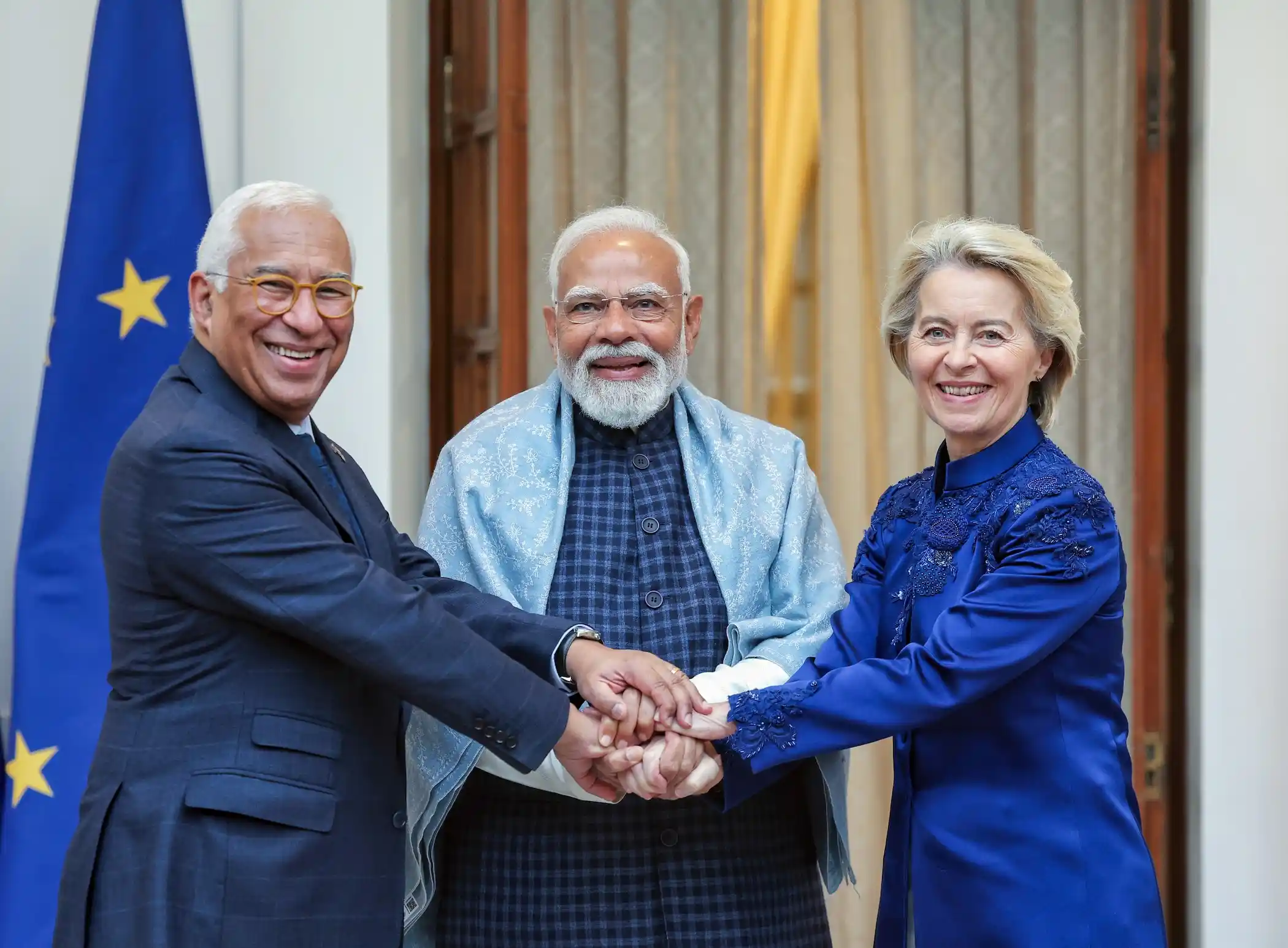
The most consequential shifts in global politics rarely announce themselves with a single dramatic moment. More often, they emerge through quiet realignments, incremental decisions, and partnerships forged out of necessity rather than romance. The free trade agreement signed this week between the European Union and India is one such moment. On its surface, it is a commercial accord. In reality, it is a geopolitical signal: the world is reorganizing around a United States that increasingly places unilateral advantage above collective leadership.
Since returning to office, Donald Trump has revived and intensified a doctrine that treats alliances as liabilities and economic interdependence as weakness. Tariffs have become instruments of punishment rather than negotiation. Security guarantees are recast as transactions. The result has been not American strength, but global hedging. Countries once anchored firmly to Washington are now actively diversifying their bets.
The European Union and India both fall into this category. Both have discovered that proximity to the United States no longer guarantees predictability. For Europe, the shock is both strategic and symbolic: its principal ally now openly flirtates with nationalist movements within the EU, questions the value of European integration, and even signals interest in territories belonging to member states. For India, punitive tariffs on exports to the American market, reaching levels that have strangled trade, represent a stunning reversal after two decades of steadily improving relations.
Against this backdrop, the EU-India agreement looks more like an act of strategic self-preservation.
The numbers are, undeniably, vast. A potential free trade zone covering nearly two billion people, accounting for a quarter of global economic output and a third of world trade, commands attention. Tariffs will fall across multiple sectors. Investment flows are expected to rise. Cooperation on security and defense is set to deepen.
Yet the true importance of the deal lies not in its projected economic windfall, but in its intent.
This is not a sweeping, values-driven partnership modeled on lofty visions of shared norms. It is a carefully calibrated arrangement shaped by caution and compromise. Sensitive sectors such as agriculture are largely left untouched. Brussels remains wary of exposing its farmers to new competition, while New Delhi refuses to jeopardize the livelihoods of hundreds of millions who depend on rural stability. European ambitions to export its regulatory model wholesale have also been trimmed. Trade, in this case, is designed to connect interests, not fuse political identities.
Some will see these limitations as weaknesses. They miss the point.
In an era increasingly defined by power politics, the mere fact that two large actors can still negotiate rules, accept constraints, and embed their relationship in a legal framework is notable. The agreement affirms that cooperation does not require perfect alignment. It requires only a shared belief that structured engagement is preferable to economic warfare.
For the European Union, the pact reinforces a long-standing aspiration: strategic autonomy. For India, it complements a broader effort to avoid overdependence on any single great power. Neither is abandoning the United States. Both are quietly preparing for a world in which American leadership is no longer reliable.
Trump did not set out to accelerate multipolarity. But his approach has done exactly that.
By weaponizing trade and hollowing out alliances, Washington has encouraged middle powers to seek shelter in one another. The EU–India deal is a product of this environment, a defensive adaptation to a harsher, less predictable international system.
Whether this emerging order proves more stable remains an open question. Multipolar worlds have historically been turbulent. But when the alternative is submission to the law of the strongest, betting on imperfect rules and diversified partnerships becomes a rational choice.
The agreement signed in New Delhi is therefore more than a trade pact. It is a quiet declaration of independence from a superpower that no longer hopes to lead. And it may prove to be one of the clearest indicators yet that the center of gravity in global affairs is slowly, but most definitely, shifting.